
IISc Maps 9,389 Copper-Catalyst Reactions to Explain How CO₂ Becomes Methanol
An IISc-led framework combines quantum calculations, machine learning and kinetic modelling to recover missing reaction pathways and match experimental methanol production on copper.
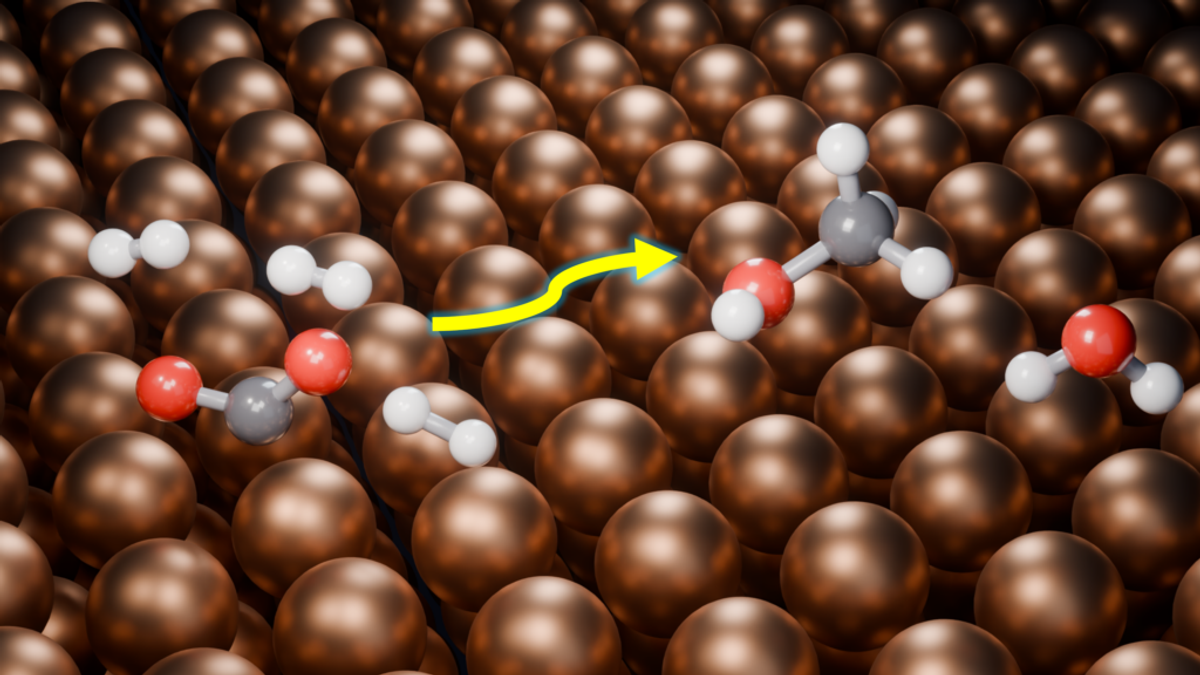
Carbon dioxide can become a feedstock for useful chemicals, but modelling the chemistry on a catalyst is difficult. A small reaction network can omit precisely the step that determines which product emerges. Researchers at the Indian Institute of Science (IISc) have developed a computational framework that expands a copper-catalyst network from 152 calculated reactions to 9,389 elementary reactions, the institute reported on 6 October 2026.
The study, published in Nature Communications, combines quantum-mechanical calculations, machine learning, automated reaction enumeration and kinetic modelling. Its contribution is a more complete account of CO₂ hydrogenation on copper, rather than an announcement of a new commercial fuel plant.
Why the smaller model got the product wrong
In hydrogenation, carbon dioxide reacts with hydrogen over a catalyst to form products that can include methanol. Numerous adsorbed species and intermediate steps compete on the surface. Calculating every possible step directly with quantum mechanics is expensive, so conventional models typically start with a selected subset.
The IISc team first curated 152 reactions using quantum-mechanical simulations. Machine learning models then predicted activation-energy barriers for further reactions. Automated enumeration considered 105 surface species and identified possible single-step reactions, extending the network to 9,389 elementary steps.
According to IISc, the original network incorrectly predicted formic acid as the main product and underestimated CO₂ conversion. The expanded network instead identified methanol and carbon monoxide as major products, in agreement with experimental observations. Its predicted conversion was approximately 40 times higher than the smaller model’s prediction. This is a comparison between computational networks, not evidence that a physical reactor suddenly became 40 times more productive.
Molecular hydrogen opens another route
The expanded network also exposed pathways in which molecular hydrogen transfers hydrogen to reaction intermediates directly, instead of acting only through separate hydrogen atoms. Subsequent quantum calculations supported favourable pathways for oxygen-containing intermediates, the institute said.
That result points to a design question: whether catalysts that interact more strongly with molecular hydrogen could favour pathways towards methanol. It is a mechanistic clue for further catalyst work, not proof that an optimised industrial catalyst has already been delivered.
Experiments and the research team
IISc attributes experimental validation to collaborators at Hindustan Petroleum Corporation Limited’s Green Research and Development Centre and Singapore’s Agency for Science, Technology and Research. The first author, Anand Mohan Verma, worked on the study as a CV Raman Postdoctoral Fellow at IISc and now teaches at MNNIT Allahabad. Ananth Govind Rajan of IISc’s Chemical Engineering department is the corresponding author. Shivam Chaturvedi is a co-author, and Ambedkar Dukkipati contributed to the machine learning models.
The authors suggest that the framework could be extended to other catalysts and reactions, including nitrogen reduction and water splitting. Those applications remain possibilities. The immediate result is a way to test how missing steps can change a catalytic model’s conclusions, with experimental comparison providing a check on the resulting predictions.