IIT Delhi Sends Entangled Photons Over 50 km of Fibre Alongside Classical Telecom Data
IIT Delhi demonstrated quantum-entangled photons and classical data sharing a 50 km optical-fibre link under controlled conditions, a step towards reusing telecom infrastructure for quantum networks.
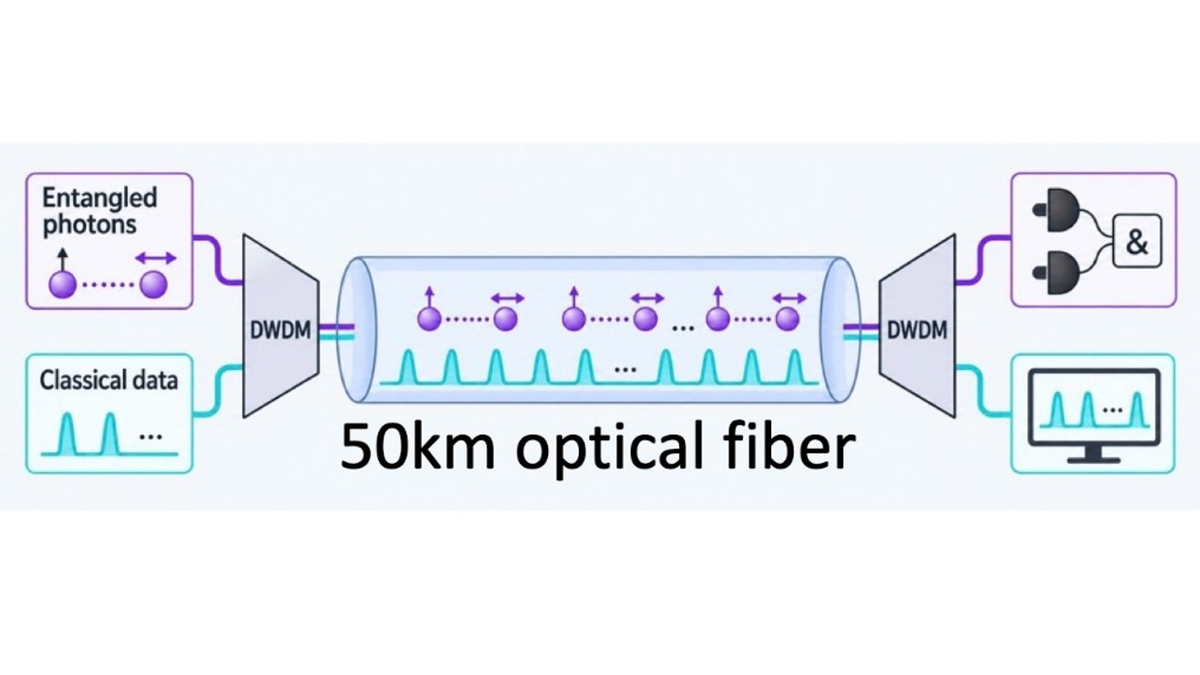
Researchers at IIT Delhi have sent quantum-entangled photons through 50 km of optical fibre while the same fibre carried ordinary telecom data. That points to a cheaper way to build quantum communication networks: reuse existing fibre instead of laying dark fibre dedicated to quantum signals.
The work was led by Prof. Bhaskar Kanseri of IIT Delhi's Department of Physics and described in IIT Delhi’s 5 October 2026 research announcement.
The problem: loud neighbours
Quantum communication schemes such as entanglement-based quantum key distribution (QKD) rely on single photons or entangled photon pairs. These signals are extremely faint. Classical telecom signals, by comparison, are millions of times stronger.
When both share one fibre, the strong classical light generates noise, mainly through effects such as Raman scattering, that spills into the wavelengths used by the quantum channel. That noise can drown out the quantum signal or corrupt the delicate correlations that make entanglement useful. As a result, many quantum links so far have used dedicated "dark" fibres, which are costly to lease or lay and are often in short supply.
What IIT Delhi showed
IIT Delhi’s announcement describes quantum-entangled photons travelling alongside classical data over a 50 km optical-fibre link. The result addresses whether fragile quantum correlations can survive in infrastructure carrying much stronger conventional optical signals.
The demonstration shows coexistence under carefully controlled conditions. The institute links the research to a paper in Optics Communications (doi:10.1016/j.optcom.2026.133728) and identifies PhD researchers Nishant Kumar Pathak and Abhay Singh Dulta alongside Prof. Kanseri, with funding from its Institute of Eminence grant and the National Quantum Mission. The announcement does not establish an operational telecom network or disclose a deployed secure-key rate.
Why it matters for India
India's National Quantum Mission, approved in 2023 with an outlay of about ₹6,000 crore over 2023–2031, includes secure quantum communication among its core goals, including inter-city QKD links over hundreds of kilometres. Reaching those targets at reasonable cost depends heavily on using fibre that is already in the ground, much of it owned by telecom operators, power utilities and railways.
Coexistence techniques, which carefully choose wavelengths, filter noise and manage power levels, are how quantum networks around the world are trying to "ride along" on commercial fibre. Indian demonstrations in this area help build home-grown know-how that domestic QKD companies, telecom operators and government networks can use.
IIT Delhi has been active in quantum communication for several years, including a 2025 free-space quantum-secure communication demonstration with DRDO. This new result shifts the focus from proving that quantum links work to showing they can share infrastructure with everyday data traffic.
Entanglement versus "prepare-and-measure" QKD
Most commercial QKD systems today use "prepare-and-measure" protocols, in which one party sends specially prepared single photons to another. Entanglement-based schemes work differently: a source creates pairs of linked photons and sends one to each user. Measuring both reveals correlations that can be turned into a shared secret key, while an appropriate protocol can test those correlations for signs of interception. Security also depends on the implementation and protocol assumptions.
Entanglement-based approaches are harder to build, but they are also the foundation of future quantum networks that could link quantum computers and sensors, not just exchange keys. Showing that entanglement survives 50 km of shared fibre is therefore relevant beyond cryptography.
The caveats
Laboratory and testbed demonstrations differ from deployed networks. Real telecom fibres carry many wavelength channels at varying power levels, pass through amplifiers and switches, and are subject to temperature changes and physical disturbance. Key rates in coexistence experiments are also usually lower than over dark fibre. The next steps will be field trials over operator fibre, higher key rates, and integration with the trusted-node and, eventually, quantum-repeater architectures needed for national-scale networks.