Simple Energy Raises ₹1,750 Crore Series C to Scale Its Rare-Earth-Light EV Platform
Bengaluru EV maker Simple Energy has raised ₹1,750 crore in an all-equity Series C led by the Dr. Arokiaswamy Velumani Family Office, its largest round yet, to fund a new plant, wider distribution and R&D on its heavy-rare-earth-free motor technology.
Bengaluru-based electric two-wheeler maker Simple Energy has raised ₹1,750 crore (roughly $180 million) in an all-equity Series C round, the company said on 30 September 2026. It is the largest cheque in the startup's seven-year history. It also comes from an unusual source. The reported lead is not a conventional venture fund. The round is led by a family office.
The deal
The round was led by the Dr. Arokiaswamy Velumani Family Office, the investment vehicle of the founder of diagnostics chain Thyrocare. Simple Energy's founder and CEO Suhas Rajkumar and co-founder and CFO Ankit Gupta also put in their own money. Bengaluru-based HNI Amit Mishra and the Haran Family Office joined them.
According to the company, the round takes its total capital raised to more than ₹2,530 crore. In other words, this one round is worth more than twice everything Simple Energy had raised before it.
Simple Energy says it will spend the money on four things:
- A new manufacturing facility and a higher production rate. Its reported nameplate capacity is about 10,000 vehicles a month, not a measure of actual output or sales.
- A bigger sales and service network across India.
- Hiring, marketing and supply chain, including more localised parts sourcing.
- R&D for its next product cycle.
Who Simple Energy is
Suhas Rajkumar founded Simple Energy in Bengaluru in 2019. Its first scooter, the Simple One, was unveiled with a removable 4.8 kWh lithium-ion pack and a top speed of 105 km/h. It went into production in 2023. The company has since added the Simple Wave, and reports place it among India's top ten electric two-wheeler makers by monthly sales.
Production is based at a roughly 2,00,000-square-foot plant in Hosur, Tamil Nadu, the same industrial cluster where several of India's largest two-wheeler makers build vehicles. In September 2025 reporting, Simple Energy put localisation across manufacturing and its supply chain at about 95%.
Why this is a deep-tech story, not just a scooter story
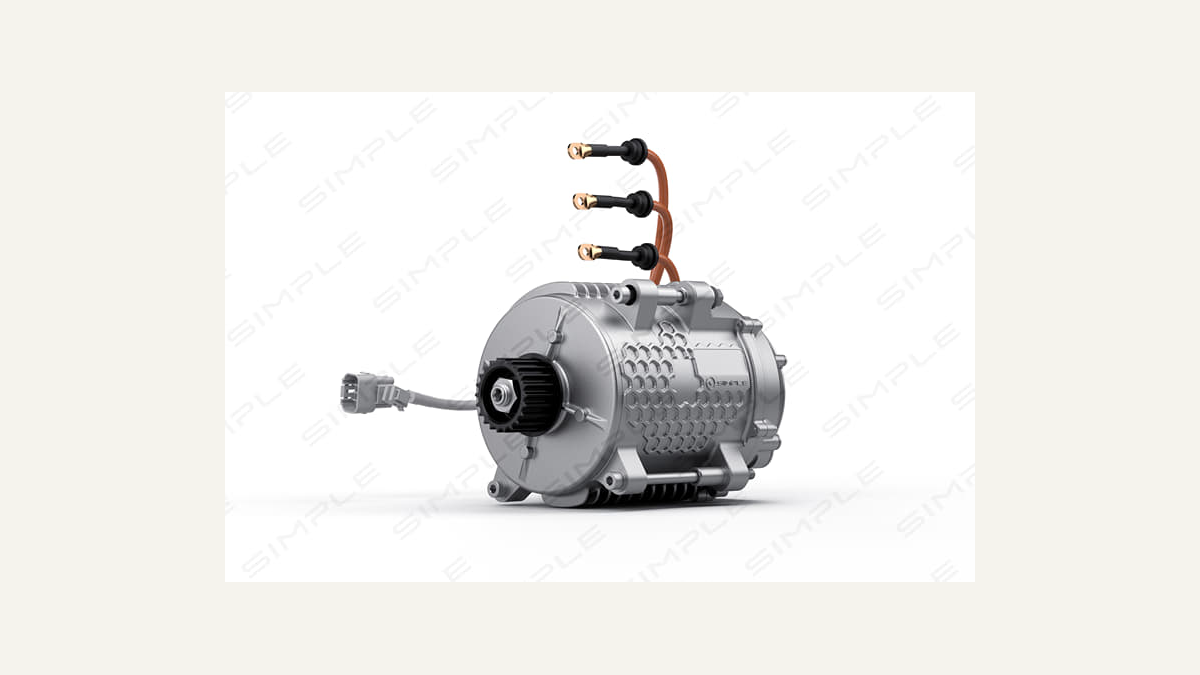
What sets Simple Energy apart from most consumer EV brands is its work on the motor. In September 2025 the company said it had become the first Indian OEM to commercially produce electric motors without heavy rare earths.
That matters for two reasons.
1. Supply-chain exposure. Most EV traction motors use permanent magnets made from neodymium-iron-boron. Heavy rare earths such as dysprosium and terbium are added so the magnets keep their strength at high temperatures. The mining and processing of these elements is concentrated in China. India's EV makers felt that concentration in 2025, when export curbs on rare-earth magnets disrupted supply across the global auto industry.
2. Engineering trade-offs. Taking heavy rare earths out of a magnet is not free. It can weaken the magnet's resistance to demagnetisation as the motor heats up. Simple Energy says it closed that gap with alternative magnet compounds and its own control algorithms, which manage heat and torque delivery. The motors are built at the Hosur plant.
A funding round of this size gives the company room to scale that motor work across more vehicles. It also lets Simple Energy put R&D money into its next platform rather than only into working capital.
The market it is scaling into
India's electric two-wheeler market has changed sharply over the past two years. Legacy makers such as TVS Motor and Bajaj Auto have taken large shares, Ather Energy has listed on the stock market, and early leader Ola Electric has lost ground. For a smaller challenger like Simple Energy, the problem is reach more than technology: dealerships, after-sales service and the working capital to hold stock all cost money.
That is why the stated use of funds is so heavy on manufacturing and distribution. A second plant and more service points are what a sub-scale EV brand needs to compete on availability, not just on spec sheets.
The family-office lead is also worth noting. Large Indian family offices have become steady backers of hardware companies that need patient money but may not suit the return timelines of traditional venture funds. Here, Simple Energy's founders investing in the round signals their own confidence. The round is all-equity funding; the company did not disclose its valuation or each investor’s contribution.
What it means for India
For India's clean-mobility goals, Simple Energy's value lies in two areas:
- Domestic motor know-how. Every rare-earth-light motor built at scale in India reduces the industry's exposure to one of the most concentrated supply chains in clean energy.
- Manufacturing depth. The existing Hosur operation sits in an established automotive supplier base. The proposed new plant could expand domestic production, although its location and additional capacity have not been disclosed.
Whether Simple Energy can turn ₹1,750 crore into a lasting share of the market will depend on how fast it builds out its dealer and service network and how its next product is received. But with this round, India's push for EVs that rely less on rare earths now has one of its best-funded independent manufacturers.
What to watch next
There are three things to watch over the next year:
- Where the new plant goes, and how big it is. Simple Energy has not yet said where the new facility will be or how much it will add to today's 10,000-units-a-month capacity.
- The next product cycle. The round explicitly funds R&D for new vehicles. Whether those keep the heavy-rare-earth-free motor and push localisation further will show how central the motor technology is to the company's strategy.
- Service reach outside the south. Scaling sales and service across North and East India will test whether a Bengaluru-built challenger can match the national footprint of the incumbents.
Sources
Image: Simple Energy motor illustration, as carried by Autocar Professional in September 2025. Company branding retained; not a new 2026 motor test. Original source.