India Lays the Foundation for Its First Port-Based E-Methanol Plant at Kandla
A ₹2,300-crore, 150-tonne-a-day e-methanol plant at Deendayal Port in Kandla, a joint venture with Assam Petro-Chemicals, aims to supply green fuel to ships on the Asia–Europe route from 2027.
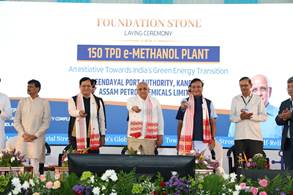
Shipping moves most of the world's trade, and it still runs almost entirely on fossil fuel. On 26 September 2026, India laid the foundation stone for a plant meant to supply some of the alternative. The facility is India's first port-based e-methanol plant, at Deendayal Port in Kandla, Gujarat.
The foundation stone was laid by Gujarat Chief Minister Bhupendra Patel, Union Minister of Ports, Shipping and Waterways Sarbananda Sonowal, and Assam Chief Minister Himanta Biswa Sarma. The project is a joint venture between the Deendayal Port Authority (DPA) and Assam Petro-Chemicals Ltd (APCL), the state-owned methanol producer based at Namrup in Assam.
The numbers
The plant will cost ₹2,300 crore and is designed to produce 150 tonnes of e-methanol a day. It will be built in two phases:
- Phase 1: ₹1,200 crore for 50 tonnes a day, targeted for completion by January 2027.
- Phase 2: ₹1,100 crore for another 100 tonnes a day, targeted for completion by March 2027.
Reports on the launch put expected employment at more than 3,500 direct and indirect jobs. The fuel is meant for ships on the Asia–Europe trade corridor, one of the world's busiest shipping routes. Kandla sits on India's west coast, close to that route.
What e-methanol is
Methanol is a simple alcohol, and ordinarily it is made from natural gas or coal. E-methanol takes a different route. Renewable electricity splits water into hydrogen, and that hydrogen is combined with captured carbon dioxide to make methanol. At Kandla, the plant will use renewable power, water and biogenic CO2, which is carbon dioxide that comes from biological sources rather than fossil fuels.
Biogenic CO2 can reduce net fossil-carbon use, but full life-cycle emissions depend on electricity, feedstock sourcing, transport and production efficiency. The carbon released when a ship burns the methanol was originally taken out of the air by plants, rather than dug out of the ground.
For shipping, methanol has practical advantages over other clean-fuel candidates. It is liquid at room temperature and normal pressure, which makes it far easier to store and bunker than hydrogen or liquefied natural gas. Methanol remains toxic and flammable and requires appropriate handling. Major container lines have ordered methanol-capable vessels in recent years.
Why a port
Most green-fuel projects are sited where renewable power is cheapest and the product is then shipped to a port. Kandla reverses that: production takes place at the port itself, where ships refuel.
That cuts the logistics between production and bunkering, and it positions Kandla as a refuelling stop rather than just a cargo gateway. Speaking at the launch, Sonowal said: "In the years ahead, Kandla will become a green-fuel hub on the Singapore–Rotterdam route, and this plant a model for every major port in the country."
Kandla is well placed to try. Deendayal Port is a major Indian cargo port, and it has already been designated as a green hydrogen hub under the government's port decarbonisation plans.
The Assam connection
APCL's role is what makes the partnership unusual. The Namrup company has decades of experience in conventional methanol production and brings process know-how to the project. For Assam, the project extends a northeastern state enterprise into a west-coast clean-fuel market. For DPA, it adds a partner that already knows how to run a methanol plant.
Why this matters for India
Shipping decarbonisation is coming, whether India is ready or not. International shipping rules are tightening, and European regulation already puts a price on ship emissions. Ports that can offer compliant fuel will attract traffic, while fuel availability can influence route and refuelling choices.
It gives the National Green Hydrogen Mission a concrete buyer. Green hydrogen is only useful if someone takes the output. Turning it into methanol for ships creates a derivative with a ready, growing market.
It fits the Maritime India Vision. The government has set out to make Indian ports greener and more competitive, and bunkering is a revenue line India has historically ceded to Singapore, Fujairah and Rotterdam. A domestic green-fuel supply at a major west-coast port is a step towards changing that.
Reality check
The timelines are aggressive. Reaching the announced phased deadlines from a September foundation-laying, will need everything to go right, from electrolyser supply to a steady renewable power feed. Price will also matter. E-methanol costs well above fossil methanol today, and shipping lines will only buy it at scale if regulation or incentives close that gap.
The scale is also modest in global terms. At full output, 150 tonnes a day is roughly 55,000 tonnes a year, a fraction of what a large container fleet would need. The point of this plant is to prove the model: production at a port, with a ready market on the route outside it. If it works, the minister's pitch that every major Indian port could follow becomes much more credible.
Sources
Core announcement or reporting
Image: MoPSW / PIB. Foundation-laying ceremony at Kandla, 26 September 2026; not an operating plant. Original source.