Modi Meets 20 Space Startup Founders, Pushes India as a Global Space Technology Hub
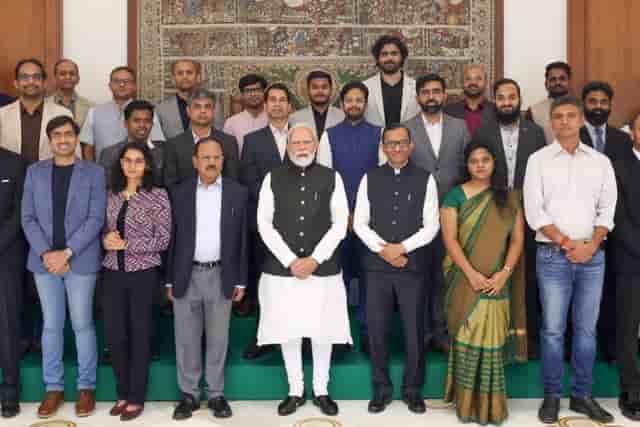
Prime Minister Narendra Modi met founders and CEOs of 20 Indian space startups at Seva Teerth on August 21, urging them to widen space tech's real-world applications as he pitched India as a future global hub for space talent and investment.
A Room Full of Rocket Builders
On Friday, August 21, Prime Minister Narendra Modi sat down at Seva Teerth in New Delhi with the founders and chief executives of 20 Indian space startups — arguably the widest single cross-section of the country's private space industry ever assembled in one room with the head of government.
The guest list read like a map of everything India's space-tech sector has built since the sector opened to private players in 2020: Skyroot Aerospace and Agnikul Cosmos, the two companies racing to commercialise small-satellite launch; Pixxel, Dhruva Space, GalaxEye, PierSight, Digantara and SatSure, spanning earth observation, radar imaging and space-situational awareness; Bellatrix Aerospace and Astrobase, working on propulsion and reusable launch technology; and a further clutch of newer names — Suhora Technologies, Manastu Space, TakeMe2Space, VyomIC, Cosmoserve Space, OrbitAID Aerospace, SkyServe (Hyspace), Serendipity Space, Vassar Labs and mistEO — building everything from AI-driven hyperlocal weather intelligence to in-orbit servicing and space-debris mitigation.
What Was on the Table
The founders used the session to walk Modi through where their companies actually stand today, not just what they promise on a pitch deck: progress on reusable semi-cryogenic propulsion, satellite avionics, advanced satellite buses, space and defence intelligence platforms, debris-removal concepts, and AI systems that turn raw orbital data into hyperlocal weather and climate forecasts.
Modi's ask in return was pointed rather than ceremonial — he pushed the founders to widen the aperture on where space technology gets applied, arguing that agriculture, disaster management, urban planning and infrastructure monitoring all stand to benefit from tools these companies have already built primarily for government and defence customers. His framing for the sector's ambition was blunt: he wants a world in which, as he put it, "when the world thinks of space, it looks towards India" — a magnet for global talent, companies and capital, not just a low-cost launch destination.
He also used the meeting to publicly credit the founders themselves, saying the confidence the private sector had shown since the doors opened in 2020 had validated the government's decision to let companies build rockets, satellites and ground infrastructure that were, until recently, the exclusive domain of ISRO.
Why Now
The timing is not incidental. The meeting comes roughly a week after the government told Parliament that private firms are on track for two commercial launches in the current financial year, rising to more than six in FY2027-28 — the first time India's private launch cadence has been quantified in a public forum rather than described in aspirational terms. It also follows IN-SPACe crossing the 100-plus mark in authorisations issued to non-government entities, and a run of headline raises and consortium wins (including the Pixxel-led Allied Orbits group's mandate to build India's first privately-led national Earth-observation constellation) that have made 2026 the strongest fundraising year the sector has recorded.
Private investment in Indian spacetech has climbed roughly six-fold in under five years, and the roster in the room on Friday — many of them companies that did not exist, or existed only as slide decks, when IN-SPACe was created — is direct evidence of how fast that base has widened beyond the two or three marquee launch-vehicle firms that dominated the sector's early headlines.
The Substance Behind the Photo-Op
It would be easy to read a 20-founder roundtable as symbolism, and some of it undoubtedly was. But the guest list itself carries information: it is a fairly complete cross-section of where Indian private space capital and engineering effort are actually concentrated in mid-2026 — launch and propulsion, earth observation and defence intelligence, satellite servicing and debris management, and a thin but growing layer of downstream analytics companies turning orbital data into products for non-space customers.
For founders still working through certification timelines, funding rounds and their first paying government contracts, a public, on-record assurance from the Prime Minister that "the Government of India will continue to stand with them" is not nothing — it is a signal to investors and future customers that the sector's political backing extends well past the marquee names to the wider ecosystem of 400-plus registered space startups now operating in the country.
Sources
- PM Narendra Modi meets founders, CEOs of 20 homegrown space-tech startups – Business Standard
- PM Modi Meets 20 Space Startups, Calls For India To Become A Global Space Technology Hub – Free Press Journal
- PM urges space startups to expand applications, make India global hub for space talent, investment – The Tribune
- India's space push gets rocket boost! PM Modi meets 20 startup CEOs – Indiablooms