
ISRO Tests Semi-Cryogenic Power Head at Full Level for Five Seconds
ISRO’s September 5 test ran the power head at the stated 200-tonne level for five seconds. The hardware excludes the thrust chamber, making this a propulsion-development milestone rather than a flight-ready engine demonstration.
Manik Gupta
Founder and editor of DeepTech India. Manik writes about India's frontier technology ecosystem — AI, semiconductors, space, quantum, robotics and biotech — translating research and policy into clear, reliable reporting.
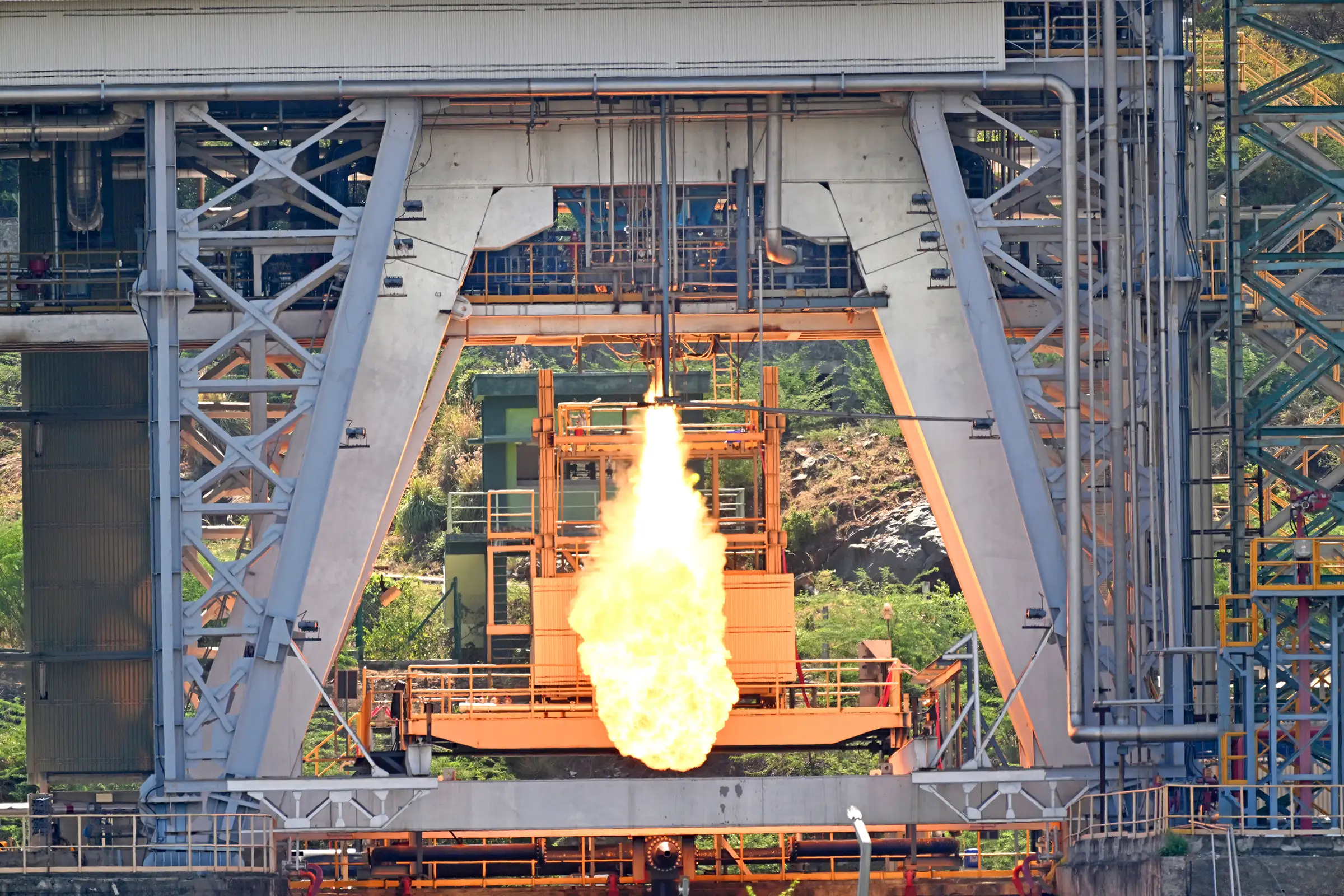
ISRO has taken another step towards a new core stage for LVM3, but the distinction between a power head and a complete engine matters.
In its 5 September announcement, the agency reported a successful firing of the semi-cryogenic Power Head Test Article at Mahendragiri. The run lasted 35 seconds, including five seconds at the agency’s stated 200-tonne, or 100%, test level.
The test article contains the engine systems except the thrust chamber. Calling this a complete engine delivering its flight thrust would overstate what was demonstrated.
Building up to the test
This was the ninth firing in the power-head series. ISRO’s earlier account places the preceding 175-tonne-level test on 24 June, with the announcement issued on 27 June. That distinction also matters when reconstructing the development timeline.
The June test examined the build-up after pre-burner ignition and operation at a higher test level. ISRO reported main turbopump outlet pressures of 400 and 500 bar. These measurements concern the machinery supplying propellants; they should not be substituted for evidence from a complete engine and nozzle.
A practical step towards longer firings
The September run also validated switching propellant supply from a low-pressure starting tank to a medium-pressure running tank. ISRO connects that result directly to enabling longer-duration tests.
That is the important engineering progression: extending operation beyond a short high-level interval. A brief successful run establishes one point in the test programme. It does not establish repeatability over flight-like durations or readiness of the integrated stage.
Why it matters for LVM3
ISRO is developing the SC120 stage around its 2,000-kN-class SE2000 engine to replace LVM3’s L110 core. The June technical account identifies liquid oxygen and purified kerosene as the propellants and describes the stage as part of a wider payload-capacity upgrade.
The practical measure of progress is the sequence of verified hardware results. Longer power-head firings, complete-engine testing and stage qualification should each be reported separately as they occur.
The latest release does not announce flight clearance or a firm first-flight date. For readers tracking India’s propulsion capability, that measured account is more useful than treating a successful development test as the end of development.
Sources
Image: ISRO’s September 5 semi-cryogenic power-head test.
Tags
More from Space Technology
RIDE! Targets Q3 2028 Launches for Two TakeMe2Space Satellites
The launch-services agreement covers mission management for two spacecraft in the Hyderabad company’s planned orbital-computing constellation. It is a future deployment commitment, not evidence that the network is operating.
Agnikul Adds Stage-Testing and Pressure-Vessel Facilities
The Chennai expansion addresses ground testing and manufacturing needed for future reusable vehicles. It does not establish that Agnikul has recovered or reflown a stage.