ISRO Prepares NVS-03 for a Reported Mid-October NavIC Revival Attempt
September reporting says ISRO is preparing NVS-03 for a mid-October launch to help restore NavIC’s standalone positioning service; launch timing and operational recovery remain prospective.
The Indian Space Research Organisation (ISRO) is preparing to launch NVS-03, a navigation satellite meant to pull India's regional satellite-navigation system, NavIC, back from a long decline. Reports in the last week of September 2026 put the launch in mid-October, aboard a GSLV Mk II rocket from the Satish Dhawan Space Centre, Sriharikota. The GSLV launch campaign began in mid-September, and the rocket's first stage has already been assembled.
It is one of the most consequential launches on ISRO's calendar this year — not because NVS-03 is technically novel, but because of what is riding on it.
Why NavIC needs rescuing
NavIC (Navigation with Indian Constellation), formerly the Indian Regional Navigation Satellite System (IRNSS), was built to give India an independent alternative to the American GPS. It covers India and the region around it, and offers two services: an open signal for civilian users and an encrypted service for the armed forces and other authorised users.
To deliver a position fix, a receiver needs signals from at least four satellites. NavIC's constellation was designed around seven. But over the past decade it has been hollowed out:
- Atomic-clock failures. Several first-generation IRNSS satellites lost their imported rubidium atomic clocks. Without accurate timing a navigation satellite cannot provide ranging signals, even if the rest of the spacecraft works.
- The NVS-02 setback. NVS-02, the second of the new-generation satellites, was launched on GSLV-F15 in January 2025 but could not raise its orbit to the intended geosynchronous slot. ISRO's failure analysis traced the problem to a pyro valve in the oxidiser line of the satellite's main engine that never received its firing signal; September reporting describes a pyro valve that did not receive the firing signal.
The Week’s September reporting says only three NavIC satellites remain fully operational for navigation — fewer than the four needed for reliable three-dimensional positioning. NVS-03 is intended to restore that minimum.
What NVS-03 brings
NVS-03 is the third of five planned second-generation NavIC satellites, following NVS-01 (launched in May 2023) and NVS-02. The second-generation series was designed to fix the weaknesses of the first: longer design lives, and — crucially — the introduction of India's own rubidium atomic clock, which first flew on NVS-01. Reporting on NVS-03 indicates it carries a mix of indigenous and imported atomic clocks, the same combination flown on NVS-02.
The NVS series also adds a signal in the L1 band, the band used by GPS and most consumer chipsets. That matters for adoption: it makes it much easier for smartphone and device makers to support NavIC without specialised hardware.
Why the armed forces are watching
For India's military, an indigenous navigation system is a strategic necessity, not a convenience. Precision-guided munitions, warship coordination, troop movement and combat aircraft operations all depend on reliable satellite navigation. Relying on a foreign system — whose signal can, in principle, be degraded or denied in a crisis — is a vulnerability that India has been trying to close since the Kargil conflict.
The Week’s report, quoting space and defence expert Girish Linganna, says the reduced constellation cannot currently provide dependable standalone positioning. NVS-03 alone will not make NavIC whole again, but it is the first step towards that.
Beyond defence: why civilians should care
NavIC is not only a military asset. Its open service is meant for transport, fisheries, disaster management, surveying, timing for telecom and power networks, and location services on phones. Several Indian states and central agencies have pushed for NavIC support in vehicle-tracking devices, and chipmakers have added it to a growing number of smartphone processors.
That ecosystem only grows if the signal is dependable. Device makers and app developers are unlikely to build around a system that cannot provide a stand-alone position fix. Restoring the constellation to at least four healthy satellites is therefore also a precondition for NavIC's commercial adoption — and for the domestic receiver and chip-design industry that India hopes will grow around it.
Accurate timing is an underappreciated part of the value. Telecom base stations, stock exchanges and electricity grids all depend on precise time signals, which today usually come from GPS. A healthy NavIC gives critical Indian infrastructure an independent, domestically controlled time reference — a resilience benefit that extends far beyond navigation.
The indigenous technology angle
The deeper story behind NavIC is indigenisation of the hardest component: the clock. Imported atomic clocks were the single largest cause of the first-generation failures. ISRO's development of a domestic rubidium standard — first flown on NVS-01 — was a direct response. Alongside it, ISRO has also developed indigenous NavIC baseband chips to drive receiver adoption.
If NVS-03 performs well, the case for flying more home-built clocks on the remaining NVS satellites becomes stronger, reducing India's dependence on foreign suppliers for its most critical navigation hardware.
What to watch
- Launch and orbit-raising. After the NVS-02 experience, the critical moment will not be lift-off but the satellite's engine burns to reach its final orbit.
- Service restoration. How quickly ISRO can declare NVS-03 operational and announce restored NavIC coverage.
- The rest of the series. NVS-04 and NVS-05 will be needed to rebuild redundancy so that NavIC does not again fall below the minimum after a single failure.
A successful NVS-03 would be a quiet but important win: proof that India can recover its own navigation system and keep it running.
Sources
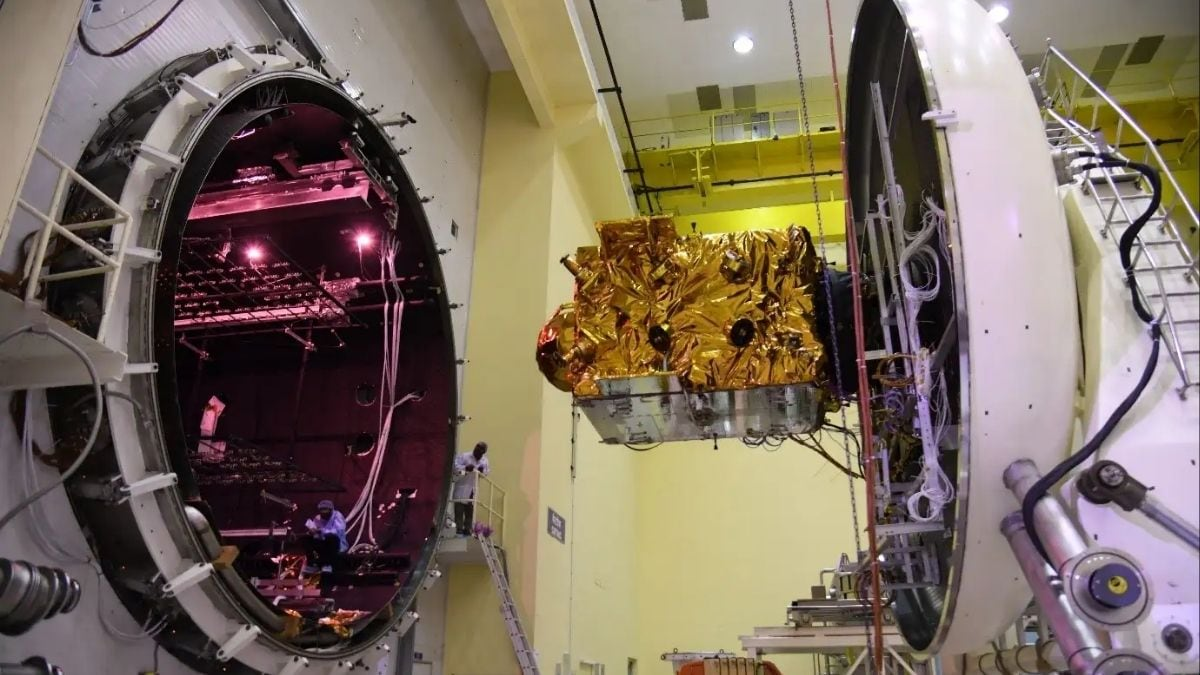
Image: ISRO, via The Week. NVS-02 during testing in early 2025, shown as context for the next-generation NavIC series; this is not NVS-03. Original source.