ISRO experts map the AI, quantum and inter-satellite future of India's spacecraft
At the National Space Technology Conclave 2026, held 17–18 August at Chandigarh University, ISRO scientists laid out the technologies they expect to define India's future spacecraft — on-board AI and machine learning, quantum-secured communications, and inter-satellite links. The gathering drew some 30 mission leaders from ISRO, IN-SPACe, NSIL and URSC, plus ten space-industry chiefs.

India's next generation of satellites will be shaped less by bigger rockets than by smarter electronics. That was the recurring message from ISRO scientists and mission leaders at the National Space Technology Conclave (NSTC) 2026, a two-day gathering held on 17–18 August 2026 at Chandigarh University — billed as the country's first university-led conclave of its kind.
The event brought together roughly 30 distinguished scientists, mission leaders and technologists drawn from the Indian Space Research Organisation (ISRO), the Indian Institute of Space Science and Technology (IIST), the Indian National Space Promotion and Authorisation Centre (IN-SPACe), NewSpace India Limited (NSIL) and the U R Rao Satellite Centre (URSC), alongside 10 chief executives and senior leaders from Indian space companies and startups. Among the attendees was Group Captain Shubhanshu Shukla, one of the astronauts associated with India's human spaceflight effort.
Three technologies to reshape the satellite
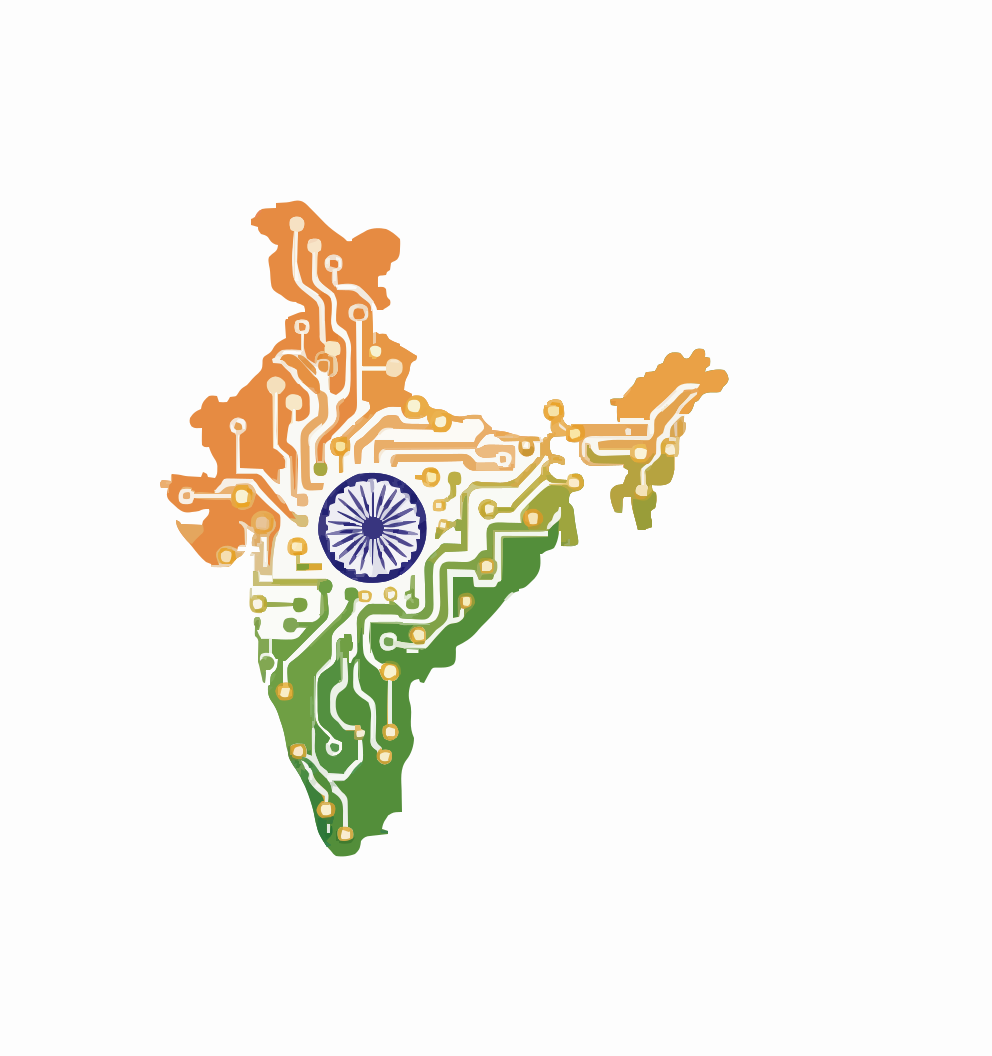
If the conclave had a thesis, it was that three capabilities will define India's future spacecraft: artificial intelligence and machine learning, quantum technology, and inter-satellite links (ISLs).
AI and machine learning were framed less as a buzzword than as a shift in where computation happens. Traditionally, a satellite is a sensor that dumps raw data to the ground, where the heavy processing is done. On-board AI flips part of that model: a spacecraft that can analyse imagery, prioritise what to downlink, and make routine decisions autonomously reduces the volume of data that has to be transmitted and speeds up the delivery of usable information. For applications where timeliness matters — disaster response, defence surveillance, maritime monitoring — that on-board intelligence is a force multiplier.
Quantum technology entered the discussion mainly through the lens of security. Quantum key distribution (QKD) offers a way to exchange encryption keys whose interception would be physically detectable, hardening satellite communications against eavesdropping. For a nation that increasingly views space assets as strategic infrastructure, communications that are secure by the laws of physics rather than by the difficulty of a computation are an attractive proposition. ISRO has previously demonstrated free-space QKD, and the conclave positioned it as a building block for future secure space and national-security systems.
Inter-satellite links address a quieter but fundamental constraint. A satellite in low Earth orbit is in view of any given ground station for only a few minutes per pass, which limits how quickly it can relay data or receive commands. Optical and radio links directly between satellites let a constellation route information across itself and down to the ground through whichever node is best placed — cutting latency and reducing dependence on a dense global network of ground stations. As India moves toward larger constellations for Earth observation and communication, ISLs become less a luxury and more a necessity.
Radar, and a decade of indigenisation
Beyond the headline trio, ISRO speakers highlighted radar as an area where India has moved from follower to leader over the past decade, crediting a sustained focus on indigenisation and active industry participation. Synthetic aperture radar, which can image the surface through cloud and darkness, underpins everything from flood mapping to security applications, and India's growing radar capability — spanning both government missions and private ventures — was cited as evidence that a domestic supply chain now exists to support ambitious future payloads.
That theme of indigenisation ran through the conclave. The presence of ten company chiefs alongside the government scientists underscored a structural change in Indian space: a sector that was, until recently, almost entirely state-run is now a partnership between ISRO, publicly owned commercial arms such as NSIL, the regulator-cum-promoter IN-SPACe, and a widening base of private firms and startups.
From priorities to people
The second day shifted from technology to the pipeline that has to deliver it. Sessions focused on translating space-technology priorities into education, research and mission capabilities, with dedicated tracks on space systems and mission engineering, scientific and engineering payloads, and ground-segment and mission operations. Hosting the conclave at a university was itself part of the point: bridging the gap between frontier research aspirations and the students and early-career engineers who will have to build the missions of the 2030s.
Why a conclave, not a launch, matters
It is worth being clear about what the NSTC was and was not. It was a deliberative gathering — a mapping of priorities and directions — rather than the unveiling of a finished spacecraft or a test milestone. Talk of AI-enabled satellites, quantum-secured links and inter-satellite networking describes a trajectory, not a system already in orbit.
But such gatherings are how a space programme aligns its research agenda, its industry and its talent behind a common technical direction, and the direction on display was coherent: spacecraft that think more on board, communicate more securely, and talk to one another more directly. Set against India's stated ambitions — a growing Earth-observation and communication footprint, the Bharatiya Antariksh Station planned for the 2030s, and a human spaceflight programme now taking shape — the conclave read as a statement of where the country intends to invest its engineering effort next.
Sources
- Chandigarh University joins ISRO to host National Space Technology Conclave on 17th–18th August — The Wire
- Chandigarh University Hosts National Space Technology Conclave with ISRO — ANI / Business Standard
- Artificial Intelligence, Quantum Tech to Power India's Next-Gen Satellites: ISRO Experts at NSTC 2026 — Business News Week
- ISRO Experts Highlight AI and Quantum Technology for Future Indian Satellites — The Quantum Insider