India Lines Up $25 Billion for Deep Tech as It Chases the US and China
Combining the government's RDI Fund with matching venture and private-equity capital, India has about $25 billion available for deep-tech investment, according to IVCA's Rajat Tandon — a large pool that still highlights the gap with US funding.

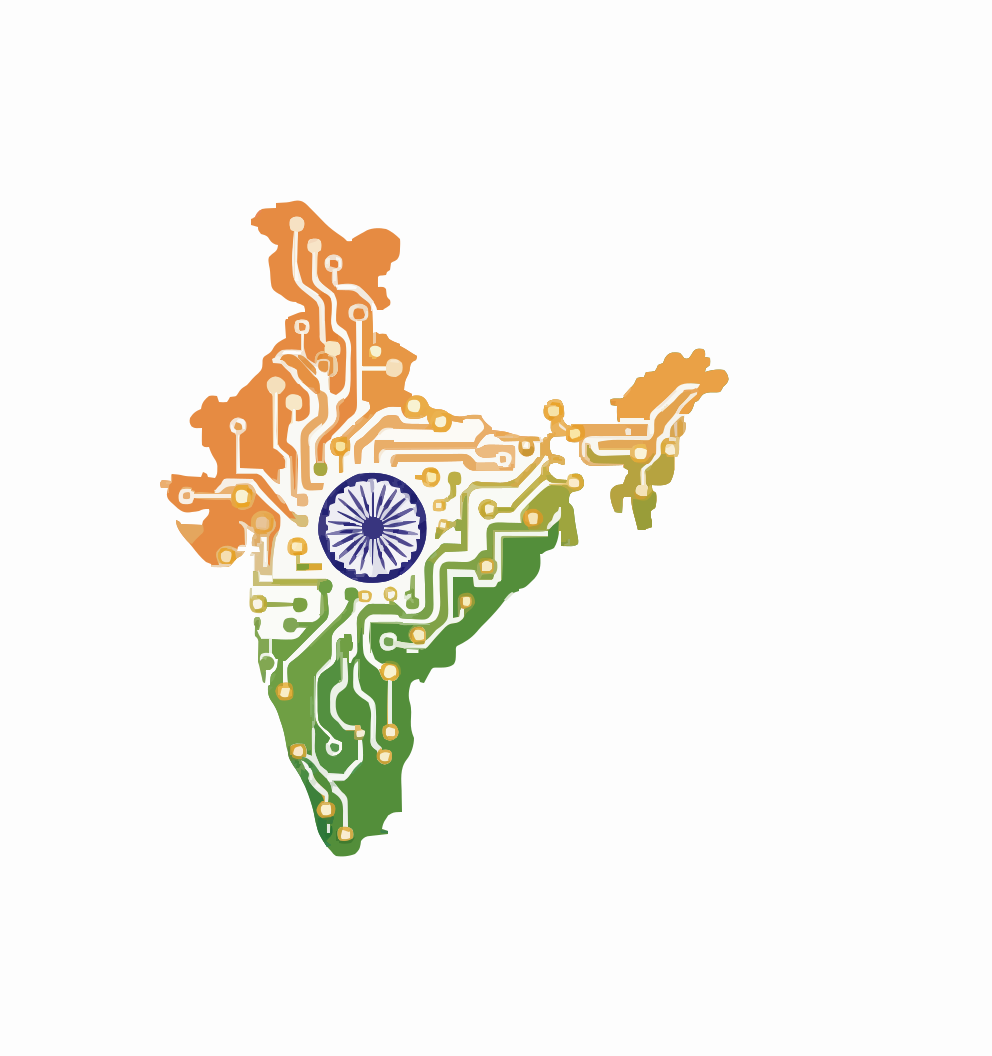
India is lining up about $25 billion for investment in deep-tech startups, as it tries to narrow the gap with the United States and China in artificial intelligence, semiconductors, drones, space and advanced manufacturing, CNBC reported on 29 September 2026.
The figure is not a single new government cheque. It is an estimate of the capital that becomes available when the government's flagship research fund is combined with the private money it is designed to pull in. Understanding how the number is built — and what it can and cannot achieve — says a lot about the state of India's deep-tech financing.
How the $25 billion adds up
According to Rajat Tandon, president of the Indian Venture and Alternative Capital Association (IVCA), quoted by CNBC, the government has committed about $11 billion through its research fund, which is to be matched by venture capital and private equity fund managers. With a further $3–4 billion on top, that brings roughly "$25 billion available to be spent on Deep-Tech investments."
The government vehicle is the Research, Development and Innovation (RDI) Fund — a ₹1 lakh crore corpus approved in 2025 to increase private-sector participation in high-impact research and development. Rather than handing out grants, it routes money through second-level fund managers such as the Technology Development Board (TDB) and BIRAC, and through venture funds, often as long-tenure, low-cost debt or blended instruments.
That structure is the reason for the matching logic: public capital is meant to crowd in private investors who would otherwise shy away from long, capital-heavy development cycles.
Why now
The push reflects both opportunity and anxiety. CNBC reported that the government has come to see frontier technology as "very critical" amid rising geopolitical tensions. Chinese technology is viewed with suspicion in India, while US export curbs on advanced technology make Washington an unreliable sole supplier. Building domestic capability in chips, AI and space is increasingly framed as a question of strategic autonomy, not just industrial policy.
There is also momentum to build on. Indian deep-tech startups raised nearly $3 billion in 2025, the sector's highest ever, even as overall startup funding in India fell, according to the report. The report also noted that companies including Emergent, Skyroot Aerospace and Sarvam AI became unicorns in their latest funding rounds.
The scale of the gap
Even at $25 billion, the numbers are sobering. CNBC noted that US deep-tech startups raised about $136 billion in 2025 alone — roughly 45 times India's total that year. India's $25 billion is a pool to be deployed over several years, not an annual flow.
That means India cannot compete dollar for dollar. Its strategy instead leans on cost advantages in engineering talent, a large domestic market for applications, and targeted bets in areas where it has credible capabilities: small launch vehicles, Earth observation, chip design, drones, and AI for Indian languages.
What the money is already doing
The RDI Fund has begun to deploy. The TDB selected its first cohort of 22 projects in July, with a combined project cost of ₹4,744 crore and RDI support of ₹2,192 crore, spanning reusable launch vehicles, Earth-observation satellites, quantum-secure communication, chip design, drones, robotics and next-generation batteries. Recent agreements include support for Agnikul Cosmos's reusable launch vehicle programme and GalaxEye's multi-sensor satellite work. BIRAC has separately named biotech startups for its RDI tranche.
At the same time, private deep-tech funds have multiplied. Over the past few months, several Indian and global investors have announced new funds or closes aimed specifically at deep tech, while the India Deep Tech Alliance says its members deployed about ₹2,170 crore across 56 startups in its first year.
Why debt, not just equity
One distinctive feature of India's approach is its reliance on patient debt. Much of the RDI Fund's early support has been structured as low-interest, long-tenure loans or convertible instruments rather than straightforward equity. For founders, that means they can finance long research and development cycles without giving away large ownership stakes before their technology is proven.
For the state, it means capital can eventually be recycled into new companies rather than locked into minority stakes. The trade-off is that debt suits companies with a visible path to revenue; the earliest-stage science projects still depend on grants and equity investors willing to take technology risk.
What will determine success
A headline pool matters less than how well it is deployed. Three factors will decide whether India's deep-tech push works:
- Speed and flexibility: deep-tech companies live and die by timelines. Slow approvals or rigid instruments can blunt the impact of cheap capital.
- Follow-on capital: the RDI Fund can help companies cross early technology-readiness levels, but scaling a factory, a fab or a satellite constellation requires much larger later-stage rounds, where India remains thin.
- Customers: government procurement — in defence, space and public infrastructure — is often the first real market for deep-tech products. Capital without buyers produces prototypes, not companies.
The bottom line
The $25 billion figure is best read as a statement of intent backed by real public money and a mechanism to multiply it. It will not close the gap with the US or China on its own. But if it is deployed quickly into companies with credible technology and early customers, it could help India build durable capability in a handful of strategic areas — which, for a country of its resources, may be the more realistic goal.
Sources
- CNBC — India readies $25 billion for Deep Tech investment as U.S. and China race ahead: https://www.cnbc.com/2026/09/29/india-investment-billions-tech-ai-us-china.html
- Arise News — India Plans $25bn Deep Tech Push To Close Gap With US, China: https://www.arise.tv/india-plans-25bn-deep-tech-push-to-close-gap-with-us-china/
- GuruFocus — India's $25 Billion Push for Deep Tech Startups Amid Global Competition: https://www.gurufocus.com/news/9101115/indias-25-billion-push-for-deep-tech-startups-amid-global-competition
- Free Press Kashmir — India plans $25 billion push for deep tech amid US-China competition: https://freepresskashmir.news/2026/09/29/india-plans-25-billion-push-for-deep-tech-amid-us-china-competition/
- BizzBuzz — RDI Fund: Centre Approves 22 Projects Worth Rs 4,744 Crore: https://www.bizzbuzz.news/national/rdi-fund-22-projects-rs-4744-crore-1398537
- CIOL — Agnikul Cosmos Secures ₹200 Crore TDB Funding for Reusable Launch Vehicle: https://www.ciol.com/funding-acquistion-merger/agnikul-cosmos-secures-200-crore-tdb-funding-for-reusable-launch-vehicle-12587463
- SiliconIndia — GalaxEye secures Rs 63.8 crore RDI support for satellite tech: https://www.siliconindia.com/news/startups/galaxeye-secures-rs-638-crore-rdi-support-for-satellite-tech-nid-242445-cid-19.html