India's RDI Fund Picks Its First 22 Deep-Tech Startups, Committing 2,192 Crore in Patient Capital
The Technology Development Board has selected the first 22 startups for India's new RDI Fund, approving 2,192 crore rupees of low-cost "patient capital" across space, quantum, robotics, EV, biotech and climate — with space firms like Agnikul and Dhruva Space and companies such as ePlane, Ather and Tejas Networks among the beneficiaries.
Manik Gupta
Founder and editor of DeepTech India. Manik writes about India's frontier technology ecosystem — AI, semiconductors, space, quantum, robotics and biotech — translating research and policy into clear, reliable reporting.
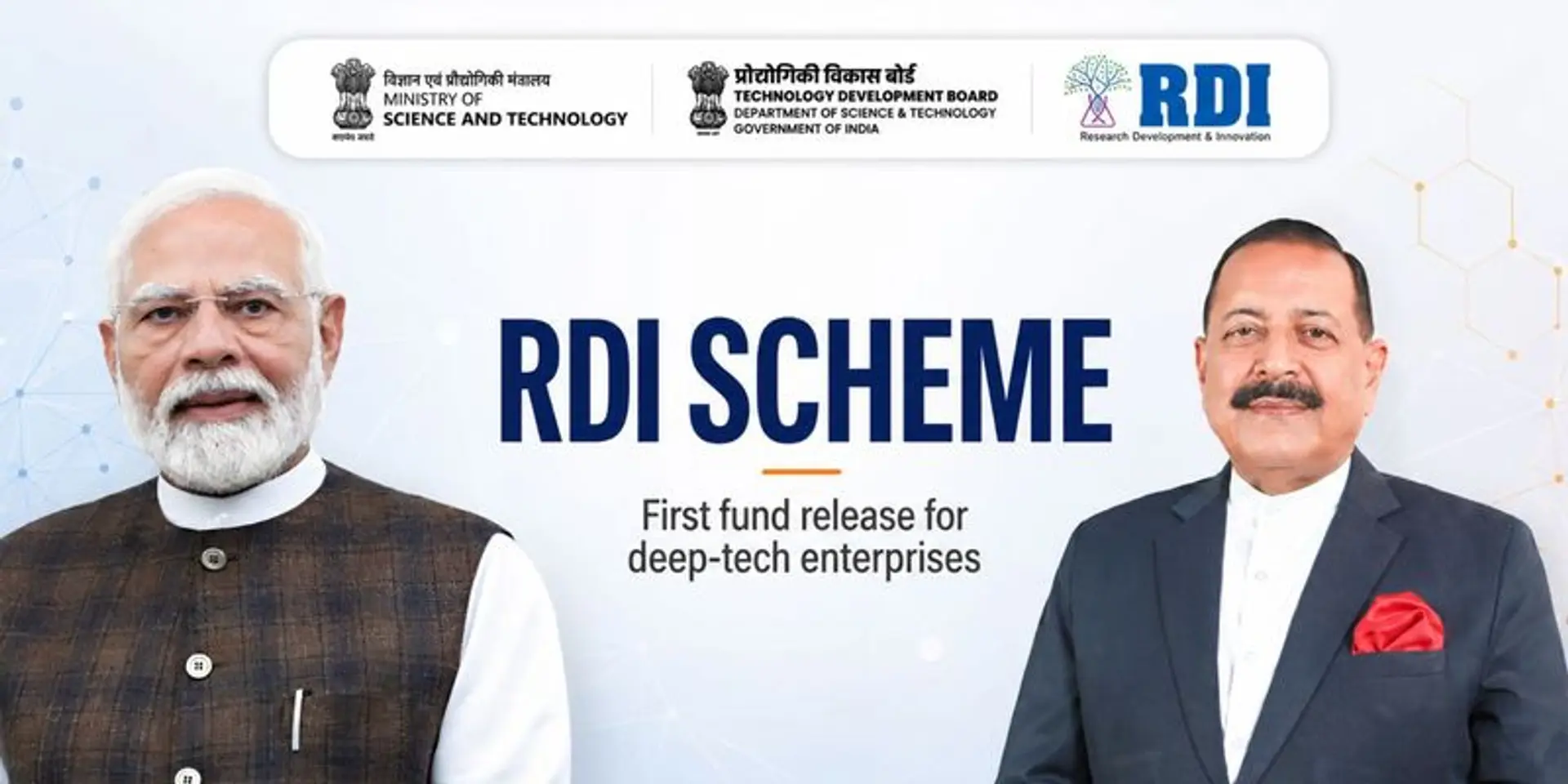
India's ambition to bankroll frontier technology took concrete shape in the third week of July 2026, when the Technology Development Board (TDB) revealed the first 22 deep-tech startups selected for support under the government's new Research, Development and Innovation (RDI) Fund. The state has approved financial support worth 2,192 crore rupees against a combined project cost of 4,744 crore rupees — a signal that the long-promised one-lakh-crore RDI corpus is beginning to flow into companies building hard technology.
What the RDI Fund is trying to fix
For years, Indian founders working on space launch vehicles, quantum hardware, robotics and biotech have faced a financing gap that software startups rarely encounter. Deep-tech companies need years of capital-intensive research before they earn revenue, and traditional venture capital — which expects returns on a shorter clock — often demands large equity stakes in exchange for that early risk. The result has been dilution that leaves founders with little of their company by the time it matures.
The RDI Fund is designed to change that calculus. Rather than taking equity, the fund offers low-cost debt at interest rates of roughly 3 to 4 percent, with repayment tenures stretching 12 to 15 years. That structure — often described as "patient capital" — lets founders finance long development cycles without surrendering ownership to investors too early, preserving value for the growth stages when it matters most. The TDB acts as a second-level fund manager, channelling money from the central corpus into vetted projects.
Where the money is going
The 22 selected startups span the strategic sectors the government most wants to strengthen: space, quantum computing, robotics, electric mobility, biotechnology, healthcare, climate technology and digital technologies. Space technology drew the single largest allocation, with about 833.89 crore rupees earmarked for the sector — a reflection of how central private launch and satellite firms have become to India's technology strategy.
Among the biggest individual beneficiaries are The ePlane Company, the IIT Madras-incubated electric aircraft maker, which was allocated 285 crore rupees; Tejas Networks, the telecom equipment firm, with 250 crore rupees; Ather Energy, the electric two-wheeler pioneer, with 212 crore rupees; Agnikul Cosmos, the small-satellite launch startup, with 200 crore rupees; and drone maker ideaForge with 151 crore rupees. Other companies on the list include space firms Dhruva Space, Manastu Space, GalaxEye and Astrome, along with biotech and health-tech ventures Eyestem, Noccarc, Peptris and REPLUS.
The spread is deliberate. By backing a portfolio that runs from rocket propulsion and Earth-observation satellites to gene therapy, medical devices and next-generation networking, the fund is trying to seed capability across the whole of India's deep-tech base rather than concentrate on a single fashionable field.
A shift in how India funds innovation
The RDI Fund marks a philosophical shift in Indian science and technology policy. Historically, government support for research flowed largely to public laboratories and academic institutions, while private innovation was left to the market. The RDI mechanism instead routes patient, low-cost capital directly to private companies that are commercialising research, betting that firms already building products can turn public money into deployed technology faster than grants alone.
The approach borrows from the playbooks of countries that have used sovereign or development finance to nurture strategic industries, adapted to India's startup ecosystem. It also complements other recent instruments — sector-specific funds for space and biotech, production-linked incentives for electronics and semiconductors, and equity funds run by bodies like the Small Industries Development Bank of India — that together are pushing more risk capital toward hard technology.
Why it matters
Deep tech has become one of India's fastest-growing startup segments, but scaling from a working prototype to a manufactured product remains the point where many promising companies stall for lack of affordable, long-duration capital. If the RDI Fund delivers on its terms, it could help bridge that "valley of death" for exactly the kinds of firms — launch vehicles, satellites, medical devices, clean-energy hardware — whose success carries strategic as well as commercial weight.
The first cohort of 22 is only an opening tranche against a corpus that runs to a lakh crore rupees, and the government has said it has received a large pipeline of further proposals. How quickly the fund can evaluate, disburse and — crucially — recover its patient loans will determine whether this becomes a durable engine for Indian innovation or another well-intentioned scheme that struggles to move money at speed. For now, the founders on the list have something rarer than a grant: years of runway that does not cost them their companies.
Sources
- TDB-RDI selects 22 deeptech startups with project cost of 4,744 crore — Business Standard
- India's RDI Fund Invests 2,192 Crore in 22 Deeptech Firms — Whalesbook
- RDI Fund Selects 22 Startups as India's Rs 1 Lakh Crore DeepTech Push Picks Up Speed — Newskart
- RDI Fund — Anusandhan National Research Foundation
Tags
More from Miscellaneous
Minimac Systems Raises ₹30 Crore to Turn Industrial Oil Into a Circular Resource, Not Waste
Minimac Systems has raised ₹30 crore in a pre-Series A round led by Zerodha's Rainmatter to scale mobile, miniaturised units that restore industrial lubricant on-site instead of trucking it away as waste.
The/Nudge Foundation Launches TILT, a ₹250 Crore Fund for India's 'Next Billion' Tech Startups
The/Nudge Foundation has launched TILT, a ₹250 crore impact-investment platform backing seed-to-Series A science and technology startups working on livelihoods, climate resilience and financial inclusion.