
India Signs for the Javelin, Ending a Fifteen-Year Wait for America's Tank-Killer
The Indian Army has signed a Letter of Offer and Acceptance for FGM-148 Javelin anti-tank missiles from the United States, closing out more than a decade of on-again, off-again negotiations over the man-portable, fire-and-forget weapon.
Manik Gupta
Founder and editor of DeepTech India. Manik writes about India's frontier technology ecosystem — AI, semiconductors, space, quantum, robotics and biotech — translating research and policy into clear, reliable reporting.
A Letter of Offer and Acceptance, at Last
On Friday, August 28, 2026, the Indian Army signed a Letter of Offer and Acceptance (LOA) with the United States for the FGM-148 Javelin anti-tank guided missile system, the US Embassy in New Delhi confirmed. The signing converts what had been a US-approved but unexecuted Foreign Military Sale into an actual contracted acquisition — the last procedural step before missiles, launch units and support equipment start moving through the pipeline.
It is a moment Indian and American defence officials have been working toward for a long time. Indian interest in the Javelin dates back to the mid-2000s, and formal talks have run on and off for well over a decade, repeatedly stalling over cost, technology-transfer terms and India's preference for co-production over a straight commercial purchase. Reporting on the signing framed it, variously, as the end of "sixteen years of talk" — a fair description of just how long this file sat on the table in New Delhi and Washington.
What India Is Actually Buying
The scope of the deal traces back to a Defense Security Cooperation Agency (DSCA) notification to the US Congress in November 2025, which cleared a possible sale valued at an estimated $45.7 million. Per that notification, India's request covers:
- 100 FGM-148 Javelin missile rounds
- One additional missile earmarked for a "fly-to-buy" evaluation round
- 25 Javelin Lightweight Command Launch Units (LWCLU), the reusable targeting-and-fire-control unit that pairs with each missile
- Associated trainers, simulation rounds, technical manuals, spare parts and life-cycle sustainment support
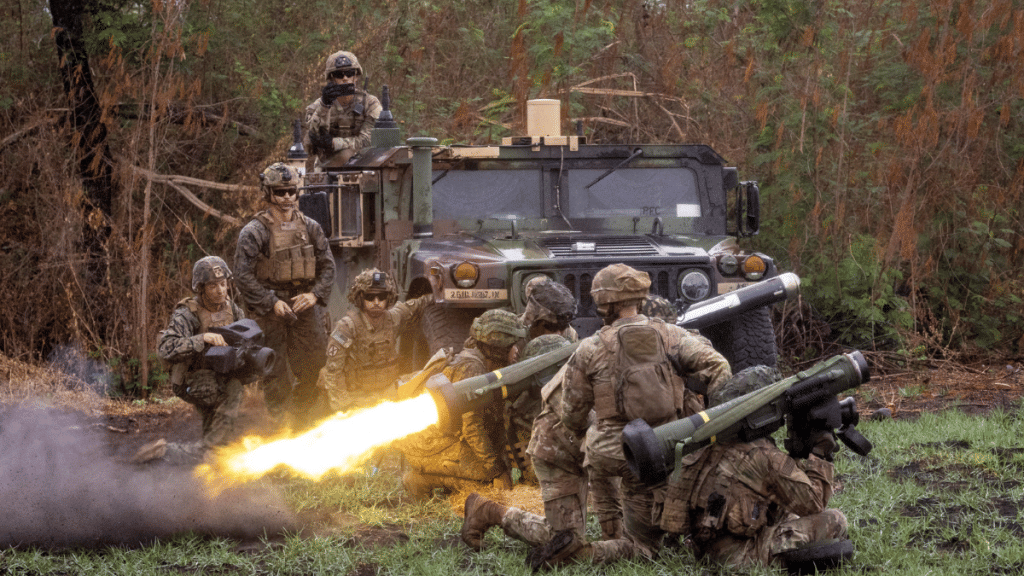
The Javelin is a shoulder-fired, man-portable, "fire-and-forget" anti-tank weapon — a soldier can lock onto a target, fire, and take cover or reposition without having to guide the missile in. Its signature feature is a top-attack flight profile: rather than striking a tank's heavily armoured front or sides, it arcs up and comes down on the thinner armour of the turret roof, a design built specifically to defeat explosive reactive armour (ERA) fitted to modern main battle tanks. It has been in US and allied service since the 1990s and has since been adopted by dozens of countries, with its combat record in Ukraine giving it a level of battlefield notoriety few anti-tank systems can claim.
Why the Timing Matters
For the Indian Army, the Javelin fills a gap that has been open for years. Much of its existing man-portable anti-tank inventory — older Konkurs and Milan-family missiles — is either ageing out or was never available in the quantities mechanised and infantry formations wanted. India's indigenous alternative, DRDO's Man-Portable Anti-Tank Guided Missile (MPATGM), has been in trials and limited-scale induction, but has not yet reached the volumes needed to fully replace legacy systems along both the western front with Pakistan and the mountainous, high-altitude sectors facing China, where lightweight, easily-carried anti-armour firepower is especially prized.
US Ambassador-designate Sergio Gor's comments around the signing pointed to more than a one-off purchase: officials on both sides have talked about India eventually buying additional Javelin systems and, longer-term, exploring co-production in India rather than a purely import-based relationship. That framing matters in New Delhi, where the Ministry of Defence has spent the past several years pushing every major import deal — from French Rafales to now the Javelin — for some kind of local manufacturing or technology-transfer component, in keeping with the broader Atmanirbhar Bharat push in defence production.
Part of a Wider Pattern
The Javelin LOA lands in the middle of an unusually busy stretch for India-US defence trade. It follows years of incremental steps — the MQ-9B Predator drone deal, Excalibur precision artillery rounds, and a string of DSCA notifications covering everything from naval systems to fighter-related equipment — that together have made the US one of India's fastest-growing arms suppliers even as Russia remains the single largest legacy supplier by inventory.
For India's broader defence-industrial narrative, the deal is a reminder that indigenisation and imports are running on parallel tracks rather than one replacing the other. While DRDO, private industry and the armed forces push ahead on homegrown missiles, radars, drones and now conventional-missile technology transfers to private manufacturers, the Army has shown it will still go abroad — through the FMS route — when a proven, combat-tested system like the Javelin can close a capability gap faster than a domestic programme currently can.
What happens next will be watched closely: delivery timelines for the 100 rounds and 25 launch units, whether the promised co-production conversation moves from talking point to term sheet, and whether this LOA is eventually followed by the larger follow-on order that both sides have signalled is under discussion.
Sources
- India and US sign deal for Javelin missiles, the plan eventually is co-production — ThePrint
- India to buy more anti-tank Javelin systems from US: Sergio Gor — The Week
- India plans to buy Javelin missiles from US: What makes the 'fire and forget' anti-tank weapon so lethal? — Business Today
- India signs deal to buy US Javelin anti-tank missiles for Army: US Embassy — Business Standard
- India signs deal with US to buy Javelin anti-tank missile systems — Business Recorder
Tags
More from DefenceTech
DRDO Invites Bids for an Indigenous Air-to-Air Refuelling Pod, Targeting a Gap Russian Tankers Can't Fill
DRDO has opened bidding under its Technology Development Fund for an indigenous, modular Air-to-Air Refuelling Pod, aiming to reduce the Air Force's dependence on its serviceability-plagued Il-78 tanker fleet.
Bharat Forge's Kalyani Strategic Systems Signs With Thales to Build 70mm Rockets in India
KSSL, the defence arm of Bharat Forge, has signed a strategic alliance with Belgium's Thales to locally produce combat-proven 70mm rocket systems, part of a ten-agreement India-Belgium defence package signed during a state visit.