GalaxEye’s Next OptoSAR Programme Targets Sub-Half-Metre Imaging
The development programme aims to combine radar and optical observations at finer resolution. Its target must be distinguished from the specifications advertised for Mission Drishti.
Manik Gupta
Founder and editor of DeepTech India. Manik writes about India's frontier technology ecosystem — AI, semiconductors, space, quantum, robotics and biotech — translating research and policy into clear, reliable reporting.
GalaxEye’s next satellite-development programme aims to make combined radar and optical observations more detailed. The important distinction is between the new target and imagery already demonstrated or offered by an existing spacecraft.
A 24 September Technology Development Board announcement describes a multisensor satellite intended to achieve OptoSAR imaging finer than 0.5 metres. The programme aims to advance from technology readiness level 6 to level 9 through engineering, testing and validation. It is a technology-maturation plan, not a released imaging benchmark.
Two sensors contribute different information
OptoSAR combines synthetic aperture radar with electro-optical observations. Radar contributes measurements in darkness and through cloud cover; optical imagery contributes visual and spectral information when illumination and viewing conditions permit. Combining the streams does not make an optical sensor itself immune to clouds.
GalaxEye’s current Mission Drishti description places radar and a seven-band multispectral imager on the same satellite. The company advertises fused data at 1.8-metre resolution, alongside separate radar and optical specifications. Those figures describe that product; they should not be silently replaced by the new programme’s sub-0.5-metre objective.
Capturing complementary observations from one platform can reduce some of the difficulties of reconciling separate passes. The practical test remains whether users receive well-aligned data under clearly stated collection conditions. A nominal resolution figure alone does not establish performance on every detection or classification task.
Moving from a target to useful data
TDB has agreed ₹63.84 crore in RDI support, through optionally convertible debentures, for a project with an approved cost of ₹247.69 crore. The technical work, rather than the financing headline, is the central development: validating a finer-resolution multisensor capability and preparing it for deployment.
The reviewed announcement does not supply public sample imagery at the proposed resolution, a task-specific accuracy assessment or an operational service date. Subsequent evidence should make clear which measurement refers to the radar sensor, the optical sensor or a fused output, and under what conditions it was obtained.
For an Earth-observation customer, usable coverage and confidence in the interpretation matter alongside pixel size. Demonstrations with transparent collection conditions and validation data would make the new specification easier to evaluate than an isolated best-case number.
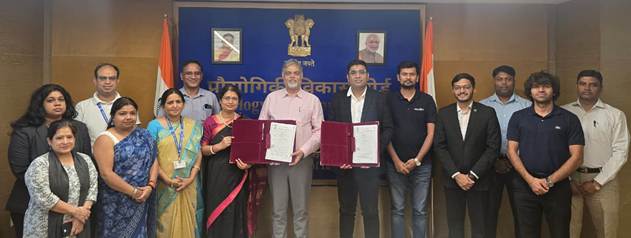
Image: the TDB–GalaxEye agreement event pictured in the official 24 September release. This is not an image of the proposed satellite or data captured from orbit. Credit: Technology Development Board / Department of Science & Technology / PIB.
Sources
Tags
More from Space Technology
Agnikul’s Reuse Programme Targets the Upper Stage as Well as the Booster
A new TDB-backed programme sets out restartable propulsion, controlled descent and an ambition for full-system reuse. Operational recovery and reflight remain milestones to demonstrate.
U-Space and AXISCADES Sign Cooperation Deal to Explore India's Microsatellite Market
French space company U-Space and Bengaluru's AXISCADES have signed a commercial cooperation agreement to jointly pursue India's microsatellite market, one of three India-France private space deals struck at the Paris International Space Summit.