
IIT-Madras Startup D-Propulse Pushes Its Rotating Detonation Engine to TRL-5
IIT-Madras-incubated startup D-Propulse has advanced its rotating detonation engine with an aerospike nozzle to TRL-5, sustaining 5 kN of thrust in tests at a DRDO facility — a step towards efficient propulsion for missiles, drones and reusable launch systems.
Manik Gupta
Founder and editor of DeepTech India. Manik writes about India's frontier technology ecosystem — AI, semiconductors, space, quantum, robotics and biotech — translating research and policy into clear, reliable reporting.
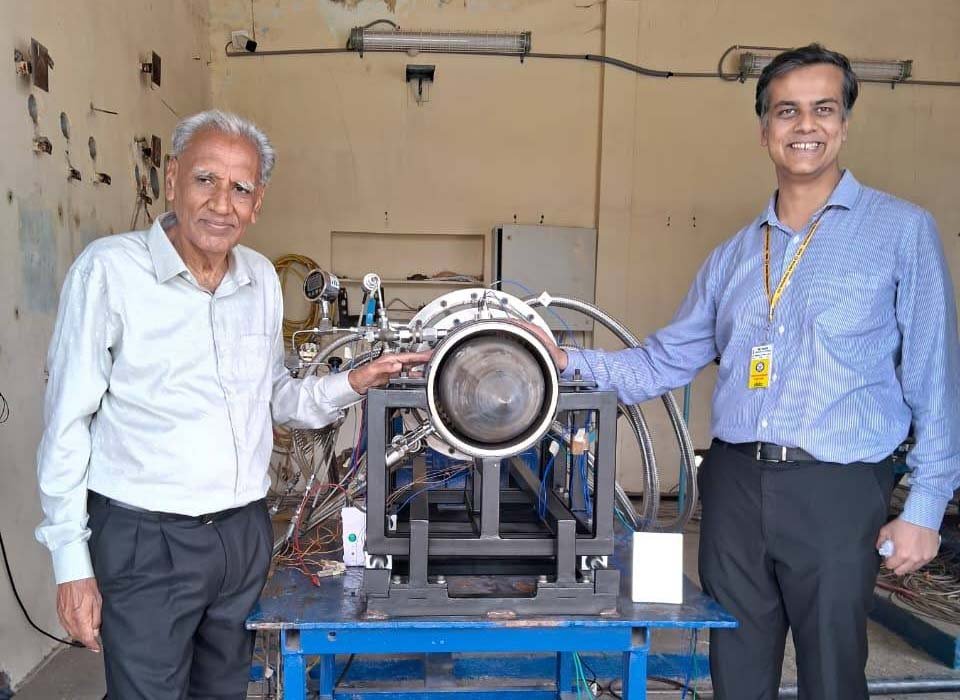
An Indian deep-tech startup working on one of aerospace's most exotic propulsion concepts has reached a notable maturity milestone. D-Propulse, incubated at IIT Madras, has demonstrated its Rotating Detonation Engine (RDE) fitted with an aerospike nozzle at Technology Readiness Level 5 (TRL-5), producing 5 kN of thrust even under reduced air mass-flow conditions. The demonstration, reported in recent days, was carried out at a DRDO facility.
What a rotating detonation engine actually does
Conventional jet and rocket engines burn fuel through deflagration — a relatively slow, subsonic flame front held at roughly constant pressure. A rotating detonation engine works differently. It sustains one or more detonation waves that travel continuously around an annular (ring-shaped) combustion chamber at supersonic speed. Because detonation compresses the gas as it burns, the process can be more thermodynamically efficient, promising more thrust from less fuel in a more compact package.
That efficiency is why RDEs have drawn intense research interest worldwide. It is also why they are hard: taming a detonation wave so that it rotates stably, cycle after cycle, without tearing the engine apart is a formidable engineering challenge. Pairing the RDE with an aerospike nozzle — a design that adjusts its effective shape to stay efficient across a wide range of altitudes — adds another layer of ambition.
Why TRL-5 is the headline
Technology Readiness Levels are a standard scale for gauging how far a technology has moved from the lab towards real-world use. TRL-5 means a prototype has been validated in a relevant environment — a meaningful jump from bench-top proof-of-concept work. In practice, reaching TRL-5 signals that D-Propulse's engine has shown it can handle realistic physical stresses, with its combustion, wave stability and thrust holding up under conditions closer to those it would face in service.
The startup had earlier reported a TRL-4 stage for the same engine, so the latest demonstration represents steady, incremental progress up the maturity ladder rather than a leap from nothing. Sustaining 5 kN of thrust even when the air supply is throttled back is a particularly useful result, because real flight rarely delivers ideal, steady inflow.
Where this could lead
The near-term applications for an engine in this thrust class are missiles, unmanned aerial vehicles and upper-stage rocket motors — systems where compactness, efficiency and thrust matter more than the long service life of a crewed aircraft engine. Looking further out, the developers see a path towards higher thrust regimes that could support hypersonic vehicles and reusable launch systems, both areas where India is keen to build indigenous capability.
That the testing was done at a DRDO facility underlines how India's defence research establishment is increasingly acting as an enabler for startup-led propulsion work, providing the specialised test infrastructure that a young company cannot build on its own.
A note of perspective
Advanced propulsion timelines are long, and RDEs in particular have a history of dazzling in the lab while proving stubborn to field. TRL-5 is real progress, not a finished product; substantial work on scaling, durability and integration remains before such an engine powers an operational vehicle. Still, an India-incubated startup independently advancing a rotating detonation engine to a validated prototype is a genuine marker of how far the country's deep-tech propulsion ecosystem has come — and a reminder that some of the most ambitious frontier engineering is now emerging from campus incubators rather than only from state labs.
Sources
- idrw.org — Indian Startup D-Propulse Tests 5 kN Air-Breathing Rotating Detonation Engine with Aerospike Nozzle: https://idrw.org/indian-startup-d-propulse-tests-5-kn-air-breathing-rotating-detonation-engine-with-aerospike-nozzle/
- Indian Defence News — IIT-Madras Start-Up D-Propulse Advances RDE-Aerospike Engine To TRL-4 With Stable 5kN+ Thrust: https://www.indiandefensenews.in/2026/03/iit-madras-start-up-d-propulse-advances.html
- DT Next — From IIT-M labs to high-speed skies: D-Propulse drives India's indigenous propulsion breakthrough: https://www.dtnext.in/news/chennai/from-iit-m-labs-to-high-speed-skies-d-propulse-drives-indias-indigenous-propulsion-breakthrough
- idrw.org — Indian Startup D-Propulse Develops 5kN+ RDE with Aerospike Nozzle for High-Speed Systems: https://idrw.org/indian-startup-d-propulse-develops-5kn-rde-with-aerospike-nozzle-for-high-speed-systems/
Tags
More from Space Technology
ISRO's GSLV-F17 Places EOS-05 Into Orbit, Its Heaviest-Ever Payload on a GSLV
ISRO's GSLV-F17 placed the 2,367-kg EOS-05 satellite into a higher-than-planned geosynchronous transfer orbit on September 4, redeeming the GSLV family after the 2021 loss of its predecessor and setting up a packed launch calendar toward Gaganyaan.
Kepler Aerospace Raises $8 Million to Build Six Autonomous ISR Satellites That Talk to Each Other in Orbit
Bengaluru's Kepler Aerospace has closed its first-ever external funding round to launch six swarming ISR satellites under two Ministry of Defence iDEX contracts.