
Agnikul’s Reuse Programme Targets the Upper Stage as Well as the Booster
A new TDB-backed programme sets out restartable propulsion, controlled descent and an ambition for full-system reuse. Operational recovery and reflight remain milestones to demonstrate.
Manik Gupta
Founder and editor of DeepTech India. Manik writes about India's frontier technology ecosystem — AI, semiconductors, space, quantum, robotics and biotech — translating research and policy into clear, reliable reporting.
Agnikul’s new reusable-launch programme puts a difficult engineering question in focus: how much of a rocket can be brought back into service, and what must its propulsion system do differently to make that possible?
In a 25 September announcement, the Technology Development Board described an agreement to support development of Agnibaan RLV. The stated goal extends beyond recovering a first stage to working towards full-system reusability. It is a development objective, not confirmation that a fully reusable vehicle has flown.
Propulsion has to serve more than ascent
The proposed architecture includes a lightweight upper stage, orbital-insertion capability and semi-cryogenic liquid propulsion designed for restart and deep throttling. The announcement also identifies descent propulsion and recovery as development areas. The programme aims to progress from technology readiness level 4 and above towards level 8.
Restart and throttling matter because a vehicle descending towards a recovery point faces a different task from one accelerating away from the launchpad. Engineers need control over when thrust is available and how much it changes. That is the engineering rationale for these capabilities; it does not establish that Agnikul has completed their validation across a reusable flight cycle.
Agnikul’s own technology description identifies in-house engine production, a configurable engine arrangement, autopilot and avionics as parts of its approach. Those component capabilities provide context for the programme, while recovery still requires the complete vehicle and its operations to work together.
The next evidence is an integrated demonstration
TDB’s support is ₹200 crore through optionally convertible debentures. The significance for technology reporting is the defined development work behind that support: ascent, insertion, descent and recovery must be connected in a repeatable system.
The reviewed announcement does not provide a completed reflight result, a validated refurbishment interval or an achieved cost per reused launch. Nor does it establish a commercial operating date. These remain useful questions for subsequent reporting.
For customers, recovery alone would not settle the economic case. A recovered stage must be inspected and made fit for another mission. The evidence to watch is a documented progression from component tests to integrated flight, recovery and reuse, with performance and operating conditions disclosed at each step.
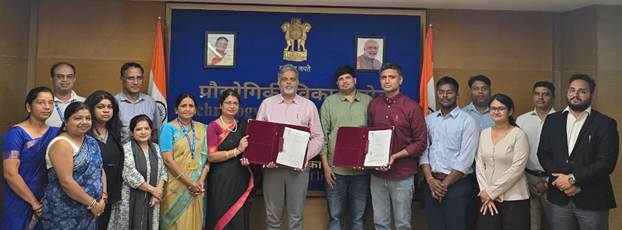
Image: the TDB–Agnikul agreement event pictured in the official 25 September release. It is an agreement photograph, not a reusable-flight demonstration. Credit: Technology Development Board / Department of Science & Technology / PIB.
Sources
Tags
More from Space Technology
GalaxEye’s Next OptoSAR Programme Targets Sub-Half-Metre Imaging
The development programme aims to combine radar and optical observations at finer resolution. Its target must be distinguished from the specifications advertised for Mission Drishti.
U-Space and AXISCADES Sign Cooperation Deal to Explore India's Microsatellite Market
French space company U-Space and Bengaluru's AXISCADES have signed a commercial cooperation agreement to jointly pursue India's microsatellite market, one of three India-France private space deals struck at the Paris International Space Summit.