
SiMa.ai, an Edge-AI Chipmaker With Deep Bengaluru Roots, Becomes a $1.45 Billion Unicorn
SiMa.ai, which designs physical-AI chips with a large engineering base in Bengaluru, raised a $150 million Series C co-led by Fidelity and Amplify at a $1.45 billion valuation.
SiMa.ai, an edge-AI chip company with a large engineering base in Bengaluru, has become a unicorn. On 28 September 2026, the San Jose-headquartered company announced a $150 million Series C at a reported valuation of $1.45 billion. Its total funding now stands at about $500 million.
The round was described as oversubscribed and was co-led by Fidelity Management & Research Company and Amplify. New investors include AllianceBernstein, Baron Capital, J.P. Morgan and the State of Michigan. Existing backers Dell Technologies Capital, Maverick Capital, Point72, StepStone Group, Alter Venture Partners and +ND Capital also took part.
What SiMa builds
SiMa designs chips for what the industry now calls physical AI: artificial intelligence that runs inside machines in the real world, such as robots, drones, cars and industrial equipment, rather than in distant data centres.
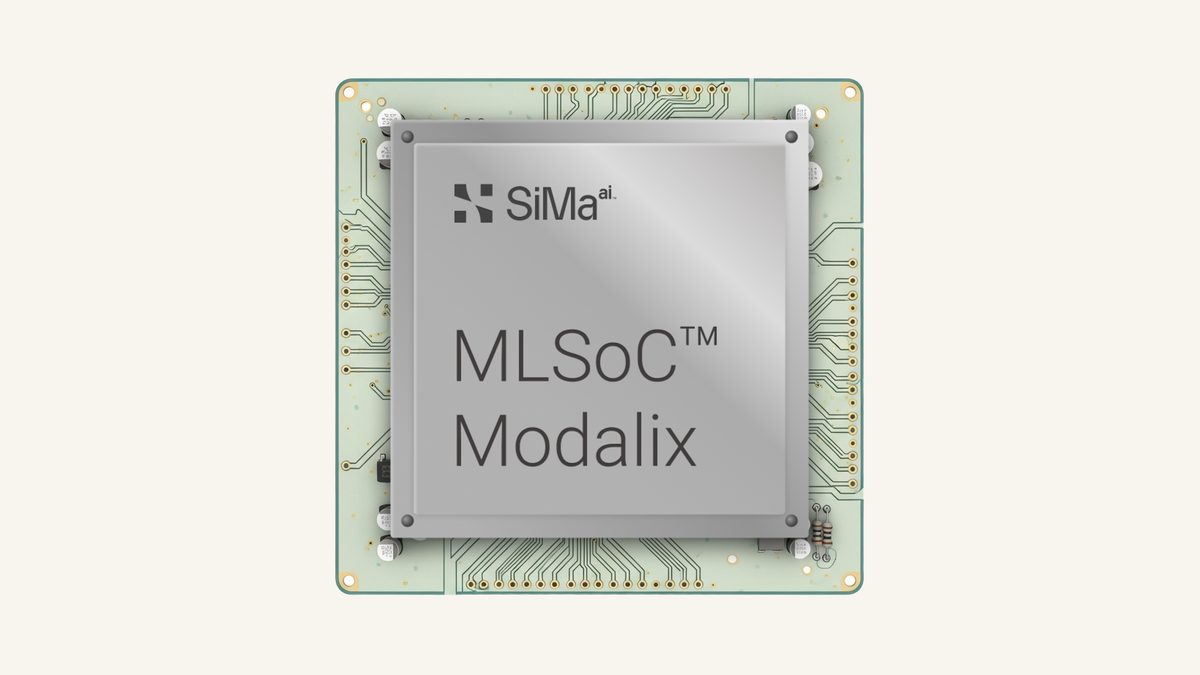
Those machines need AI that is fast, local and frugal with power. A drone cannot wait for a round trip to the cloud to recognise an obstacle, and a robot on a factory floor cannot carry a data-centre GPU. SiMa's answer is its Modalix family of machine-learning systems-on-chip (MLSoCs), which went into production in August 2025. SiMa rates the chip at 50 TOPS (trillion operations per second) in a low-power package; its product page describes multimodal applications below 10 watts. It can run multimodal models that take in images, text and audio on the device itself.
The company says revenue quadrupled between 2024 and 2025 and describes a customer and partner network across automotive, drones and robotics. Customers named in coverage include Bosch, Synopsys and India's L&T Technology Services.
What the money is for
SiMa says the funding has two main uses.
The first is Palette Neat, a software environment it calls "the industry's first agentic software environment for Physical AI". It is meant to make it easier for engineers to take AI models and deploy them onto SiMa hardware. For edge chips, software is often the deciding factor, because customers pick the platform that is easiest to build on.
The second is its next-generation silicon. SiMa is targeting 1,000 dense TOPS, slated for the first half of 2028. It plans to offer this as licensable IP, as chiplets, and as complete SoCs. That is a roadmap target, not a shipping product.
"Physical AI in humanoids, automotive, and drones is the gateway to a $50 trillion market that has remained largely untouched by modern innovation," said founder and CEO Krishna Rangasayee, who was earlier chief operating officer of AI chip company Groq.
The India connection
SiMa is a US company, but India is central to how it builds chips. It opened a Bengaluru design centre in 2021, and in coverage of the round Rangasayee described India as a major share of the company's workforce. Estimates of the India headcount vary between outlets, but the company's engineering is heavily concentrated there.
That makes SiMa a useful example of how India's chip ambitions work in practice. A large share of global chip-design work already happens in India, through global companies' Bengaluru, Hyderabad and Noida centres. The India Semiconductor Mission now wants more of that value to be captured by companies whose products, IP and leadership are rooted in India. SiMa sits in between: it is US-headquartered and US-funded, but its product depends heavily on Indian engineering talent.
Why it matters
Edge AI is one of the few parts of the chip market where Nvidia does not dominate by default. Power budgets, cost limits and specialised workloads leave room for focused challengers. A unicorn valuation for SiMa shows that investors think that window is real.
For India, it also shows what a well-funded, India-heavy chip team can reach. As the government pushes its Design Linked Incentive scheme and support for domestic chip startups, SiMa's path offers a benchmark: a design-led company, building for robotics and drones, that has turned engineering depth into commercial traction.
Sources
Core announcement or reporting
Image: SiMa.ai. Official Modalix product visual; existing product, not the proposed 2028 chip. Original source.