QNu Labs, BISAG-N and IIT Gandhinagar Run India's First 5.56-km Free-Space Quantum Key Link
A night-time field trial in Gandhinagar sent quantum-secured keys through 5.56 km of open air with an error rate under 5%, then used them in BISAG-N's post-quantum Vedic Kavach platform — a stepping stone towards satellite quantum communication.
On the night of 27–28 September, two buildings about five and a half kilometres apart in Gandhinagar were linked by something more than a line of sight. A beam of single photons travelled through open air from the Bhaskaracharya National Institute for Space Applications and Geo-informatics (BISAG-N) to the campus of IIT Gandhinagar, and the two ends used it to agree on secret encryption keys that, in principle, no eavesdropper could copy without being detected.
The Ministry of Electronics and Information Technology announced the result through the Press Information Bureau on 3 October, calling it India's first 5.56-km free-space quantum key distribution (QKD) link. The trial was run by Bengaluru-based QNu Labs together with BISAG-N and IIT Gandhinagar.
What the trial actually showed
QKD works by encoding key bits in the quantum states of individual photons. Any attempt to measure those photons in transit disturbs them, which shows up as errors at the receiving end. The figure engineers watch most closely is therefore the quantum bit error rate (QBER): a low error rate is one requirement for extracting secure keys after further error correction and privacy amplification; it does not by itself prove the security of every device or implementation.
According to the government announcement and reports on it, the Gandhinagar link held a stable QBER below 5%, and generated secure keys at between 230 and 260 bits per second. That is a modest rate by the standards of classical networking, but it is ample for the job QKD is meant to do: refreshing the symmetric keys that conventional encryption systems then use to protect bulk data.
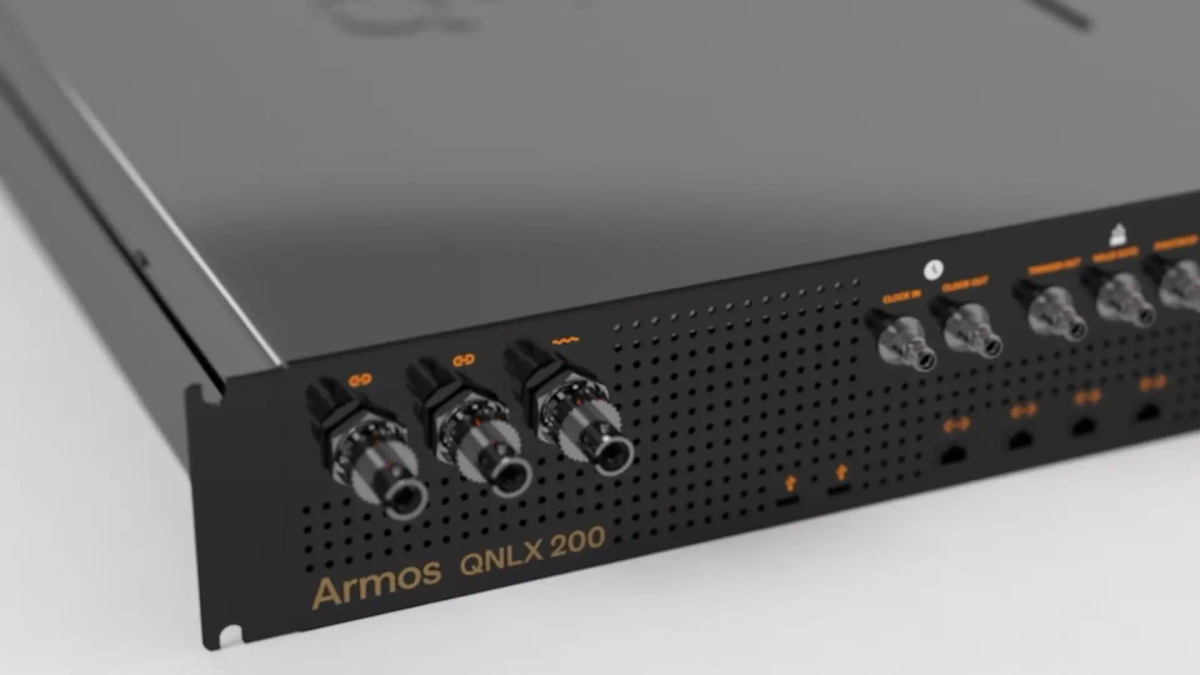
Keeping a free-space link alive is the hard part. Unlike a fibre, an open-air channel is exposed to turbulence, haze, building sway and thermal shimmer, all of which knock a narrow beam off target. QNu Labs used its own pointing, acquisition and tracking (PAT) system to keep the optical beam locked between the two sites for the duration of the trial. Reports identify the QKD hardware as QNu Labs' Armos system.
Plugging quantum keys into post-quantum software
The more practically interesting part of the trial came after the keys were generated. They were fed into Vedic Kavach, a BISAG-N software platform built on post-quantum cryptography (PQC) — mathematical algorithms designed to resist attacks from future quantum computers. Using the quantum-generated keys, the teams encrypted and decrypted test messages end to end.
That pairing matters because QKD and PQC are often presented as rivals. The demonstrated architecture uses both: a physical quantum channel to supply keys, and post-quantum software for message protection.
Dr Vinay Thakur, Director General of BISAG-N, described the integration as progress towards practical quantum-resilient communication.
Sunil Gupta, QNu Labs' co-founder and chief executive said the 5.56-km result opens the way to longer quantum-secure networks and to satellite-based quantum communication.
Why free space, and why now
Most of India's QKD work so far has run over optical fibre. QNu Labs itself has reported quantum-secure links over cumulative fibre distances of around 1,000 km, validated with test-equipment maker VIAVI. Fibre, however, absorbs photons steadily with distance, which is why fibre QKD networks need trusted relay nodes every few tens of kilometres.
Free-space links are the stepping stone to the alternative: sending photons through the near-vacuum of space, where losses are far lower once the beam is above the dense lower atmosphere. China demonstrated satellite-to-ground QKD with its Micius satellite in the last decade, and Europe and others are now building space segments for quantum communication. A ground-to-ground link of several kilometres is how a programme proves it can point, track and maintain a quantum channel through the atmosphere before attempting the far harder task of doing so from orbit.
India has done shorter free-space demonstrations before — DRDO and IIT Delhi showed an entanglement-based free-space link over roughly a kilometre on the IIT Delhi campus in 2025 — but the Gandhinagar trial pushes the distance out to an inter-site, city-scale link and couples it to a working software stack.
BISAG-N, which sits under MeitY and has a long history in satellite applications and geo-informatics, is a natural partner for that next step.
Where it fits in the National Quantum Mission
The trial is framed as a milestone under the National Quantum Mission, the government's eight-year programme with an outlay of ₹6,003.65 crore covering quantum computing, communication, sensing and materials. Secure communication is one of the mission's most near-term deliverables, because it addresses a threat that already exists: adversaries can record encrypted traffic today and wait for a quantum computer capable of breaking it tomorrow — the so-called "harvest now, decrypt later" problem.
QNu Labs is one of the start-ups selected under the mission, with a brief to build a quantum-safe network that combines free-space QKD with indigenous components such as single-photon detectors, encryptors and a software-defined QKD controller. The Gandhinagar result is a visible proof point for the free-space part of that plan.
What comes next
Several questions remain open. The trial was conducted at night, when background light is lowest; daylight operation is considerably harder and will be a key test of whether free-space links can carry traffic around the clock. Key rates will also need to rise, and the link has to show it can survive Gujarat's dust and monsoon humidity over months rather than a single night.
Still, the combination demonstrated here — indigenous QKD hardware, an indigenous tracking system and a government-built PQC platform working together — is the architecture India will need for quantum-secure links between government sites, defence installations and, eventually, satellites. For a country that wants its strategic communications to rest on technology it controls, a stable 5.56-km quantum channel through Gujarat's night air is a small but meaningful step.