PRIP's first round backs 41 pharma and medtech projects with ₹1,600 crore, opens early drug-discovery track
The Department of Pharmaceuticals has sanctioned 41 projects, from Biocon and Sun Pharma to Bugworks and Pandorum, and launched a discovery track offering start-ups up to ₹50 crore for TRL 1–3 novel drug work.
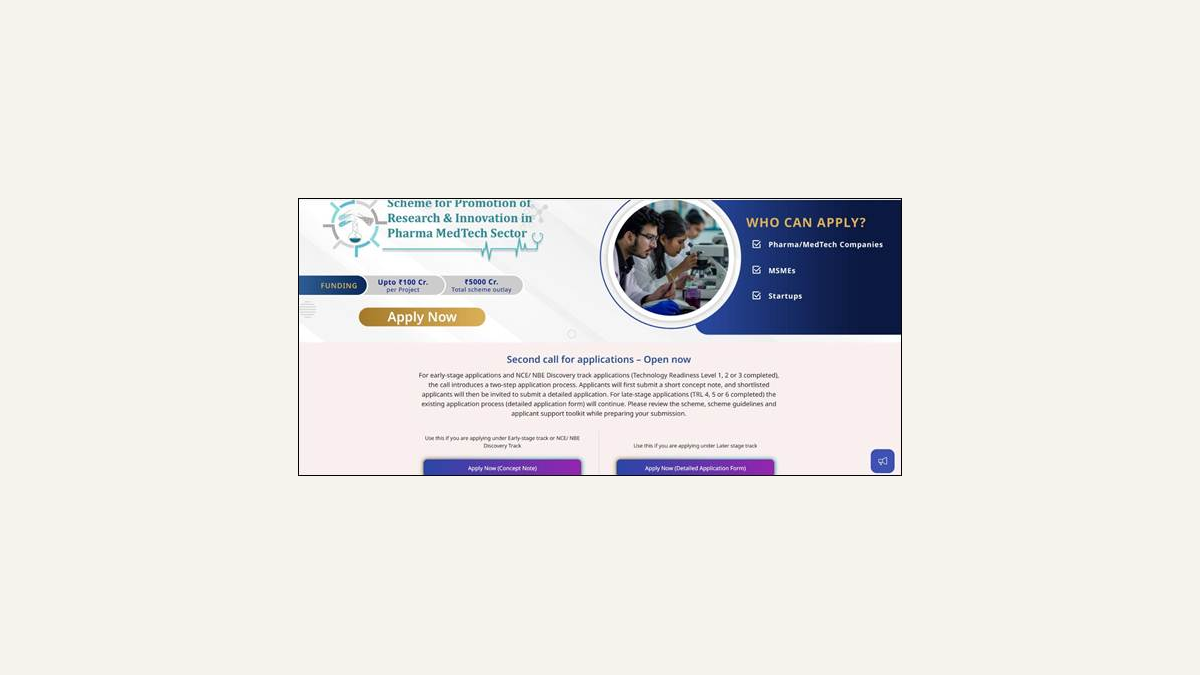
India's flagship programme for pharmaceutical and medical-technology R&D has made its first large round of awards. On 30 September 2026, the government announced that 41 projects have been approved under the first phase of the Promotion of Research and Innovation in Pharma MedTech Sector (PRIP) scheme, with about ₹1,600 crore in financial assistance.
The Department of Pharmaceuticals also opened a new discovery track for start-ups and MSMEs working on early-stage novel drugs. It offers up to ₹50 crore per company or project portfolio.
Who got funded
The sanctioned projects are expected to bring in another ₹3,020 crore of private investment, for a combined R&D investment of about ₹4,620 crore. In other words, the expected private contribution is almost twice the approved public assistance; it is not confirmation that all private funds have already been invested.
The portfolio breaks down as follows:
- By stage: 12 projects are at an initial stage and 29 at a later stage.
- By applicant: 19 projects come from start-ups and MSMEs, and 22 from large companies.
- By priority area: 27 projects are for new drugs, 5 for complex generics and biosimilars, and 9 for new medical devices.
Participants include established names such as Biocon, Bharat Biotech, Sun Pharma, Wockhardt, Zydus and Mankind Pharma. Younger, research-led companies including Pandorum Technologies, Celogen Therapeutics, Origin Oncology and Bugworks Research are also in the list. The government says the portfolio spans the innovation value chain, from new drug discovery through clinical development to new medical technologies.
A new track for very early discovery
The second announcement may matter more for India's deep-tech biotech start-ups. The discovery track is open exclusively to start-ups and MSMEs working on New Chemical Entities (NCEs) and New Biological Entities (NBEs) at Technology Readiness Levels 1 to 3. That is the earliest, riskiest stage of drug discovery, from basic concept to early proof of principle.
Key terms:
- financial assistance of up to ₹50 crore per company, project or portfolio of projects;
- a minimum 25% co-funding of project costs from bona fide institutional investors.
The co-funding rule is deliberate. It means public money follows professional investors' judgement instead of replacing it, which is intended to encourage commercial scrutiny alongside public support. It also gives venture investors a reason to back very early drug discovery, a stage Indian VCs have mostly avoided because the timelines and capital needs are long.
The scheme behind it
PRIP has a total outlay of ₹5,000 crore. Of this, ₹700 crore goes to Centres of Excellence at seven National Institutes of Pharmaceutical Education and Research (NIPERs), and ₹4,250 crore supports R&D investment by industry, start-ups and academia. The scheme's stated goal is to turn India into a global powerhouse for pharma and medtech R&D.
Why it matters
India is often called the "pharmacy of the world", but that title rests mainly on making high-quality, low-cost generics. The country has produced very few new drugs of its own. Research spending in the sector has stayed low compared with innovator-led industries in the US, Europe, Japan and, increasingly, China.
PRIP is the government's most direct attempt so far to change that. The first round signals three things:
- Large firms are moving up the value chain. Companies such as Biocon, Sun Pharma, Wockhardt and Zydus already run innovation programmes. Co-funding helps them take on more late-stage clinical risk in India.
- Start-ups are getting real weight. Nearly half the projects, 19 of 41, come from start-ups and MSMEs. Companies such as Bugworks (antibacterials) and Pandorum (regenerative medicine) represent the deep-science biotech that India needs to scale.
- Medtech is in scope. Nine device projects reflect the policy push to cut India's heavy dependence on imported medical equipment.
What to watch
The real test will be outcomes: how many of the 41 projects reach clinical milestones, regulatory filings or market approvals, and how fast. The discovery track's results will depend on whether enough institutional investors are willing to put in the 25% co-funding at TRL 1 to 3. If they are, PRIP could do more than fund individual projects. It could help build the early-stage biotech financing market that India has lacked.
Sources
The official new discovery track supports progression from TRL 1–3 to higher stages, up to TRL 6. Research funding is not regulatory approval or proof of clinical success.
Image: Department of Pharmaceuticals / PIB. Official PRIP second-call application graphic; published scheme illustration, not a photograph of an award-winning laboratory. Original source.