India's Home-Built 'Eye in the Sky' Clears Its Last Hurdle: Netra AEW&C Gets Final Operational Clearance
On 25 June 2026, DRDO handed the Indian Air Force the Final Operational Clearance for its indigenous Netra airborne early-warning system — capping a programme sanctioned back in 2004 and clearing the way to nearly triple India's AEW&C fleet.
A two-decade project crosses the finish line
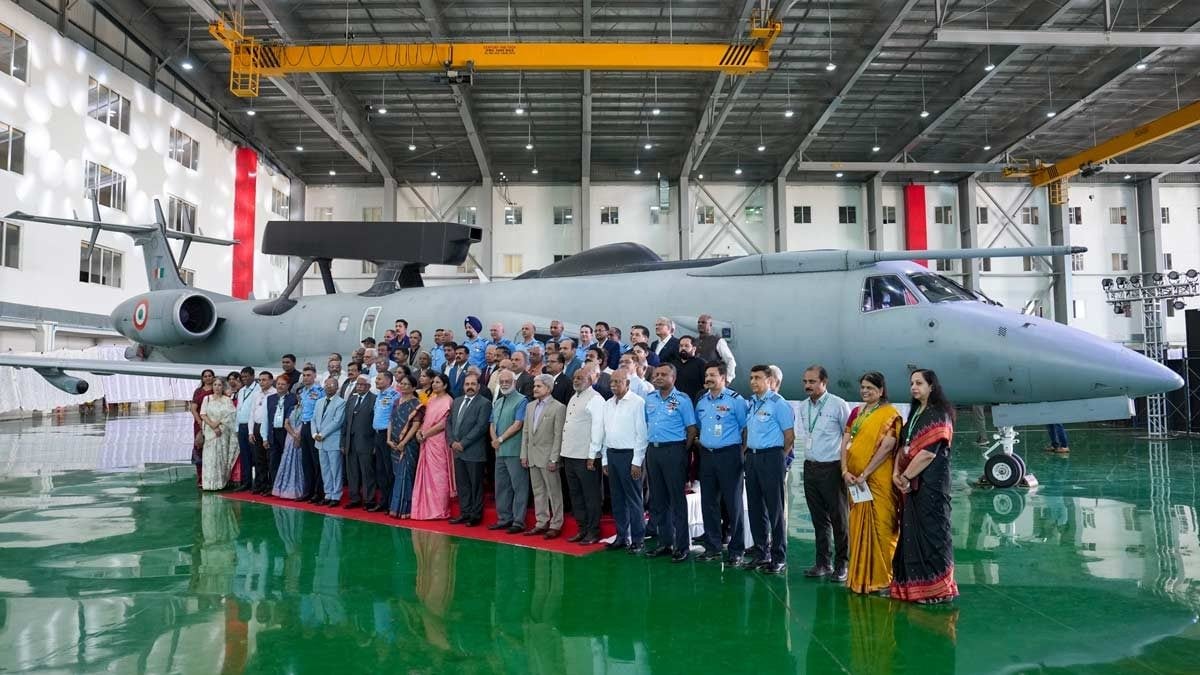
On 25 June 2026, at the Centre for Airborne Systems (CABS) in Bengaluru, the Defence Research and Development Organisation (DRDO) formally handed the Indian Air Force (IAF) the Final Operational Clearance (FOC) for the Netra Airborne Early Warning and Control (AEW&C) system. The certificate confirms that the platform is structurally sound, fully mission-capable and ready for combat operations — the last formal box a major defence system must tick before it is considered cleared for full operational exploitation.
The milestone caps a programme that the Cabinet Committee on Security first sanctioned in October 2004. More than two decades of design, systems integration, flight-testing and operational validation separate that approval from last week's ceremony, making the FOC as much a statement about institutional persistence as about technology.
What Netra actually is
Netra is India's indigenous "eye in the sky." Developed by DRDO's CABS, it mounts a home-grown active electronically scanned array (AESA) radar on a modified Embraer EMB-145I (ERJ-145) regional jet. The radar provides roughly 240-degree coverage, allowing the aircraft to detect and track airborne and surface targets across a wide swathe of airspace while acting as a flying command-and-control node — directing fighters, building a real-time air picture and coordinating responses to incoming threats.
The IAF currently flies three Netra Mk1 aircraft, inducted in 2015 and operated by No. 200 Squadron from Bhisiana Air Force Station near Bathinda, Punjab. Those aircraft have already seen high-intensity use, including during recent operations along India's western front.
Why "final" clearance matters
A defence platform typically earns an Initial Operational Clearance (IOC) once it is safe and good enough to begin limited service, then a Final Operational Clearance once every subsystem has been wrung out under the full envelope of operational conditions. FOC is the point at which the armed forces can deploy the system without caveats. For an indigenously developed sensor-and-software-heavy platform like Netra — where the radar, electronic-support measures, communication suite and mission software are all Indian — reaching FOC is a far harder bar than importing a finished system off the shelf.
A fleet about to grow
The clearance arrives just as India prepares to expand its airborne surveillance fleet significantly. Six new Netra Mk1A aircraft, also based on the Embraer platform, are planned with upgraded software and gallium-nitride-based transmit/receive modules for the radar. Beyond them sits the more ambitious Netra Mk2, which will be carried on larger Airbus A321 airframes and is designed to offer around 300-degree coverage with a nose-mounted antenna in addition to the dorsal array. Together, the Mk1A and Mk2 programmes are expected to nearly triple India's AEW&C fleet over the coming years — a direct response to the surveillance gap with China.
The strategic read
AEW&C aircraft are classic force multipliers: a single platform can extend an air force's radar horizon by hundreds of kilometres, spot low-flying intruders that ground radars miss, and turn a collection of individual fighters into a coordinated, networked force. Only a handful of countries design and build these systems themselves. With Netra's FOC, India consolidates its place in that small club and reduces its dependence on foreign AEW&C platforms at a moment when contested airspace on two fronts has made early warning a national priority.
At the Bengaluru ceremony, Defence Minister Rajnath Singh described the FOC as not only a technological milestone but a strategic advance in India's airborne surveillance and command-and-control capabilities. Air Marshal Awadhesh Kumar Bharti was the chief guest, with former Air Chief Marshal R.K.S. Bhadauria (Retd.) and former DRDO chairman Dr. S. Christopher among the guests of honour; Dr. K. Rajalakshmi Menon, DRDO's Director General (Aeronautics), and CABS Director P. Santhya led the technical proceedings.
Sources
- The Week — Netra AEW&C gets final operational clearance: what it means
- PIB / GlobalSecurity — IAF gets Final Operational Clearance of indigenous AEW&C 'Netra'
- India TV — Netra AEW&C receives final operational clearance
- Airforce Technology — IAF receives final clearance for Netra AEW&C system
- Wikipedia — DRDO AEW&CS (Netra)