
India Commissions Three Home-Built Warships in a Single Day at Kolkata
PM Modi commissioned three home-built warships — stealth frigate INS Dunagiri, survey ship INS Sanshodhak and anti-submarine craft INS Agray — into the Indian Navy in a single day at Kolkata, a marker of how much of the combat stack GRSE now builds in India.
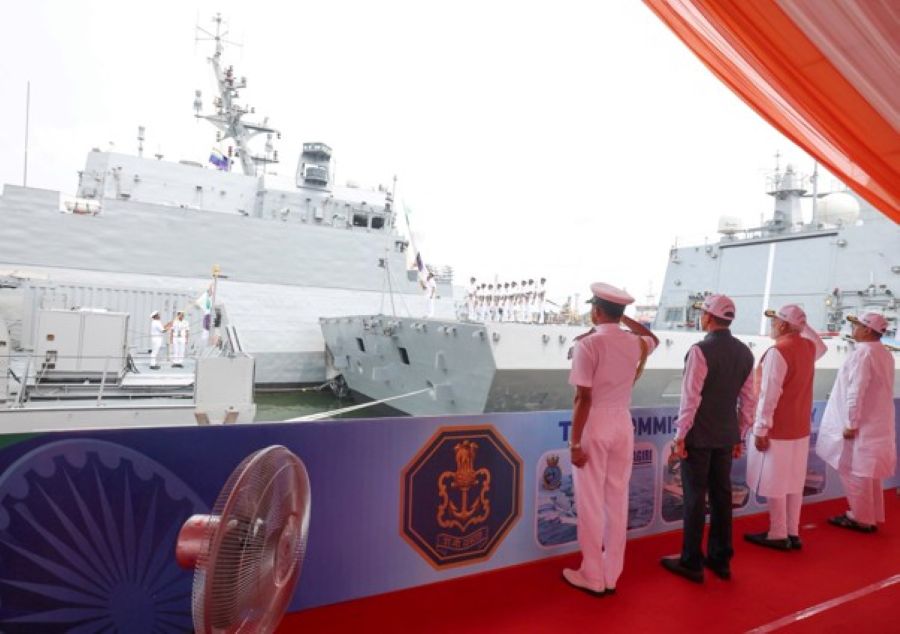
Three ships, one yard, one day
On June 21, 2026, Prime Minister Narendra Modi commissioned three indigenously built warships into the Indian Navy at a ceremony in Kolkata — INS Dunagiri, INS Sanshodhak and INS Agray. All three were designed by the Indian Navy's Warship Design Bureau and built by Garden Reach Shipbuilders & Engineers (GRSE), the Kolkata defence shipyard, and together they span three distinct missions: surface warfare, hydrographic survey and anti-submarine warfare.
Commissioning three surface vessels from a single shipbuilder on the same day is unusual, and the Navy framed it as a marker of how far India's warship-building base has matured.
What each ship brings
INS Dunagiri is a Project 17A (Nilgiri-class) stealth frigate — the Navy's most advanced indigenous frigate line, built around a reduced radar cross-section, modern sensors and a combat suite with a high share of Indian-made systems. Ships of the class are designed to carry supersonic anti-ship and land-attack missiles and to operate integrated air-defence and surveillance radars.
INS Sanshodhak is a Survey Vessel (Large) — a hydrographic and oceanographic ship fitted to map the seabed and coastal waters, support safe navigation, and contribute to maritime-domain awareness. Survey ships of this class are equipped to deploy autonomous and remotely operated underwater vehicles, extending how much ocean a single hull can chart.
INS Agray is an Anti-Submarine Warfare Shallow Water Craft (Arnala class), built to hunt submarines in the littoral — the crowded coastal waters where larger ships are less effective. It carries indigenous sonar, anti-submarine rockets and lightweight torpedoes tuned for shallow water.
Why a commissioning counts as a tech story
A warship is less a vessel than a floating systems-integration project: hull, propulsion, sensors, weapons, and the software that ties them together. The deep-tech significance of Project 17A and its companions is the share of that stack now designed and built in India — stealth hull engineering, combat-management software, sonar and radar, and underwater autonomy on the survey ships. Each indigenously delivered hull lowers the cost and risk of the next one and keeps the design talent employed between programmes.
GRSE's ability to hand over three different ship types at once also says something about throughput. India's naval expansion has long been constrained less by design than by how fast yards can build, fit out and trial complex combatants; a triple commissioning is, in part, a yard demonstrating that it can.
The context
India is in the middle of a sustained naval build-up driven by a more contested Indian Ocean and a growing regional naval presence around it. The Navy has said it wants to be a fully self-reliant force, and the mix on display in Kolkata — a frontline stealth frigate alongside specialised survey and anti-submarine craft — reflects a fleet trying to grow both its high end and the unglamorous workhorses around it, from domestic yards.
Sources
- https://www.theweek.in/news/defence/2026/06/21/pm-modi-commissions-3-navy-warships.html
- https://www.thestatesman.com/india/pm-modi-commissions-three-indigenous-naval-platforms-in-kolkata-boosting-indian-navys-maritime-strength-1503608286.html
- https://aninews.in/news/national/general-news/pm-modi-commissions-three-indigenous-naval-platforms-in-kolkata20260621102052/