Modi's Red Fort Blueprint Puts AI Skilling, Chips and Quantum at the Heart of Viksit Bharat
In his 2026 Independence Day address from the Red Fort, PM Modi placed AI, semiconductors, quantum and space at the centre of India's Viksit Bharat 2047 plan — pledging to train one crore youth in AI, adding seven to eight new chip plants and reaffirming a 100 GW nuclear target.
A technology-first Independence Day
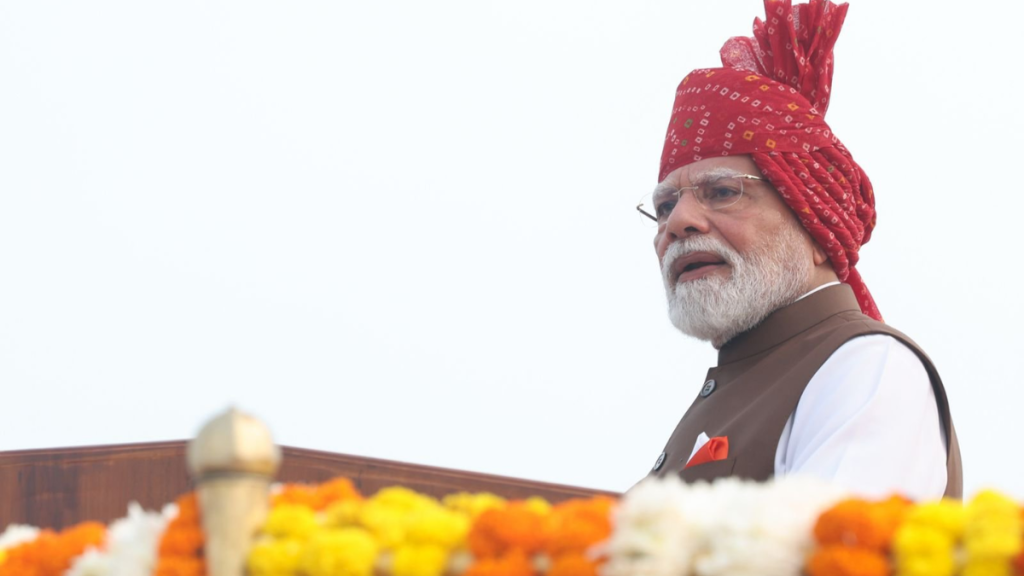
Prime Minister Narendra Modi devoted an unusually large share of his 2026 Independence Day address from the Red Fort to deep technology, framing artificial intelligence, semiconductors, quantum computing, robotics and space as the load-bearing pillars of a self-reliant, developed India by 2047. Delivered on 15 August 2026 — his 13th consecutive address from the ramparts of the 17th-century monument — the speech doubled as a progress report on missions the government has launched over the past two years and a set of fresh targets for the years ahead.
For a country that has spent the last decade building the scaffolding of a frontier-tech economy — a semiconductor mission, a quantum mission, an AI mission and a wave of space-sector reforms — the address read less like a ceremonial flourish and more like an attempt to knit those threads into a single national story.
One crore young Indians to be trained in AI
The headline commitment was a pledge to train one crore (10 million) young Indians in artificial intelligence over the coming year through a nationwide skilling programme. Modi tied the promise directly to the 2047 goal, arguing that a large, AI-fluent workforce is the engine India needs to convert its demographic weight into economic and technological leadership rather than remaining a back office for tools built elsewhere.
The AI push was paired with a plan for free online coaching for competitive examinations, a measure aimed at widening access to skilling beyond the metros. Taken together, the two announcements signal a bet that India's edge in the AI era will come as much from the breadth of its talent base as from any single model or chip.
Chips: three plants running, seven to eight more coming
On semiconductors, Modi said India expects seven to eight new plants to come up over the next one to two years, building on three facilities that are already in commercial production. Those three — Micron, Kaynes Semicon and CG Semi, all located at Sanand in Gujarat — focus on assembly, testing and packaging, and the prime minister noted that exports from Indian units have already begun.
The remarks land against the backdrop of Semicon 2.0, the roughly Rs 1.27 lakh crore expansion of the India Semiconductor Mission cleared earlier in 2026, which widens government support from fabrication and packaging into materials, equipment, display manufacturing, design and talent. The message to investors was continuity: the chip programme is not a one-off subsidy but a multi-year industrial commitment.
A call to lead in AI, quantum, robotics and space
Beyond the specific numbers, Modi set a broader ambition — that India should become a global innovation hub across emerging technologies including AI, robotics, quantum technology, space technology and data centres, rather than staying a consumer of systems designed abroad. The framing echoes a cluster of national missions already in motion: the IndiaAI Mission, the National Quantum Mission and the space-sector reforms channelled through IN-SPACe.
That ambition is not abstract. India has already stood up sovereign large language models, launched a 25-qubit indigenous quantum computer, and watched its first privately built rocket reach orbit — concrete proof points the prime minister could draw on to argue that the innovation-hub goal is within reach.
100 GW of nuclear power by 2047
Energy security featured prominently. Modi reiterated a target of 100 GW of nuclear power capacity by 2047 and said India aims to bring five new reactors into operation in the coming years. The nuclear pledge connects to the Nuclear Energy Mission and the government's push to develop indigenous small modular reactors, and it complements parallel bets on solar, green hydrogen and grid-scale storage as the country works to decarbonise while meeting fast-growing electricity demand.
Why it matters for India's deep-tech ecosystem
For founders, researchers and investors, the value of the address is less in any single figure than in the signal it sends about direction. A prime ministerial commitment to chips, AI skilling, quantum and nuclear — repeated from the country's most-watched podium — shapes procurement priorities, anchors private capital and reassures the long-horizon backers that deep tech depends on. It also raises the stakes: targets stated this publicly become benchmarks against which the government will be measured.
The harder questions remain execution ones — whether skilling translates into employable engineers, whether new fabs move up the value chain from packaging toward fabrication, and whether mission budgets survive contact with delivery timelines. But as a statement of intent, the 2026 address made clear that India intends to compete at the frontier rather than the periphery.
The road to 2047
With just over two decades to its centenary of independence, India has chosen to define "developed" partly in the language of deep tech. The Red Fort speech turned that choice into a checklist — millions trained in AI, a cluster of new chip plants, leadership ambitions in quantum and space, and a large nuclear build-out. The coming years will show how much of the blueprint becomes brick.
Sources
- Business Standard — Modi Independence Day: semiconductor plants, AI skilling, Red Fort speech
- Republic World — 10 key highlights from PM Modi's Independence Day speech
- The Logical Indian — PM Modi's six big Independence Day announcements
- Business Today — India to have more semiconductor plants in 7-8 yrs, says PM Modi
- Asianet Newsable — PM Modi's Red Fort speech on chips, 6G and AI