
ISRO Static-Fires a Redesigned SSLV Booster in a Push to Make the Small Rocket Cheaper
ISRO has ground-tested a redesigned first-stage solid booster for its Small Satellite Launch Vehicle, trimming the stage's mass and simplifying its manufacture as the agency prepares to hand the small rocket to private industry.
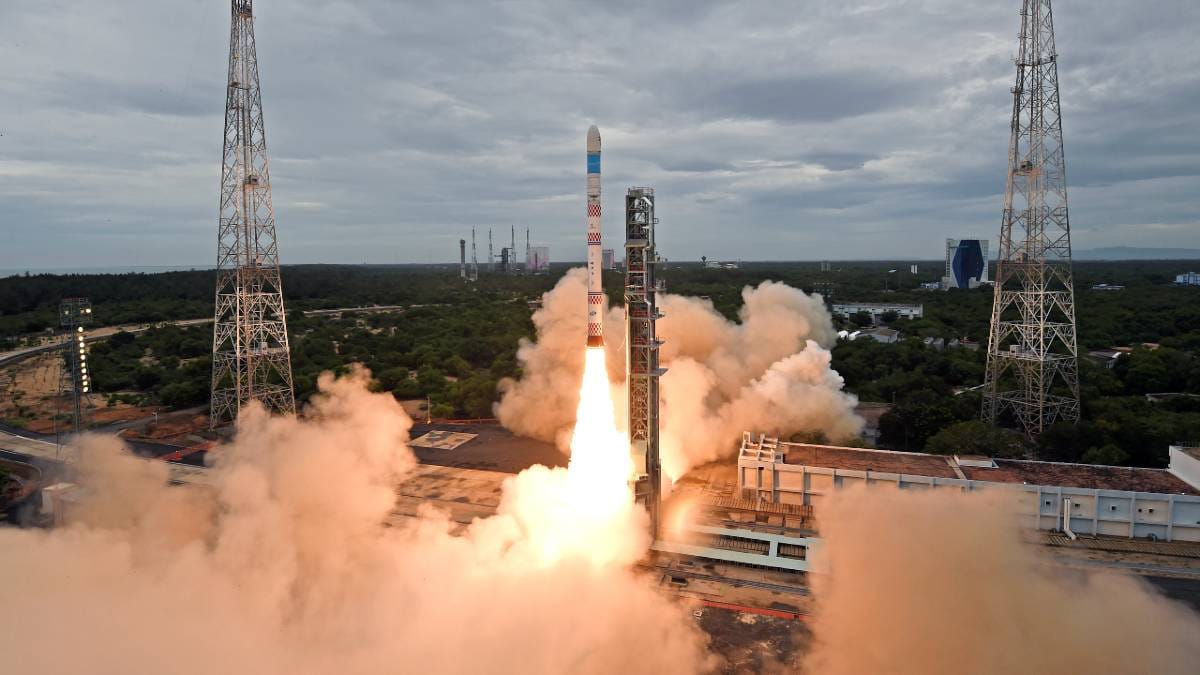
India's smallest rocket got a quiet but consequential upgrade this week. On 11 August 2026, the Indian Space Research Organisation (ISRO) successfully ground-tested a redesigned version of the first-stage solid booster of its Small Satellite Launch Vehicle (SSLV), firing the motor at the static test facility of the Satish Dhawan Space Centre in Sriharikota. The stage, designated SS1, is the largest of the SSLV's three solid segments, and the test was aimed squarely at a goal that rarely makes headlines but decides whether a launch vehicle survives commercially: delivering the same performance for less money and less mass.
A ground test built around 600-plus measurements
In a static test, the motor is bolted down and fired in place while sensors record how it behaves — there is no flight, only data. ISRO said the SS1 firing was monitored through more than 600 parameters, capturing ignition, internal ballistics, structural behaviour, thermal response, dynamic loads and acoustic performance. That density of instrumentation is the point. Before a redesigned stage is ever trusted to carry a customer's satellite, engineers need to confirm that every change behaves exactly as the models predicted, from the first millisecond of ignition to the pressure and vibration environment the rest of the rocket will have to tolerate.
What changed inside SS1
The improvements ISRO built into SS1 are incremental on paper and significant in practice. Two of the motor's segments were given an enhanced propellant burn rate, the thermal protection system was optimised, and the nozzle sub-system was refined through process changes. Taken together, the agency says the modifications make the stage more production-friendly while also cutting its mass.
Both aims feed the same objective. A lighter first stage means more of the rocket's total energy can go toward payload rather than lifting the vehicle's own structure. And a stage that is easier to manufacture — with fewer bespoke steps and more repeatable processes — is one that can be built faster, in greater numbers, and at lower cost. For a vehicle whose entire pitch is cheap, on-demand access to orbit, those are not cosmetic gains.
Why a cheaper first stage matters
The SSLV was designed to lift payloads of up to roughly 500 kilograms into low-Earth orbit, filling the gap between ISRO's larger workhorses and the swelling global demand for small-satellite launches. In that market the competition is not primarily about raw capability; it is about price, turnaround and the ability to launch on a customer's schedule rather than the agency's. Every kilogram shaved from inert mass and every rupee taken out of the build translates fairly directly into a more competitive quote.
Solid stages are particularly attractive here because they are relatively simple to store, handle and integrate compared with cryogenic or liquid systems. Refining the biggest solid stage of the vehicle is therefore one of the highest-leverage places ISRO can work if it wants the SSLV to be genuinely commercial rather than merely operational.
From development flights to a private product
The SSLV reached this point the hard way. Its first developmental flight in August 2022 failed to place its satellites in a usable orbit, but the vehicle recovered with the successful missions that followed, and ISRO has since moved to hand the design to Indian industry so the state agency can concentrate on larger and more complex rockets. The plan is for the private sector to build and eventually operate SSLVs at scale, with ISRO's role shifting from manufacturer to technology source and mentor.
That transition is what makes an unglamorous booster test strategically interesting. A production partner inheriting the SSLV will want a design that is stable, well-characterised and economical to build — not a research article that changes with every flight. By retiring mass and simplifying manufacture at the stage level now, and proving the changes on the ground before they ever fly, ISRO is effectively de-risking the vehicle it intends to pass on. The 11 August firing is a step in turning the SSLV from a hard-won national capability into a product someone else can sell.
The improved SS1 will still have to prove itself in flight before the changes become standard. But ground tests like this one are where the economics of a launch vehicle are quietly decided, long before a countdown clock ever appears on a screen.
Sources
- ISRO, "Ground testing of Solid Booster Stage (SS1) for Small Satellite Launch Vehicle (SSLV)" — https://www.isro.gov.in/SS1.html
- Indian Defence News, "ISRO Successfully Tests Improved SSLV First Stage Solid Booster" — https://www.indiandefensenews.in/2026/08/isro-successfully-tests-improved-sslv.html
- Wikipedia, "List of SSLV launches" — https://en.wikipedia.org/wiki/List_of_SSLV_launches