India and UK Move to Seal an Electric-Propulsion Pact for the Navy's Next Landing Ships
India and the UK are close to signing twin agreements — one for electric propulsion on four new Navy landing ships, another for Martlet missile production — deepening a defence-industrial partnership that dates back to 2024.
Manik Gupta
Founder and editor of DeepTech India. Manik writes about India's frontier technology ecosystem — AI, semiconductors, space, quantum, robotics and biotech — translating research and policy into clear, reliable reporting.
Two Agreements, One Signing
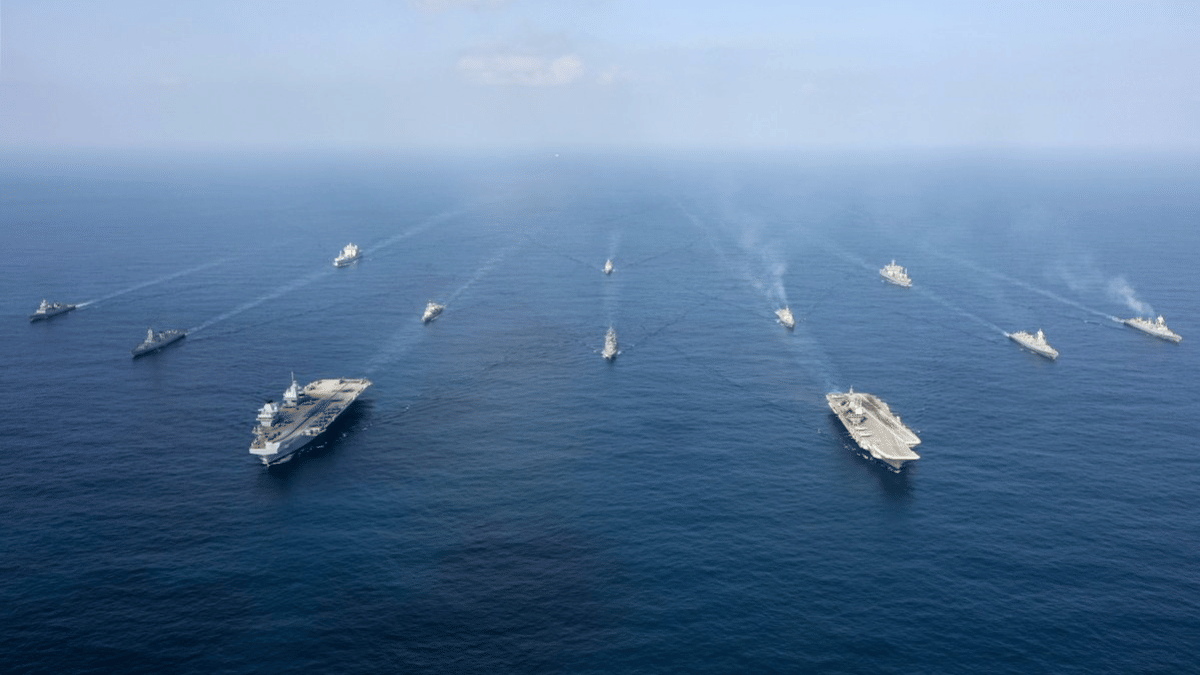
India and the United Kingdom are set to sign two inter-governmental agreements that would deepen defence-industrial cooperation between the two countries, according to reports from early September 2026. The first covers the design and development of Integrated Full Electric Propulsion (IFEP) systems for the Indian Navy's next-generation Landing Platform Docks (LPDs). The second covers production of the Martlet Lightweight Multirole Missile (LMM) for the Indian Army.
What's an LPD, and Why Electric Propulsion
Landing Platform Docks are large amphibious ships — floating bases, in effect — that carry troops, vehicles, helicopters and landing craft, and can flood part of their own hull to launch that equipment directly into the water near a coastline. They're used for amphibious assault, disaster relief and humanitarian response, where a navy needs to move large numbers of people and equipment ashore without a port.
India's navy currently operates exactly one such ship, INS Jalashwa — originally built as the USS Trenton and acquired secondhand from the US Navy in 2007 — and has been working for years toward acquiring purpose-built replacements. The LPD programme now moving forward calls for four new ships, each roughly 220 metres long and displacing around 29,000 tonnes, large enough to carry close to 900 troops along with their vehicles and equipment. A separate tender for construction of the ships themselves is already underway, expected to be built at an Indian shipyard.
The IFEP agreement specifically covers the electric propulsion systems for those four ships — a technology that replaces conventional mechanical drivetrains with electric motors fed by onboard generators, giving a ship more flexible power distribution, quieter operation, and the ability to route power between propulsion and other systems, such as weapons or sensors, as needed. If the ships proceed with IFEP, they would become India's first large naval platforms to run on fully electric propulsion.
Who Builds What
The IFEP pact leans on British expertise while building indigenous manufacturing capability in India: GE Vernova, headquartered in Rugby, UK, is partnering with the state-run Bharat Heavy Electricals Limited (BHEL) to establish what would be India's first maritime Land-Based Testing Facility for full electric propulsion systems — a shore-based rig used to test and validate propulsion systems before they're installed on an actual ship. That combination — a UK technology partner working alongside an Indian state-owned heavy-electricals manufacturer — mirrors the broader "Make in India" template India has pushed across most of its recent defence-technology agreements, prioritising technology transfer and local manufacturing over straightforward equipment purchases.
The Second Deal: A Belfast-Built Missile
The Martlet agreement covers production of the Lightweight Multirole Missile for the Indian Army — a compact, precision-guided weapon manufactured by Thales in Belfast that uses laser beam-riding guidance and can be fired from helicopters, ground vehicles, naval vessels, or man-portable launchers. Its versatility across platforms is the main selling point: a single missile type that can equip multiple branches of the armed forces reduces the logistics and training burden compared with maintaining separate weapon systems for each role.
Building on a 2024 Foundation
Neither agreement is coming out of nowhere. The two governments signed a Statement of Intent on cooperation around electric propulsion systems for the Indian Navy in November 2024, laying the diplomatic and technical groundwork for what is now expected to become a binding inter-government agreement. That pattern — a Statement of Intent followed, roughly two years later, by a formal agreement — reflects how slowly major defence-industrial partnerships typically move even between close strategic partners, as both sides work through technology-transfer terms, cost-sharing, and industrial-participation commitments before committing to a binding deal.
Part of a Broader India-UK Push
The IFEP and Martlet agreements are expected to be finalised alongside a wider set of India-UK defence-technology discussions this week, reflecting a broader deepening of the bilateral relationship that has picked up pace over the past two years, spanning missiles, propulsion, and, in earlier announcements, jet-engine cooperation. For the UK, the deals offer defence-industrial firms like GE Vernova and Thales continued access to India's large and growing defence-procurement budget. For India, they extend a now-familiar strategy: use foreign technology partnerships to build capability that stays in the country — in this case, at BHEL's new testing facility and whichever Indian shipyard eventually builds the LPDs — rather than simply buying finished ships or missiles off a foreign production line.
Formal signing was expected imminently as of the most recent reporting, with construction of the LPDs themselves still pending the outcome of a separate, ongoing tender.
Sources
- https://theprint.in/defence/india-uk-set-to-ink-inter-government-pact-for-electric-propulsion-of-4-landing-platform-docks/3025596/
- https://thediplomat.com/2026/08/india-uk-fire-up-defense-cooperation-with-joint-development/
- https://ianslive.in/india-uk-cement-ties-for-production-of-military-hardware--20260901154503
- https://www.navylookout.com/britain-to-supply-integrated-electric-propulsion-systems-for-indian-navy-lpd-programme/
Tags
More from DefenceTech
DRDO Invites Bids for an Indigenous Air-to-Air Refuelling Pod, Targeting a Gap Russian Tankers Can't Fill
DRDO has opened bidding under its Technology Development Fund for an indigenous, modular Air-to-Air Refuelling Pod, aiming to reduce the Air Force's dependence on its serviceability-plagued Il-78 tanker fleet.
Bharat Forge's Kalyani Strategic Systems Signs With Thales to Build 70mm Rockets in India
KSSL, the defence arm of Bharat Forge, has signed a strategic alliance with Belgium's Thales to locally produce combat-proven 70mm rocket systems, part of a ten-agreement India-Belgium defence package signed during a state visit.