
IG Defence Test-Fires Rocket Motors for JWALA, a Private Indian Micro-Missile Built to Kill Drones
Private defence firm IG Defence has successfully test-fired two solid rocket motors for JWALA, a low-cost micro-missile it is developing as the hard-kill layer of a counter-drone system.
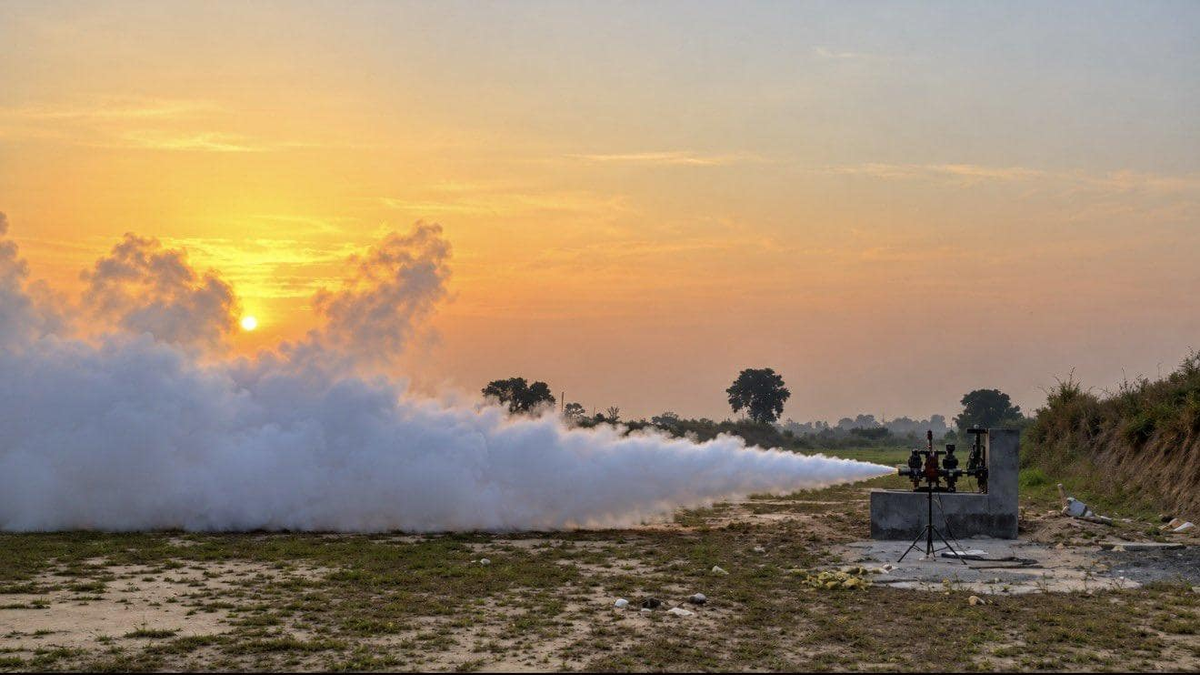
Private defence-technology company IG Defence has test-fired two solid rocket motors for JWALA, the micro-missile it is developing as a low-cost, hard-kill answer to hostile drones. The result was reported on 3 October 2026, with the company calling it a key milestone in what it describes as India's first privately developed micro-missile programme for counter-unmanned aircraft systems (counter-UAS).
A rocket motor test is an early step, not a finished weapon. But it marks a private Indian firm moving into missile propulsion — a field long dominated by DRDO and defence public sector undertakings — and it targets one of the most pressing problems in modern air defence: how to shoot down cheap drones without spending expensive missiles on each one.
What was tested
According to the company, the two solid rocket motors were fired successfully in the early hours of the test day. IG Defence said the test is an important step in developing indigenous propulsion, interceptor and counter-UAS technologies, and that further testing and system-level development will follow as JWALA moves towards greater maturity, reliability, manufacturability and scalability.
The company has not released thrust, burn-time or other performance data from the test.
What JWALA is meant to do
IG Defence describes JWALA MK1 as a short-range surface-to-air missile intended primarily for air defence against UAVs, with:
- an engagement range of 2–5 km;
- an altitude envelope of 50 m to 5,000 m; and
- a role as the "hard-kill" layer within a broader counter-drone system.
That system also includes the company's GRID command-and-coordination layer. "JWALA becomes the hard-kill effect, while GRID provides the brain that coordinates the mission," said Bodhisattwa Sanghapriya, founder and CEO of IG Defence.
Business Standard reports that the company demonstrated T-SHUL BEAM, a separate soft-kill system using GRID, at Dronathon 2026 in Pokhran.
The cost-exchange problem
The case for a micro-missile is economic. Recent conflicts — including India's own experience during Operation Sindoor — have shown that adversaries can launch large numbers of inexpensive drones. Shooting them down with conventional surface-to-air missiles works, but each interceptor can cost many times more than its target. Jammers and other soft-kill systems are cheaper, but increasingly capable drones can be hardened against jamming or fly pre-programmed routes.
A small, mass-producible interceptor fills the gap between guns, jammers and full-size missiles. It is the same logic that has driven a wave of counter-drone interceptor programmes worldwide. For India, the attraction is a domestic supply chain: interceptors that can be built in volume at home, without dependence on imported components during a crisis.
Who is IG Defence
IG Defence also develops electronic counter-UAS systems, including T-SHUL BEAM. JWALA gives the firm a hard-kill complement to those soft-kill products — a layered approach that most modern counter-drone architectures now follow.
Why it matters
The JWALA test fits a broader shift in Indian defence: private companies taking on core technologies, from engines to seekers to propulsion, that were once the preserve of government laboratories. The Defence Ministry has been encouraging that shift through procurement reforms and faster emergency buys for drones and counter-drone systems.
The road ahead is long. JWALA still needs guided flight tests, seeker and fuze integration, live intercepts and user trials before it can be inducted. But a working solid rocket motor is the foundation every missile is built on, and a private Indian firm now has one of its own.
Sources
Image: IG Defence rocket-motor test image carried by Business Standard in its 3 October 2026 JWALA report. Ground propulsion test; not an airborne interception. Original source.