
ideaForge Launches ZOLT Hybrid and ZOLT UCAV, Moving Into Long-Range Surveillance and Combat Drones
The Mumbai drone maker's two new ZOLT variants offer more than six hours of hybrid endurance and a battery-powered strike version, both built on an anti-jam, GNSS-denied navigation stack.
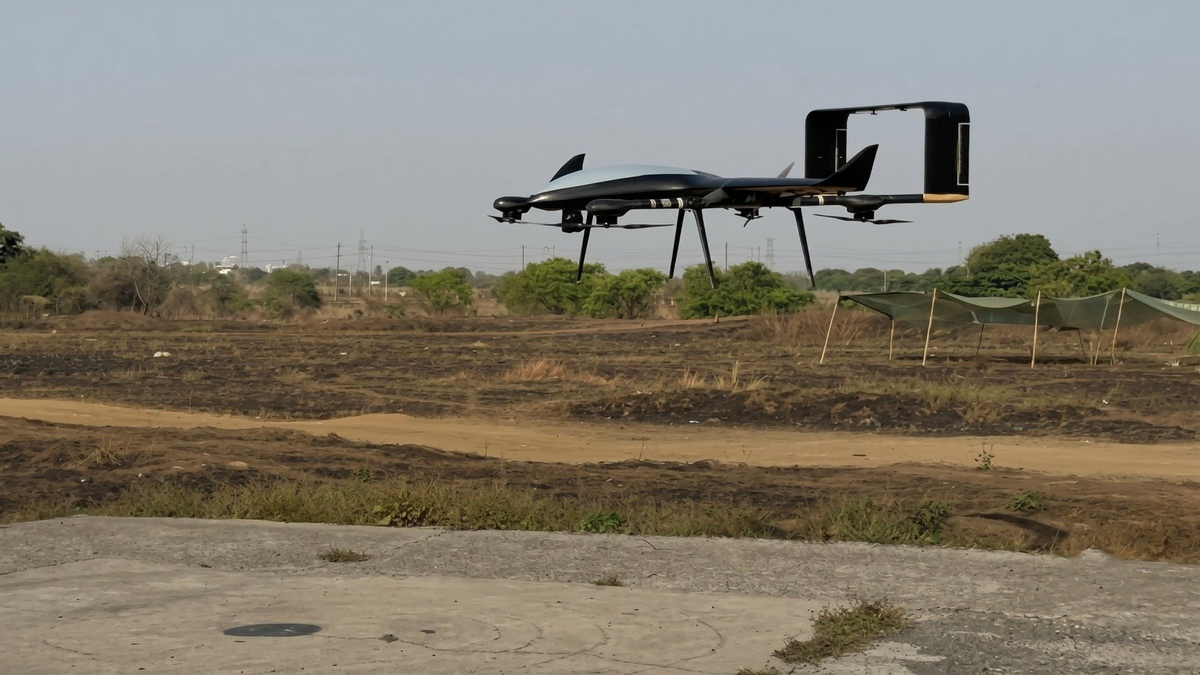
ideaForge Technology, the Mumbai-based drone maker best known for small surveillance quadcopters used by Indian security forces, has launched two new versions of its ZOLT tactical UAV platform. With them it moves into two segments where it has not competed before: long-range intelligence, surveillance and reconnaissance (ISR), and unmanned combat aerial vehicles (UCAVs). The company announced the ZOLT Hybrid and the ZOLT UCAV on 6 October 2026.
Two variants, two missions
ZOLT Hybrid is built for extended missions and persistent overwatch. It pairs an internal combustion engine with battery power, a hybrid layout that trades some simplicity for much longer time in the air. ideaForge lists:
- more than 6 hours of endurance;
- line-of-sight data transmission of up to 100 km;
- a launch altitude of up to 2,000 m above mean sea level.
ZOLT UCAV is a battery-powered variant built for tactical missions and "precision effects", the industry term for delivering munitions. Its listed specifications are:
- 2–3 hours of endurance;
- 30–50 km line-of-sight transmission;
- a launch altitude of up to 4,500 m AMSL, which covers much of the high-altitude terrain along India's northern borders.
ideaForge says a high-altitude version of the ZOLT Hybrid, with a launch altitude of up to 4,000 m AMSL, will follow soon, for operations in contested terrain.
The electronic-warfare problem
The common core of both variants is what ideaForge calls its indigenous EW-resilient technology stack. These are company capability claims, not independently verified results from contested-environment trials. It is built around three capabilities:
- anti-jam communications, to keep the control and video link alive under jamming;
- GNSS-denied navigation, to keep flying accurately when GPS and other satellite signals are spoofed or blocked;
- onboard intelligence, to process data and make some decisions on the aircraft rather than relying entirely on the ground link.
That focus is no accident. Recent conflicts, from Ukraine to India's own operations along its western border, have shown that drones that depend on clean satellite navigation and uncontested radio links are quickly neutralised by electronic warfare. Militaries now treat resilience to jamming and spoofing as a baseline requirement, not an add-on.
From quadcopters to combat drones
ideaForge built its business on small vertical take-off drones for surveillance, such as its SWITCH and Q-series platforms, and became one of India's first listed drone companies. The ZOLT platform, unveiled at Aero India 2025, was its step up to a larger, multi-role tactical UAV. The Indian Army has since placed orders for ZOLT, and the drone was showcased in the Republic Day Parade in January 2026.
The new variants extend the ZOLT family in two directions: longer endurance for surveillance, and armed missions for strike. That brings ideaForge into a crowded and fast-growing segment in India, where established defence companies and newer startups are all developing loitering munitions and armed drones, spurred by emergency procurement and a policy preference for domestic suppliers.
Hybrid versus battery
The split between the two variants reflects a basic engineering trade-off. Battery-electric drones are quiet, have low heat signatures and are simple to maintain, but energy density limits how long they can stay up. Combining combustion-engine and battery power can extend endurance and support longer surveillance missions, at the cost of noise, heat and more complex maintenance. Choosing battery power for the strike-focused UCAV and hybrid power for the surveillance variant matches each design to its mission profile.
Why it matters
For India's armed forces, a domestic supply of jam-resistant ISR and strike drones reduces dependence on imports and allows faster upgrades as electronic-warfare threats evolve. For ideaForge, which has faced uneven order flow, a broader product range opens up larger contracts.
The real test will be in user trials. Endurance, link range and high-altitude performance quoted on specification sheets must hold up in Himalayan cold, thin air and heavy jamming. Watch for Army trial results, the timing of the high-altitude Hybrid, and any first orders for the UCAV variant.