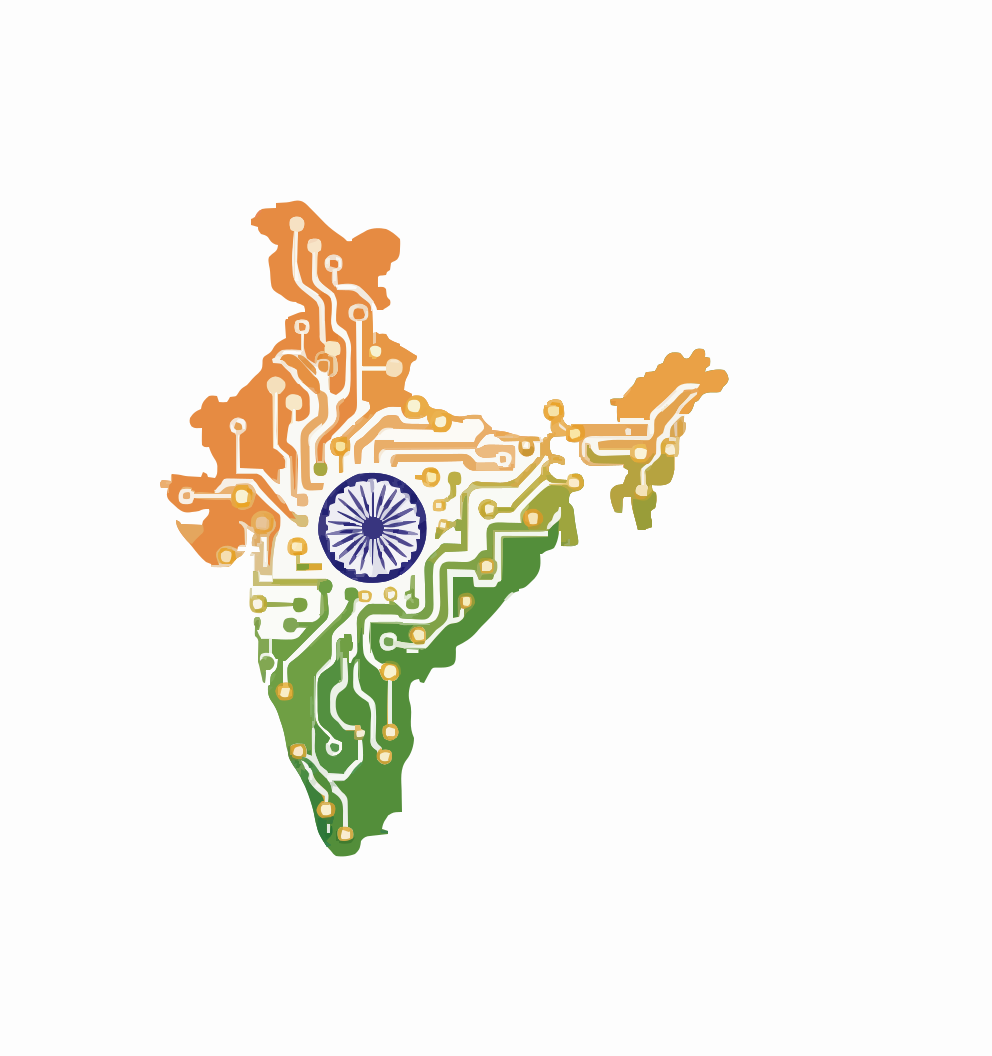
Gnani.ai Launches 'Artha', a Sovereign AI Stack Built on an 11-Language Model
Vice President C.P. Radhakrishnan unveiled Gnani Artha, pairing the 30-billion-parameter Evon 3.3 language model with the Plexus agentic platform for Indian enterprises and public institutions.
Manik Gupta
Founder and editor of DeepTech India. Manik writes about India's frontier technology ecosystem — AI, semiconductors, space, quantum, robotics and biotech — translating research and policy into clear, reliable reporting.

A Sovereign AI Stack, Launched From Rashtrapati Bhavan
Vice President C.P. Radhakrishnan launched "Gnani Artha" at his official residence in New Delhi on August 28, 2026 — an end-to-end AI stack built by Bengaluru-based Gnani.ai and pitched explicitly as a "sovereign" alternative for Indian enterprises and public institutions, rather than another wrapper around a foreign foundation model.
Artha is built from two components. Evon 3.3 is a 30-billion-parameter open-weight large language model trained natively across 11 Indian languages — not translated or fine-tuned after the fact, but trained on multilingual data from the outset. Plexus is Gnani.ai's agentic AI platform, designed to connect that underlying model intelligence to real institutional workflows: the layer that turns a language model's outputs into actions inside an actual business or government process.
Why "Sovereign" Is the Operative Word
The sovereignty framing matters because it's doing real work, not just marketing. Most large language models used by Indian enterprises today are either foreign-built and English-first, or are fine-tuned versions of foreign base models adapted after the fact for Indian languages — an approach that tends to carry over both the biases and the computational assumptions of the original training data. Evon 3.3's native multilingual training across 11 Indian languages is a bet that starting from Indian linguistic diversity as a first-class design constraint, rather than retrofitting it, produces meaningfully better performance for the country's actual user base.
Speaking at the launch, Radhakrishnan framed Gnani Artha as evidence that Indian engineers can move beyond deploying frontier AI tools built elsewhere to building them domestically, describing it as part of a larger national push toward technological self-reliance in AI.
Where It Fits in India's Crowded Sovereign-AI Field
Gnani Artha lands in an increasingly busy field. The IndiaAI Mission has already backed 20 home-grown foundation model proposals — a mix of 12 large multimodal models and 8 small language models — selected from 506 applications. Sarvam AI has raised significant capital toward building a trillion-parameter model from scratch and unveiled a dozen products at its own Epoch 2026 event. BharatGen has pursued a portfolio approach across several sovereign-model bets. HCLTech and Sarvam are separately building a large sovereign AI data centre in Odisha to house exactly this kind of compute-intensive work.
What differentiates Gnani.ai's entry is less the underlying model — a 30-billion-parameter model is comparatively modest next to some of India's other sovereign-AI efforts — and more the Plexus agentic layer sitting on top of it, aimed squarely at enterprise and government deployment rather than being positioned as a general-purpose consumer chatbot or a research showcase.
Gnani.ai's Existing Track Record
Gnani.ai was not a newcomer before this launch. The company, self-described as "the frontier voice AI company for enterprise," has built its business around voice AI for enterprise call-centre and customer-engagement use cases, and is listed among startups recognised by IndiaAI's own startup ecosystem tracker. That existing enterprise-voice business gives Artha a plausible early customer base — companies that already use Gnani.ai's voice products are a natural first market for a broader sovereign AI stack, rather than the company needing to build enterprise trust and a model from a standing start simultaneously.
What to Watch
The real test for Gnani Artha won't be the Delhi launch event but adoption: whether Indian enterprises and public institutions actually choose an 11-language, 30-billion-parameter sovereign stack from a mid-sized Bengaluru company over either a global foundation model or one of the better-funded sovereign efforts competing for the same government and enterprise budgets. With IndiaAI Mission compute now exceeding 38,000 subsidised GPUs and multiple sovereign-model efforts racing for the same customers, Gnani Artha's near-term path depends less on Evon 3.3's benchmark scores than on Plexus proving it can get an AI system embedded and trusted inside real institutional workflows faster than its rivals.
Sources
Tags
More from Artificial Intelligence
AMD Partners With Delhi University to Train 10,000 Students in AI and ROCm
AMD has signed an MoU with the University of Delhi to train about 10,000 students on its open-source ROCm AI platform over the next year, extending its push to build developer loyalty in India.
Adobe Acquires Rilo, an IIT Bombay-Founded AI Agents Startup, Less Than a Year After Launch
Adobe has acquired Bengaluru-founded AI agents startup Rilo, less than a year after two IIT Bombay alumni launched it, in a deal that folds Rilo's six-person team and technology into Adobe's marketing suite.