DRDO Re-Validates Fourth-Generation VSHORADS, India's Hit-to-Kill Answer to the Drone Age
Three back-to-back hits at Chandipur on 27 February 2026 — against approaching, receding and crossing targets — moved DRDO's man-portable air defence missile toward production clearance, as India races to replace Soviet-era Iglas and counter the low, slow drone threat exposed during Operation Sindoor.
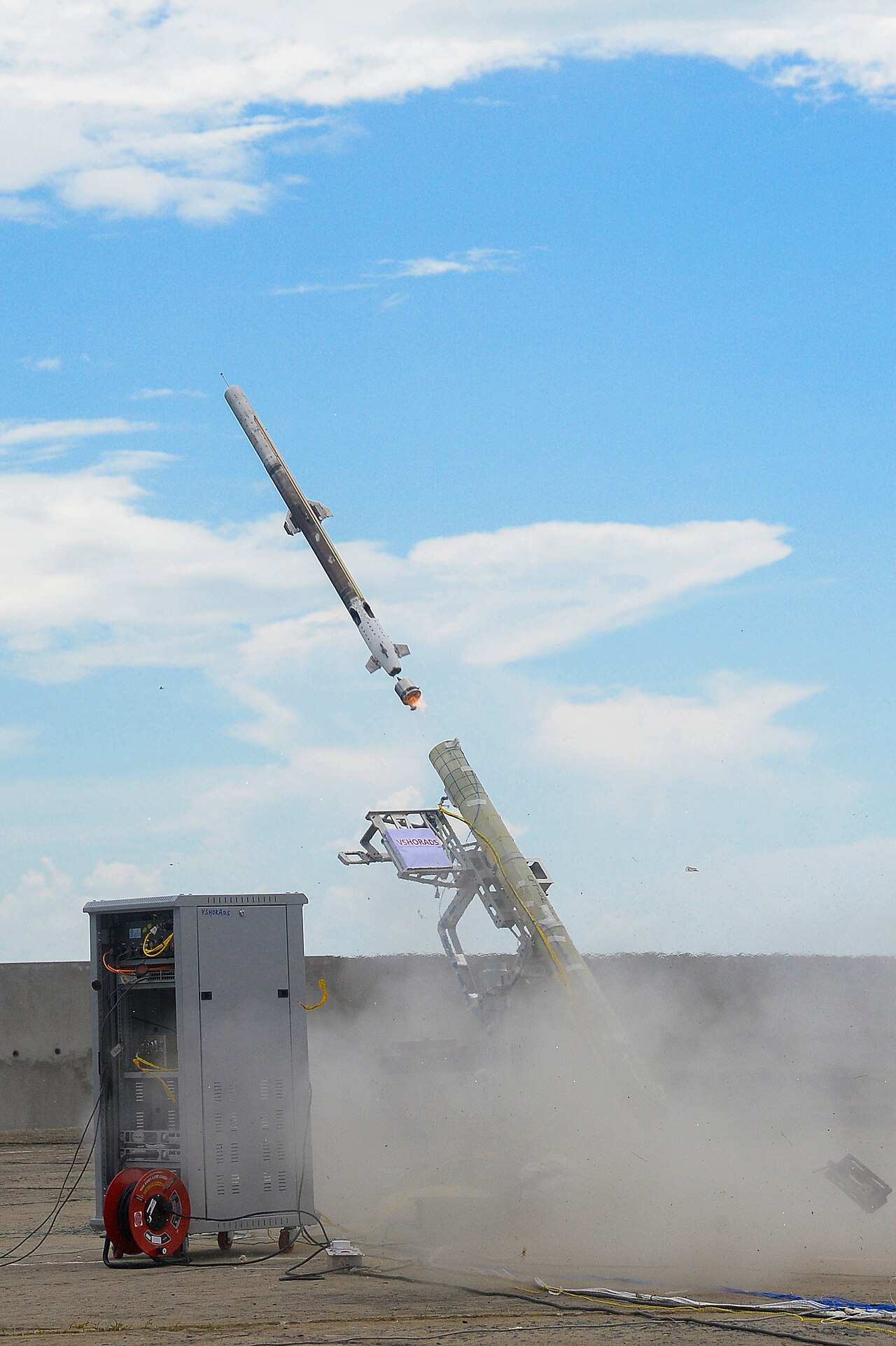
On 27 February 2026, DRDO fired three Very Short-Range Air Defence System (VSHORADS) missiles in quick succession from the Integrated Test Range at Chandipur, off the Odisha coast. All three intercepted and destroyed their targets across the hardest geometries an air-defence missile faces — approaching, receding and crossing engagements — in a campaign the Ministry of Defence described as re-validating the weapon's repeatable hit-to-kill performance.
What VSHORADS is
VSHORADS is a fourth-generation, shoulder-fired man-portable air-defence missile (MANPADS) developed primarily by DRDO's Research Centre Imarat (RCI) in Hyderabad. A dual-thrust solid rocket motor gives it the acceleration to chase fast, maneuvering targets; a miniaturised imaging infrared seeker and a reaction-control system let it steer onto the target body for a kinetic "hit-to-kill" intercept rather than relying solely on a proximity-fused blast. It is light enough for a two-soldier team to carry and shoot.
Why this trial matters now
Two pressures converge on this programme.
First, obsolescence. India's frontline MANPADS capability still leans heavily on the ageing Russian Igla family. A modern, indigenous replacement removes a supply-chain dependency that the war in Ukraine made painfully concrete, and gives forward troops along the LAC and LoC a weapon designed against today's threat set.
Second, the drone problem. Operation Sindoor in May 2025 showed how saturation attacks by cheap drones and loitering munitions can probe a layered air defence. VSHORADS sits at the bottom rung of that layered shield — the last-ditch, point-defence weapon that infantry, mechanised columns and forward bases carry with them. Its imaging seeker is meant to discriminate and kill small, low, slow targets that older infrared seekers struggle to acquire.
From trial to troops
The significance of three consecutive successes is industrial, not just technical: regulators and the armed forces look for repeatability before clearing a missile for series production. With user-association trials maturing, the system is moving toward production clearance during 2026, with Indian industry partners lined up to manufacture the missile and its launch units at scale.
For investors, VSHORADS is a textbook import-substitution story attached to a structurally growing market. Air-defence spending is rising worldwide precisely because the threat has democratised — a ₹2-lakh quadcopter can now force the use of multi-crore interceptors. Nations that can produce affordable, sovereign, short-range effectors will hold pricing power. India is positioning to be one of them, and an export-cleared VSHORADS would compete in a segment dominated by a handful of Western and Russian systems.
The open questions
Cost-per-shot and production throughput are the metrics to watch. A hit-to-kill MANPADS is harder and pricier to build than a proximity-fused one; the programme's success will hinge on holding unit economics down while ramping volume. Pairing VSHORADS with cheaper soft-kill and directed-energy options — the kind of layered, cost-balanced architecture the drone era demands — is the logical next step.