Dhruva Space's LEAP-2 Reaches Orbit Carrying a French Star Tracker on India's P-30 Satellite Platform
Launched on SpaceX's Transporter-18, Dhruva Space's second commercial P-30 mission is testing Sodern's HORUS star tracker in orbit alongside a SatLeo thermal payload and an in-house ship-tracking receiver.
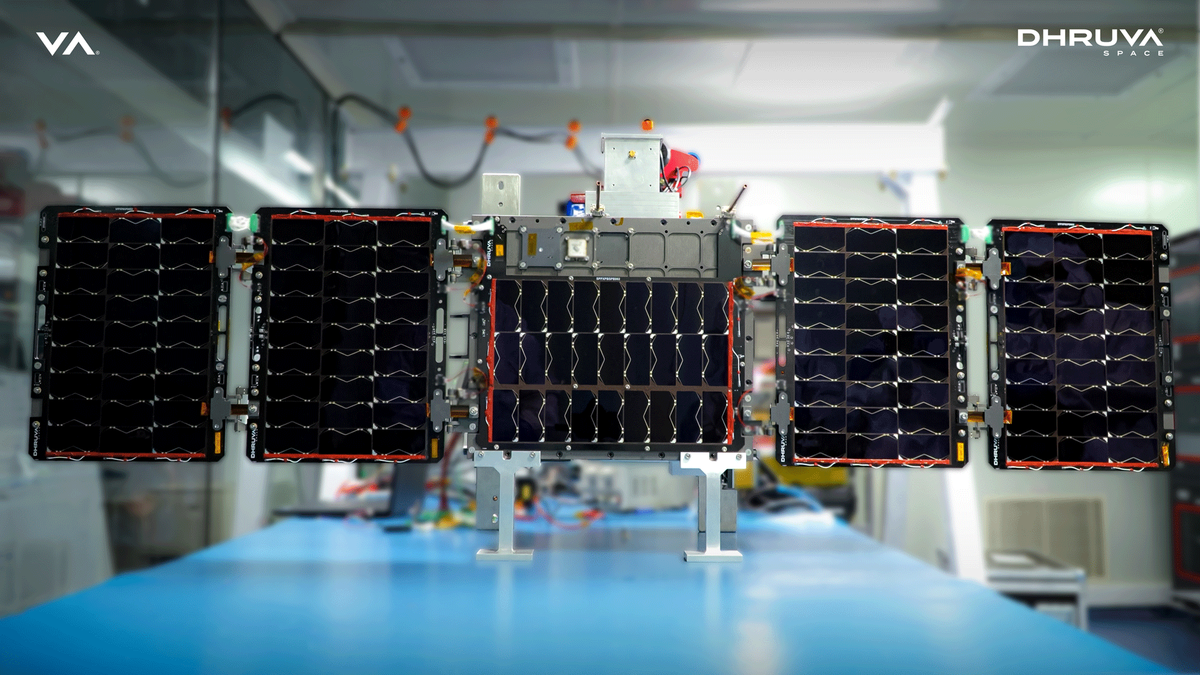
Hyderabad-based Dhruva Space has put its second commercial satellite on its P-30 platform into orbit, and this one carries more than an Indian startup's ambitions. The LEAP-2 mission, which launched on SpaceX's Transporter-18 rideshare, is flying an in-orbit demonstration of HORUS, a star tracker built by France's Sodern, an ArianeGroup company. Alongside it ride a thermal-imaging payload from another Indian startup and Dhruva's own ship-tracking receiver.
The launch
Transporter-18 lifted off on a Falcon 9 from Space Launch Complex 4E at Vandenberg Space Force Base, California, at 12:02 AM IST on 2 October 2026. According to Dhruva Space, LEAP-2 was successfully deployed into orbit at 1:00 AM IST. The rideshare carried roughly 130 payloads from customers around the world, among them several Indian ones.
What is on board
Dhruva describes LEAP-2 as its second commercial mission on the P-30 satellite platform, hosting multiple in-orbit demonstration (IOD) payloads:
- HORUS star tracker (Sodern, France): an attitude sensor that uses an Active Pixel Sensor (APS) to determine where a satellite is pointing with arcsecond-level accuracy and robust onboard autonomy.
- TAPAS-1 (SatLeo Labs, Ahmedabad): a thermal-infrared imaging payload, described as India's first commercial private thermal-imaging payload.
- An AIS receiver (Dhruva Space): an automatic identification system payload that picks up transponder signals from ships, which Dhruva plans to use to support maritime domain awareness on future missions.
Why a star tracker test matters
A star tracker is a small camera with a very large job: it photographs the star field, matches it against an onboard catalogue and works out the satellite's orientation in space. That precision underpins almost every demanding mission. High-resolution Earth-observation satellites need it to point their cameras accurately; synthetic aperture radar missions need it for stable imaging geometry; and optical inter-satellite links need it to keep laser beams aligned across thousands of kilometres.
For a component supplier like Sodern, flying a new product on a real satellite in orbit is a key step in earning flight heritage, the track record that satellite builders look for before committing to a part. For Dhruva, hosting a payload for one of Europe's established space-equipment makers is a commercial endorsement of its platform's ability to provide power, data handling and pointing for third-party hardware.
The partnership itself is not new. Dhruva Space and Sodern announced the HORUS in-orbit demonstration on the P-30 platform in mid-2025, framing it as a strengthening of Indo-French space ties. Its arrival in orbit enables that announced demonstration; commissioning and performance results remain ahead.
Satellites as a service
Dhruva Space's model goes beyond building satellites to order. Its LEAP missions offer a hosted-payload service that lets customers put a payload into orbit without designing and buying an entire spacecraft: Dhruva provides the bus, integration, launch arrangements and operations, and the customer focuses on its instrument.
That model matters for India's space economy for three reasons:
- Lower barriers for startups. A company like SatLeo Labs can validate a thermal-imaging sensor in orbit without first raising the money to build a full satellite.
- Export revenue. Hosting payloads for foreign companies such as Sodern positions Indian firms as suppliers to the global market, not just to domestic programmes.
- Building operational experience. Each mission adds to Dhruva's experience in satellite operations, ground segment management and mission design, capabilities that it is also applying to larger contracts.
The bigger context
The mission comes during a busy period for Indian private space companies, which have increasingly turned to foreign rideshare launches while domestic launch cadence has been limited. Several Indian payloads flew on Transporter-18, including Dhruva's mission and other startup hardware.
The LEAP-2 mission shows a commercial strand of Dhruva’s strategy: being an orbital host for customers’ instruments.
For India's space policy, which since 2020 has sought to open space activities to private companies under the oversight of IN-SPACe, missions like LEAP-2 are a practical measure of progress. They show Indian companies building, operating and selling space hardware services commercially, including to international customers.
Why maritime awareness is on board
The AIS receiver is a quieter but strategically telling choice. Ships above a certain size are required to broadcast AIS signals giving their identity, position, course and speed. Satellites that collect these signals from orbit can track vessels far beyond the reach of coastal stations, which is valuable for monitoring fishing, shipping lanes, sanctions evasion and maritime security across the Indian Ocean.
India has a long coastline and wide maritime interests, and both government agencies and commercial customers buy space-based AIS data. By flying its own receiver, Dhruva is testing a capability it can later offer as a data service or integrate into larger surveillance missions, moving it from hardware supplier towards data provider.
What to watch
The coming weeks of commissioning will be the real test. Watch for Dhruva and Sodern to report HORUS performance data from orbit, for SatLeo Labs to release its first thermal images from TAPAS-1, and for Dhruva to show how its AIS payload performs. Successful results would strengthen the case for P-30 as a repeatable hosted-payload platform, and help Indian satellite builders compete for the growing global market in in-orbit demonstrations.