G Kishan Reddy Launches Critical Minerals Innovation Hackathon 2026 to Chase India's Import Gap
G Kishan Reddy has launched the Critical Minerals Innovation Hackathon 2026, a JNARDDC-run call for startups, researchers and students to build technical solutions for India's critical-minerals mission, with winners announced at India Mining Week in November.
Manik Gupta
Founder and editor of DeepTech India. Manik writes about India's frontier technology ecosystem — AI, semiconductors, space, quantum, robotics and biotech — translating research and policy into clear, reliable reporting.
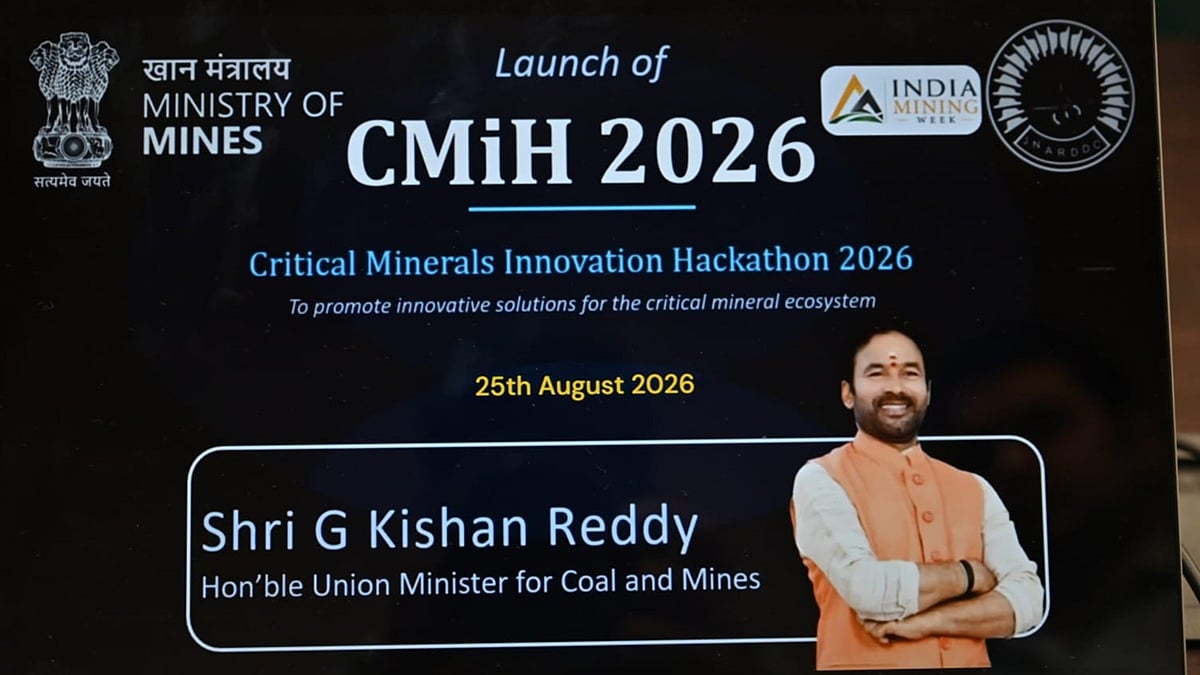
Union Minister of Coal and Mines G Kishan Reddy launched the Critical Minerals Innovation Hackathon 2026 (CMiH 2026) on August 26, 2026, opening a nationwide call for technical solutions to some of the hardest problems standing between India and self-reliance in critical minerals.
What the Hackathon Is Asking For
CMiH 2026 will be organised and hosted by the Jawaharlal Nehru Aluminium Research Development & Design Centre (JNARDDC), Nagpur — an autonomous R&D body under the Ministry of Mines that also serves as the Project Monitoring Agency for the government's National Critical Mineral Mission (NCMM). The hackathon invites students, researchers, academic and R&D institutions, startups and independent innovators to submit technical solutions against a defined set of problem statements spanning the critical-minerals value chain: exploration, mining, beneficiation, processing and recovery from end-of-life products.
The submission window closes on September 20, 2026. Two winning teams will be recognised for each problem statement, with a first prize of Rs 1.5 lakh and a second prize of Rs 1 lakh. Winners will be announced at India Mining Week 2026, scheduled for November 15–17, 2026 — giving the hackathon roughly three months from launch to result.
Why Critical Minerals Are Suddenly a Deep-Tech Story
Critical minerals do not sound like a technology category at first glance, but they sit underneath nearly every other deep-tech ambition India has set for itself. Lithium, cobalt, nickel, graphite and rare earth elements are the feedstock for EV and grid batteries, the permanent magnets inside wind turbines and EV motors, and — increasingly — the packaging and specialty materials used in semiconductor manufacturing and defence electronics. India currently imports the overwhelming majority of these inputs, with supply chains concentrated in a small number of countries and, in the case of rare earths and battery-grade materials, subject to real geopolitical leverage.
The Centre's response has been the National Critical Mineral Mission, approved by the Union Cabinet with an outlay of Rs 34,300 crore over seven years, aimed at building a resilient value chain across exploration, mining, beneficiation, processing and recycling for a list of 24 minerals designated critical under the Mines and Minerals (Development and Regulation) Act, 1957. The Geological Survey of India has been tasked with roughly 1,200 exploration projects under the mission through 2030-31, and India, through state-owned Indian Rare Earths Limited (IREL), currently mines monazite-bearing sands — the country's principal rare-earth source — in Odisha, Tamil Nadu and Kerala.
CMiH 2026 is a comparatively small piece of that larger mission, but it reflects a pattern the government has leaned on across other frontier-tech pushes: pairing a large capital-heavy mission (here, the NCMM) with a lightweight, open call for outside innovation that can surface ideas — in extraction efficiency, in recycling critical minerals out of e-waste and spent batteries, in low-cost beneficiation techniques — that neither PSUs nor large private miners are necessarily incentivised to chase on their own.
The Bigger Picture
The hackathon lands weeks after India, Australia and Canada signed ACITI, a technology pact built partly around critical minerals cooperation, and amid a broader wave of private capital moving into the space — from battery-recycling ventures pulling lithium and cobalt out of dead batteries, to companies mining critical minerals from e-waste. Coal and Mines Ministry officials have framed the hackathon as a way to widen the pool of people working on the problem beyond the mining industry's traditional research base, pulling in engineering students and startups who might otherwise never engage with a sector still dominated by heavy PSUs.
Whether a hackathon with modest prize money translates into deployable technology remains to be seen — three months is a short runway even for a proof-of-concept — but the bigger signal is where the government is choosing to look for critical-minerals innovation: not just geologists and metallurgists, but the same startup and R&D ecosystem it has been courting for AI, semiconductors and space.
Sources
- Reddy launches Critical Minerals Innovation Hackathon 2026 — PSU Watch
- G. Kishan Reddy Launches Critical Minerals Hackathon 2026 to Boost Mineral Technology Solutions — KNN India
- Critical Minerals Innovation Hackathon 2026 Launched — Indian PSU
- Cabinet Approves 'National Critical Mineral Mission' — Press Information Bureau
- Govt approves Rs 16,300 crore National Critical Minerals Mission — The Tribune
Tags
More from Miscellaneous
Minimac Systems Raises ₹30 Crore to Turn Industrial Oil Into a Circular Resource, Not Waste
Minimac Systems has raised ₹30 crore in a pre-Series A round led by Zerodha's Rainmatter to scale mobile, miniaturised units that restore industrial lubricant on-site instead of trucking it away as waste.
The/Nudge Foundation Launches TILT, a ₹250 Crore Fund for India's 'Next Billion' Tech Startups
The/Nudge Foundation has launched TILT, a ₹250 crore impact-investment platform backing seed-to-Series A science and technology startups working on livelihoods, climate resilience and financial inclusion.