BARC and NPCIL Release the BSMR-300 Blueprint, Turning India's Flagship Indigenous SMR Into a Real Project
BARC and NPCIL released the Detailed Project Report for the 300 MWe Bharat Small Modular Reactor on 14 August 2026 — the first fully specified engineering blueprint for India's flagship indigenous SMR, and the third parallel design in a growing SMR family alongside the BSMR-200, SMR-55 and hydrogen HTGR.
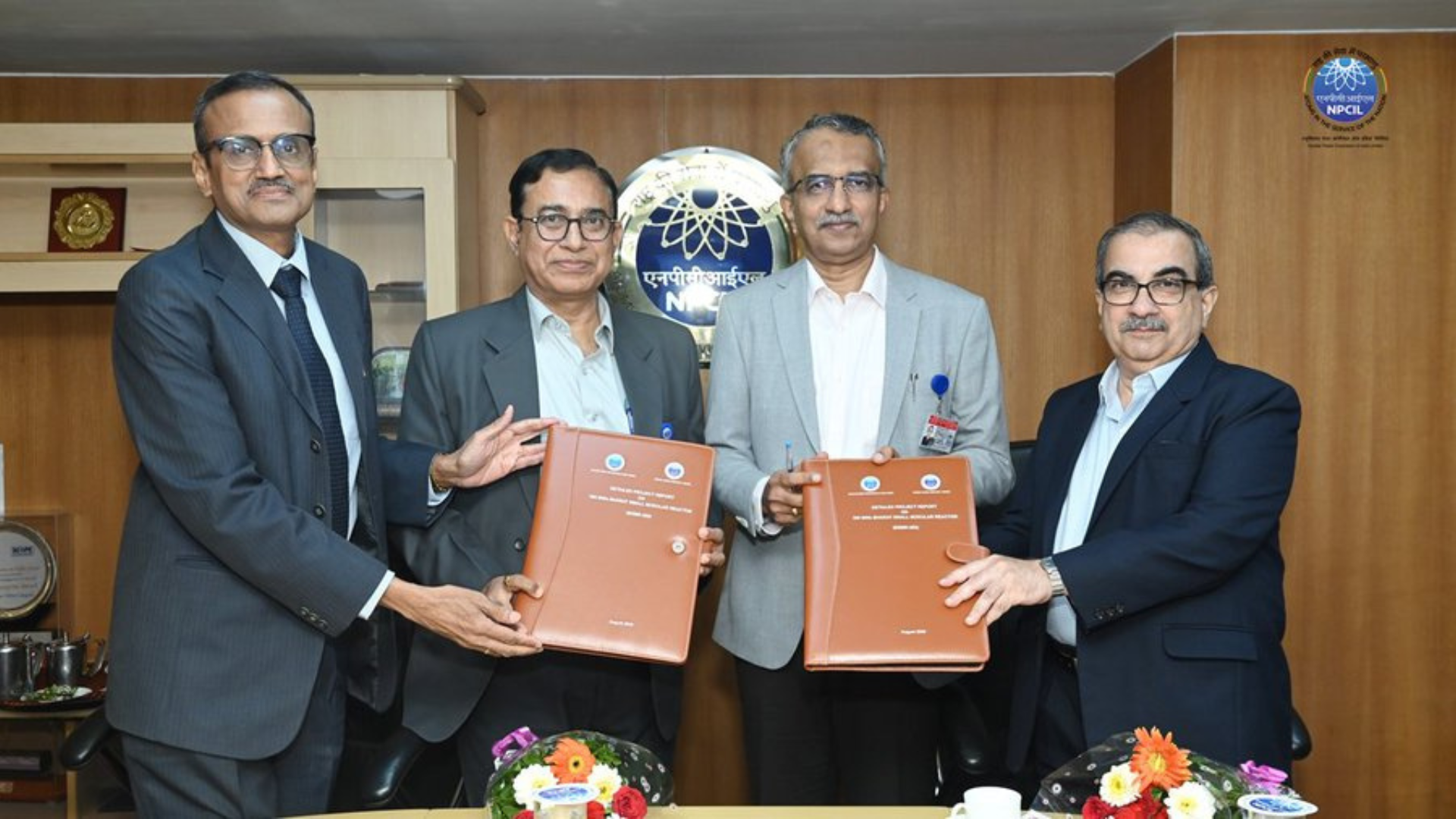
India's third parallel small-reactor track has a paper trail. On 14 August 2026, the Bhabha Atomic Research Centre (BARC) and Nuclear Power Corporation of India Limited (NPCIL) released the Detailed Project Report (DPR) for the 300 MWe Bharat Small Modular Reactor (BSMR-300) — the first time the country's flagship indigenous SMR concept has a fully specified engineering blueprint attached to it.
What the DPR says the reactor is
The BSMR-300 has been conceptualised as a wholly indigenous Generation III+ Pressurised Water Reactor. That places it in the same technology family as the imported VVER units at Kudankulam and the Westinghouse and EDF designs India has been evaluating for its 700 MWe sites — but at a fraction of the size, with the safety architecture, modular construction and licensing simplifications that the "Gen III+" label implies. Passive cooling, longer grace periods before operator action, and a design intended to survive severe events without off-site power or make-up water are all part of that template.
The 300 MWe rating is the important design point. It is small enough to be manufactured largely in factory conditions and shipped to the site in modules, which is the promise SMRs are built on: shorter build times, lower up-front capital, and a construction schedule that behaves less like a mega-project and more like a manufactured product. It is also large enough to matter to the grid — three units at a single site would exceed the output of most of India's existing pressurised heavy-water reactors.
Where BSMR-300 fits in the SMR programme
India's SMR effort now runs on three tracks in parallel, each aimed at a distinct commercial opportunity. The BSMR-300 sits alongside the BSMR-200, a 200 MWe pressurised water design pitched primarily for industrial decarbonisation and captive power at hard-to-abate sites like steel plants and refineries; the 55 MWe SMR-55, designed for remote grids and to replace end-of-life thermal plants on their existing footprints; and a high-temperature gas-cooled reactor for hydrogen production. Between them, the four designs address most of the load profiles India is expected to want nuclear power for over the next 15 years.
That segmentation is deliberate. Different customers — utilities, captive industrial users, remote-grid operators, chemical producers — want reactors sized to their offtake, their site constraints and their willingness to underwrite construction risk. A single design family cannot serve all of them.
Public-private plumbing
The DPR arrives against a backdrop of unusual private-sector interest in Indian nuclear. Adani Power has said publicly it is in discussions for eight BSMR-200 units in Uttar Pradesh alone as part of a broader plan to build up to 10 GW of nuclear capacity by 2035. Tata Power has flagged a construction start of 2028 for its own BSR unit and commissioning targets in the early 2030s. NTPC, still the incumbent state-owned generator, is in parallel technical discussions with EDF, Rosatom, Westinghouse, GE Vernova, KHNP and Holtec across all three SMR tracks.
The Department of Atomic Energy has been quietly building the industrial back end that will be needed to serve those customers. In parallel with the DPR release, DAE is running a supplier-development programme that engages private manufacturers on forgings, pressure vessels, control systems, instrumentation and other long-lead items. The intent is to have a domestic vendor base ready when serial production of the BSMR family begins, rather than repeating the concentration of manufacturing capacity in a small number of overseas suppliers that has slowed India's earlier reactor build-outs.
Why a DPR matters — and what it doesn't do
A DPR is not a construction contract. It is the document that turns a reference concept into something the finance ministry, environment ministry and Atomic Energy Regulatory Board can actually evaluate. It specifies the design in enough detail to be costed, sited and licensed. For BSMR-300, that means a much more concrete conversation about site selection, first-of-a-kind cost, projected tariff and delivery schedule than has been possible before. It is the difference between a policy commitment and an engineering programme.
There is still a long way to go from a DPR to first concrete. The design will need to pass through the AERB's licensing framework — itself being updated to handle SMRs — before construction can begin. Fuel-cycle arrangements will have to be finalised. And the private-sector interest that has been so visible over the last 18 months will need to be translated into firm offtake agreements before the first units are ordered.
The bigger arithmetic
India has set a target of 100 GWe of nuclear capacity by 2047 under the Nuclear Energy Mission announced in the Union Budget 2025-26 — a roughly ten-fold increase from today. Meeting that number will require a build-out that combines large PHWRs and imported light-water reactors with something faster and more modular. That is the space the BSMR family is designed to occupy, and the BSMR-300 is now the first member of it with a fully engineered blueprint on paper.
The DPR release does not, by itself, add a single kilowatt to the grid. But it turns the BSMR-300 from an aspiration into a project — with a design, a cost basis and a licensing pathway — and it does so at a moment when private capital, state-owned utilities and industrial users are, for the first time in decades, all pulling in the same direction on Indian nuclear. That combination is what will decide whether the country actually reaches its 2047 target, or spends the next 20 years talking about it.
Sources
- India's Nuclear Push: BARC, NPCIL Unveil DPR for Indigenous 300 MWe BSMR-300 Reactor — Indian Masterminds
- DAE engages industries to develop nuclear vendors for SMR reactors in India — Business Standard
- India Accelerates Nuclear Energy Mission With INR 20,000 Crore Push For Indigenous Small Modular Reactors — SolarQuarter
- Bharat Small Modular Reactor — Wikipedia
- Nuclear Ambitions: Building capacity for a low-carbon future — Indian Infrastructure