India and the Wellcome Trust Put ₹1,500 Crore Behind a New Generation of Biomedical Scientists
The government and the UK's Wellcome Trust have launched Phase III of the Biomedical Research Career Programme, a ₹1,500-crore fellowship scheme (₹1,000 crore from DBT, ₹500 crore from Wellcome) to fund Indian biomedical scientists across their careers and strengthen translational research.
Manik Gupta
Founder and editor of DeepTech India. Manik writes about India's frontier technology ecosystem — AI, semiconductors, space, quantum, robotics and biotech — translating research and policy into clear, reliable reporting.
India's push to move from making medicines to discovering them has a persistent weak spot: people. The country has world-class laboratories and a fast-growing biotech industry, but too few researchers can afford to spend their most productive years on risky, long-horizon science. This week the government and one of the world's largest medical-research charities put money against that gap.
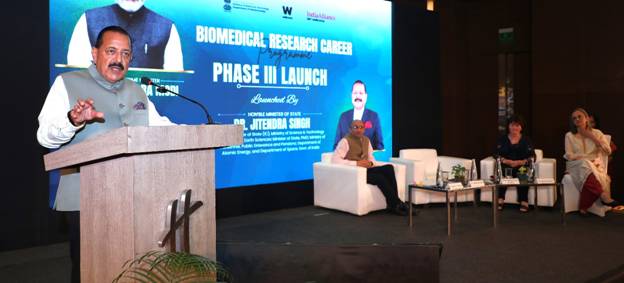
Union Minister of State for Science and Technology Dr Jitendra Singh launched Phase III of the Biomedical Research Career Programme (BRCP), a ₹1,500-crore initiative run jointly by India's Department of Biotechnology (DBT) and the Wellcome Trust of the United Kingdom. The Union Cabinet had cleared the phase ahead of the launch. Of the total, DBT is contributing ₹1,000 crore and the Wellcome Trust ₹500 crore.
What the programme actually funds
The BRCP is not a building or a piece of equipment. It is a fellowship-and-grants scheme designed to fund researchers directly, across the full arc of a scientific career — from early-career postdoctoral scientists through to established senior investigators. The idea is to give talented people flexible, generous, multi-year support so they can pursue ambitious questions without lurching from one short grant to the next.
It is delivered through the DBT–Wellcome Trust India Alliance, the long-running partnership that has operated as the vehicle for earlier phases of this collaboration. That structure matters: the India Alliance has a track record of running competitive, peer-reviewed fellowship rounds at international standards, and Phase III extends that machinery rather than reinventing it. New fellowships and grants are to be awarded over the 2025-26 to 2030-31 window, with the commitment funding those awards through their full terms in the years that follow.
Why career money, not just lab money
India's biomedical ambitions are usually discussed in terms of missions and money — the BioE3 policy, biomanufacturing hubs, a target bioeconomy in the hundreds of billions of dollars. But translational research, the slow work of turning a laboratory finding into a diagnostic, a device or a drug, depends on individual scientists staying in the field long enough to see projects through.
That is precisely where India has leaked talent, with promising researchers moving abroad or out of academia for want of stable funding. A programme that underwrites careers rather than one-off projects is aimed squarely at that retention problem, and the government framed Phase III around strengthening translational research, fostering innovation and building India's global standing in biomedical science.
The stated priorities lean toward work with real-world payoff: innovative diagnostics, medical technologies and healthcare solutions tuned to India's own disease burden. That is a deliberate emphasis. India's health challenges — from infectious disease to a rising tide of cancers and metabolic conditions — do not always map onto the priorities of research funders in wealthier countries, and home-grown funding can point scientists at home-grown problems.
The bigger picture
The Wellcome Trust's continued participation is a signal in itself. One of the best-resourced private funders of health research in the world is choosing to co-invest in Indian talent over more than a decade, a vote of confidence in the quality of the science coming out of Indian institutions.
For India, the ₹1,500-crore commitment sits alongside a broader thickening of the biomedical funding landscape — from DBT's translational schemes to BIRAC's grants for startups and diagnostics. None of it, on its own, turns India into a drug-discovery power. But a steady supply of well-funded, well-trained investigators is the raw material every other part of that ambition depends on. Phase III is a bet that the surest way to discover more medicines is to keep more scientists doing science.
Sources
- Prime Minister of India — "Cabinet approves Phase III of Biomedical Research Career Programme (BRCP)": https://www.pmindia.gov.in/en/news_updates/cabinet-approves-phase-iii-of-biomedical-research-career-programme-brcp/
- Indian Pharma Post — "Govt launches Rs. 1,500 crore Biomedical Research Career Programme Phase-III": https://www.indianpharmapost.com/policy/govt-launches-rs-1500-crore-biomedical-research-career-programme-phase-iii-20935
- United News of India — "India launches Rs 1,500 cr biomedical research programme with Wellcome Trust support": https://www.uniindia.com/india-launches-rs-1-500-cr-biomedical-research-programme-with-wellcome-trust-support/india/news/3910781.html
- Daily Excelsior — "Dr Jitendra launches Rs 1,500 cr 'Biomedical Career Programme' with joint UK funding": https://www.dailyexcelsior.com/dr-jitendra-launches-rs-1500-cr-biomedical-career-programme-with-joint-uk-funding/
Tags
More from Biotechnology
Remidio Wins a US Patent for a Wearable That Folds Five Eye Exams Into One
Bengaluru's Remidio has been granted a US patent for a headset that captures five separate eye exams without dilation, a step toward pulling Oculomics — reading the body's health through the retina — out of the clinic and into the home.
India Reopens Its ₹5,000 Crore PRIP Scheme, Inviting a Second Wave of Pharma and MedTech Innovators
The Department of Pharmaceuticals has opened a second call for applications under its ₹5,000 crore PRIP scheme, offering up to ₹100 crore per project to early- and late-stage pharma and medtech innovators.