Serum Institute Is Making the World's First Bundibugyo Ebola Vaccine — and It's Already in Human Trials
Serum Institute of India manufactured the vaccine now in the world's first human trial against Bundibugyo ebolavirus — churning out roughly 620,000 doses in two weeks and supplying 4,000 for Oxford's newly launched Phase I study.
Manik Gupta
Founder and editor of DeepTech India. Manik writes about India's frontier technology ecosystem — AI, semiconductors, space, quantum, robotics and biotech — translating research and policy into clear, reliable reporting.
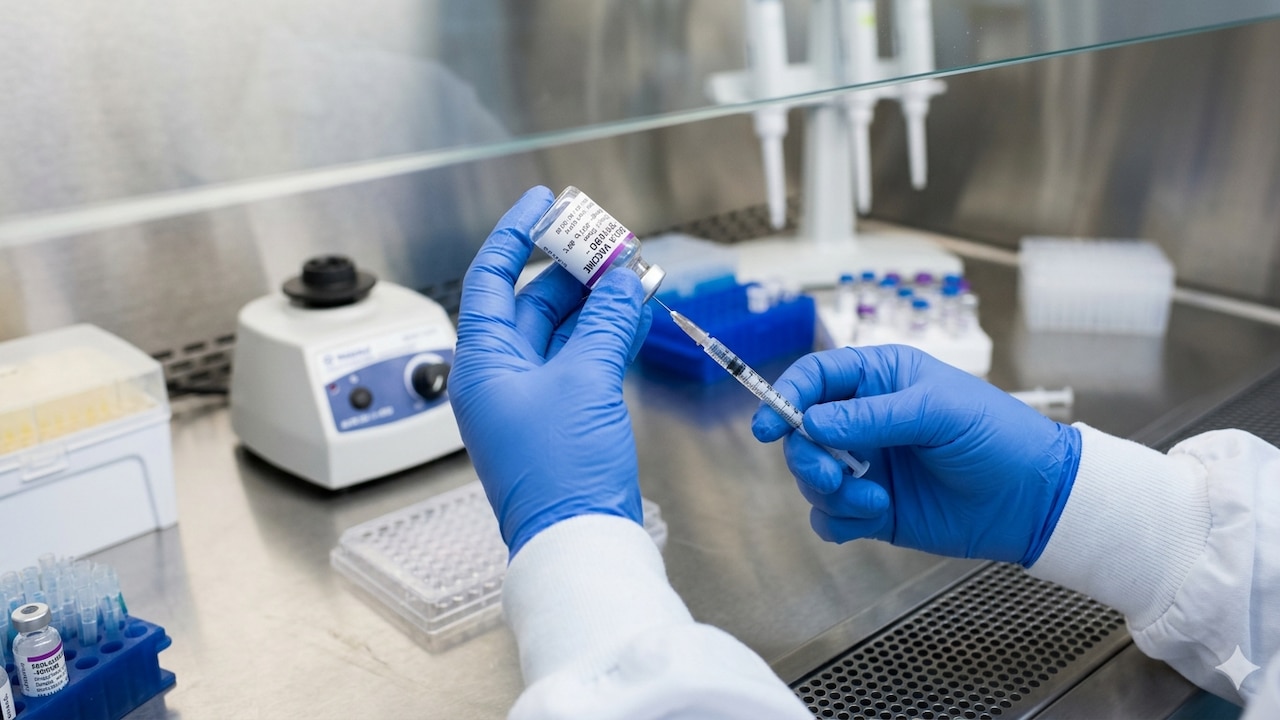
When the Oxford Vaccine Group injected its first volunteer on 13 July 2026, the moment carried an unusual weight. It was the start of the world's first-ever Phase I clinical trial of a vaccine against Bundibugyo ebolavirus — one of the deadliest members of the Ebola family, and one for which no vaccine had ever reached human testing. Behind that first dose sits an Indian supply chain: every shot being used in the trial was manufactured at the Serum Institute of India (SII) in Pune.
A gap in the world's Ebola defences
Ebola is not a single virus but a small family of them. The only licensed Ebola vaccine, Ervebo, protects against the Zaire species that caused the catastrophic 2014–16 West African epidemic. It offers no proven protection against Bundibugyo ebolavirus, a distinct strain first identified in Uganda in 2007 and responsible for outbreaks with case-fatality rates that have run to roughly a quarter to a third of those infected.
That gap became urgent when Bundibugyo resurfaced in the Democratic Republic of the Congo and spilled toward neighbouring Uganda. With no matched vaccine on the shelf, the Coalition for Epidemic Preparedness Innovations (CEPI) moved to fast-track three Bundibugyo candidates at once. The Oxford shot — a viral-vector vaccine designated ChAdOx1 BDBV — is the first of them to reach people.
The India connection: 620,000 doses in two weeks
The trial itself is small and cautious by design. Known as BD-Ebov, it is enrolling 50 healthy adults aged 18 to 55 in Oxford to assess the vaccine's safety and the strength of the immune response it produces. But the manufacturing story behind it is anything but small.
Working under CEPI's rapid-response model, the Serum Institute of India manufactured and stockpiled roughly 620,000 doses of the candidate within two weeks, and supplied 4,000 investigational doses for the Oxford study. That kind of surge capacity is precisely why SII — the world's largest vaccine maker by volume — has become a fixture in outbreak preparedness. The company already manufactures Oxford's R21/Matrix-M malaria vaccine and produced the bulk of the world's Oxford–AstraZeneca COVID-19 doses, both built on the same ChAdOx1 platform now being used against Bundibugyo.
Why the ChAdOx1 platform matters here
ChAdOx1 is a weakened chimpanzee adenovirus engineered so it cannot replicate in humans. It is used as a delivery vehicle, ferrying the genetic instructions for a target pathogen's protein into cells so the immune system learns to recognise it. Because the backbone is the same regardless of the target, a manufacturer that already runs ChAdOx1 lines can pivot to a new insert — in this case a Bundibugyo glycoprotein — far faster than starting from scratch. For an outbreak pathogen where speed is everything, that reusability is the whole point.
CEPI's 100-day ambition
The Bundibugyo push is a live test of CEPI's "100 Days Mission," the goal of compressing the timeline from pathogen identification to a deployable vaccine down to around three months. CEPI said it would initially invest up to $8.6 million in the Oxford candidate, having confirmed its backing in June. If the Phase I results are encouraging, CEPI has signalled it will work with Oxford and the Serum Institute to fund the later-stage studies needed to seek emergency-use authorisation or full regulatory approval — potentially positioning doses for use in an active outbreak setting.
What it signals for India
For India, the trial is a reminder that the country's role in global health is no longer confined to churning out large volumes of established shots. Increasingly, Indian manufacturing capacity is being wired directly into the earliest, most time-critical phase of the world's outbreak response — the window when a handful of investigational doses can decide whether a trial happens this month or next year.
None of this guarantees success. Phase I trials answer only the first questions — is the vaccine safe, and does it provoke an immune response — and many candidates stumble later. But the fact that a Bundibugyo vaccine exists in a vial at all, ready to be tested, owes a great deal to a Pune manufacturing floor that turned it out in a fortnight.
Sources
- World's first Phase I Bundibugyo ebolavirus vaccine trial launched by Oxford Vaccine Group — University of Oxford
- Oxford begins first human trial of Bundibugyo Ebola vaccine — U.S. News / Reuters
- Oxford Bundibugyo ebolavirus vaccine candidate receives CEPI backing — University of Oxford
- CEPI fast-tracks three Bundibugyo ebolavirus vaccine candidates — CEPI
- Oxford University & India's Serum Institute launch trials for Bundibugyo-borne Ebola disease — Deccan Herald
Tags
More from Biotechnology
Remidio Wins a US Patent for a Wearable That Folds Five Eye Exams Into One
Bengaluru's Remidio has been granted a US patent for a headset that captures five separate eye exams without dilation, a step toward pulling Oculomics — reading the body's health through the retina — out of the clinic and into the home.
India Reopens Its ₹5,000 Crore PRIP Scheme, Inviting a Second Wave of Pharma and MedTech Innovators
The Department of Pharmaceuticals has opened a second call for applications under its ₹5,000 crore PRIP scheme, offering up to ₹100 crore per project to early- and late-stage pharma and medtech innovators.