Applied Materials Sets a 2035 Goal for Expanding Its India Supply Chain
The SEMICON announcement combines a $5 billion decade-long investment plan with a target to increase India-based supply-chain capacity tenfold. These are future commitments, not completed capacity.
Manik Gupta
Founder and editor of DeepTech India. Manik writes about India's frontier technology ecosystem — AI, semiconductors, space, quantum, robotics and biotech — translating research and policy into clear, reliable reporting.
Backlog edition: 2026-09-19. Reviewed on 23 September 2026.
Applied Materials has set out an India-focused investment and supply-chain plan extending to 2035. At SEMICON India on 17 September, Semiconductor Products Group president Prabu Raja announced a $5 billion investment over the next decade and a target to expand India-based supply-chain capacity tenfold, according to the Ministry of Electronics and IT.
The announcement describes an intended expansion. It does not mean that $5 billion has already been spent or that the additional supplier capacity is operating.
The equipment layer of semiconductor manufacturing
Applied Materials supplies semiconductor process equipment. Its official SEMICON page identifies Raja as the keynote speaker for the inaugural session, while the event biography places him in charge of semiconductor equipment business units and the global field organisation.
The significance for India extends beyond another large investment number. A semiconductor manufacturing ecosystem needs equipment, materials, precision components and support capabilities alongside fabrication and packaging facilities.
Supplier participation also requires more than a purchase order. A new supplier must meet the customer's technical requirements consistently, with appropriate process controls, delivery performance and support. That is why a capacity target should eventually be accompanied by evidence of qualified, repeatable production.
Turning a target into measurable progress
The reviewed announcement does not provide a detailed annual schedule, a supplier-by-supplier allocation or a public definition of the baseline used for the tenfold capacity target. Those details would help readers assess progress over the coming decade.
Useful follow-up measures include completed facilities, qualified suppliers, production output and the portion of sourcing that can be sustained from India. The headline investment amount alone cannot answer those questions.
India's chip-manufacturing programme creates demand for a broader supporting industry. Applied's stated plan is relevant to that effort, but its industrial impact will depend on execution and verified operating capability.
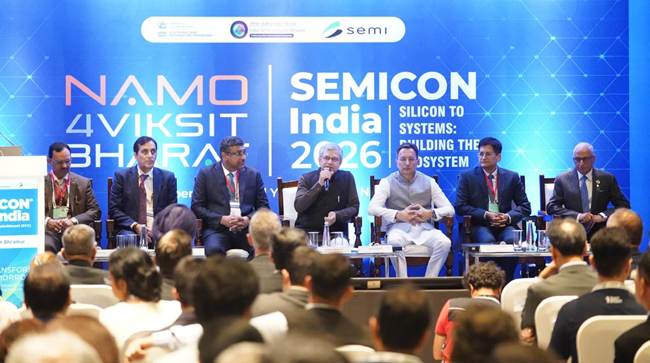
Image: the SEMICON India 2026 media briefing, photographed on 17 September. This documents the event at which the plan was announced; it does not depict an Applied Materials facility or Prabu Raja. Credit: Ministry of Electronics and IT / Press Information Bureau.
Sources
Tags
More from Semiconductors
Six ChipIN Centres and an Open PDK Expand India’s Chip-Design Access
SEMICON announcements connect regional design support with a 0.8-micron process design kit. The practical test is whether learners and startups can move from layouts to tested silicon.
SEMICON India 2026 Opens in Delhi With Modi Inaugurating, 600+ Exhibitors
SEMICON India 2026, the fifth edition of the country's flagship chip-industry event, opens in New Delhi on September 17 with Prime Minister Modi inaugurating and more than 600 exhibitors taking part.