Amaravati Quantum Valley and the Race to 1,000 Qubits
Andhra Pradesh's new IBM Quantum System Two gives India its largest quantum computer at 156 qubits. The investable story is not the hardware IBM ships, but the ~30% import dependence and 20-to-1 talent gap it exposes.
Manik Gupta
Founder and editor of DeepTech India. Manik writes about India's frontier technology ecosystem — AI, semiconductors, space, quantum, robotics and biotech — translating research and policy into clear, reliable reporting.
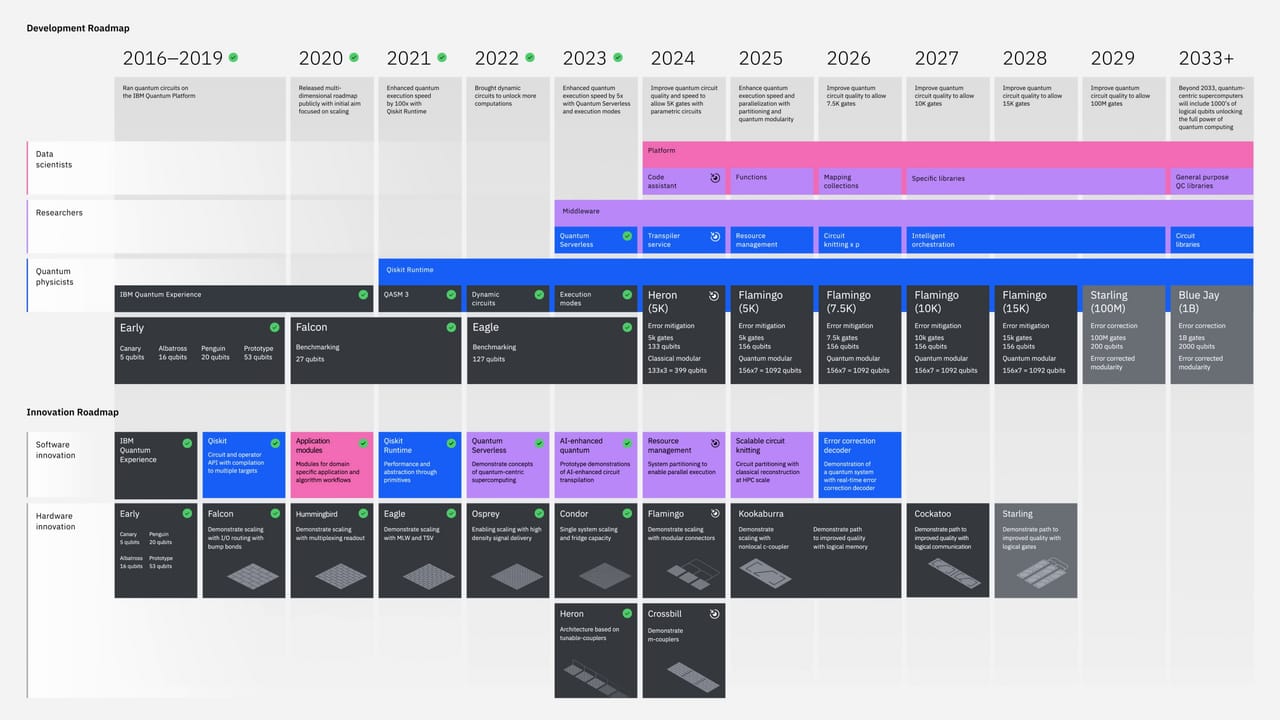
When Andhra Pradesh inaugurated Amaravati Quantum Valley on 7 February 2026, it installed the single most powerful quantum computer on Indian soil: an IBM Quantum System Two built around a 156-qubit Heron processor. Alongside the machine sit IBM-TCS Quantum Cloud Services and a joint Innovation Centre, and the launch was accompanied by nine industry MoUs with names including TCS and L&T. For a state competing with Karnataka and Telangana to be India's deep-tech address, landing the country's largest quantum computer is a credible flag in the ground. For an investor, the more useful exercise is to separate the hardware headline from the supply-chain reality underneath it.
The machine and the mission
The Heron processor is IBM's current-generation superconducting chip, engineered specifically to suppress crosstalk between qubits using tunable couplers, which is the limiting factor as devices scale. The earlier generation of IBM hardware was bottlenecked less by qubit count than by error rates that compounded as circuits grew deeper; Heron's tunable-coupler design was IBM's answer, cutting two-qubit gate errors enough to make wider circuits worth running. Mounted in System Two, IBM's modular cryogenic architecture designed so that multiple processors can eventually be linked, it represents genuine frontier hardware rather than a legacy machine shipped to the periphery. Access is the point: through the IBM-TCS cloud layer, Indian enterprises, researchers and startups can run circuits on a 156-qubit device without each having to procure and operate a dilution refrigerator, which is exactly the shared-infrastructure model that justifies a national quantum facility. It also matters that the machine is on Indian soil rather than accessed over a foreign cloud, because data residency and sovereign control of the workload are precisely what a government customer in finance, energy or defence will require.
Amaravati does not exist in isolation. It sits inside the National Quantum Mission, the ₹6,003 crore programme that runs from 2023 to 2031 and is structured around four thematic hubs: quantum computing led by IISc Bengaluru, communications led by IIT Madras with C-DOT, sensing led by IIT Bombay, and materials and devices led by IIT Delhi. The Mission's stated ambition is to build quantum computers in the 50 to 1,000 qubit range over eight years. Read against that target, the Amaravati installation is both a milestone and a tell: India reached the high end of the near-term qubit goal by importing a machine, not by building one.
The number that matters more than 156
The qubit count is the wrong figure to anchor an investment thesis on. The figure that matters is import dependence, and at Amaravati it is roughly 30 percent of components imported. That number is a proxy for a deeper structural exposure. The hardware that makes superconducting and photonic quantum systems work is dominated by a small set of foreign suppliers, and India currently produces almost none of it domestically. Three categories illustrate the problem.
- Dilution refrigerators are the cryogenic systems that cool superconducting qubits to roughly 10-15 millikelvin, near absolute zero, so that thermal noise does not destroy quantum states. The global market is concentrated in a handful of vendors, principally in Finland and the UK, and lead times run long.
- Titanium-sapphire (Ti:sapphire) lasers are the tunable, ultra-stable light sources used across quantum sensing, atomic clocks and trapped-ion and photonic platforms. They are precision instruments with few qualified manufacturers worldwide.
- Frequency combs are laser sources that emit a precise, evenly spaced spectrum of frequencies, functioning as a ruler for light, and are foundational to quantum metrology and optical clocks.
India imports all three. This is the honest framing an investor needs: Amaravati is a showcase of access to quantum compute, but the value chain underneath it largely accrues abroad. A national quantum capability that depends on imported refrigerators and lasers is strategically fragile in exactly the way a semiconductor capability that depends on imported lithography is, and the comparison is not incidental. The same instinct that produced the India Semiconductor Mission applies here, and the materials-and-devices hub at IIT Delhi is the part of the NQM most directly aimed at the gap. It is also the part furthest from commercial output.
The talent constraint
Hardware can be imported. Expertise is harder. India has fewer than 100 quantum-error-correction specialists against an estimated ~2,000 globally, and quantum error correction is precisely the discipline that separates a noisy 156-qubit demonstrator from a fault-tolerant machine that can run useful algorithms. A processor with 156 physical qubits and no large pool of people who can design and implement the error-correcting codes to make those qubits behave logically is a teaching and benchmarking asset more than a production one. The Amaravati Innovation Centre and the IBM-TCS partnership are, in part, talent-development vehicles, and that is the right use of them. But closing a 20-to-1 expertise gap is a decade-scale project, not a launch-day deliverable.
Investor takeaways
The bull case for Amaravati is straightforward. India now has frontier quantum hardware on the ground, a cloud-access layer that democratises it, anchor tenants in TCS and L&T, and a state government willing to underwrite the surrounding ecosystem. The nine MoUs matter because demand-side commitment from large Indian enterprises is the missing ingredient in most national quantum programmes, and TCS in particular gives the facility a route to real-world algorithm work in optimisation, materials and finance.
The bear case is the supply chain and the talent base, and neither is hand-wavable. The genuine investment opportunities Amaravati creates are not in the headline machine, which is IBM's. They are in the import-substitution layer the facility makes visible: domestic cryogenics, indigenous laser and photonics sourcing, control electronics, and the QEC talent pipeline. Those are the businesses that capture value if India's quantum ambition is to be more than a showcase, and they are where the ₹6,003 crore of NQM capital, and private capital alongside it, will be tested.
The right way to hold Amaravati Quantum Valley is as a demand signal, not a self-sufficiency claim. It proves India will buy and use quantum compute at the frontier. Whether India can build the stack beneath it, and train the people to run it, is the question the next five years of the National Quantum Mission have to answer. Until then, the largest quantum computer in India is also, in component terms, roughly one-third imported, and that figure deserves to travel alongside the qubit count in every honest assessment of the project.
Tags
More from Quantum Computing
Raman Research Institute Shows a Precisely-Timed 'Flip' Can Control Quantum Entanglement Loss
Physicists at Bengaluru's Raman Research Institute, working with the University of Calgary and Louisiana State University, have shown that a single precisely-timed polarization flip can prevent, delay, or hasten the abrupt loss of quantum entanglement known as entanglement sudden death, turning timing itself into a tool for protecting fragile quantum links.
QClairvoyance and Samgnya Announce a Quantum Research Partnership
The MoU covers computing, algorithms, quantum AI and post-quantum security, with research and validation ahead of deployment.