DRDO Clears Military Field Trials of a Fibre-Based Quantum Key Distribution System
DRDO, with Bengaluru startup Taqbit Labs, has completed military field trials of an indigenous fibre-based Quantum Key Distribution system — a physics-secured defence against "harvest now, decrypt later" attacks and a foundation for India's multi-hop quantum networks.
Manik Gupta
Founder and editor of DeepTech India. Manik writes about India's frontier technology ecosystem — AI, semiconductors, space, quantum, robotics and biotech — translating research and policy into clear, reliable reporting.
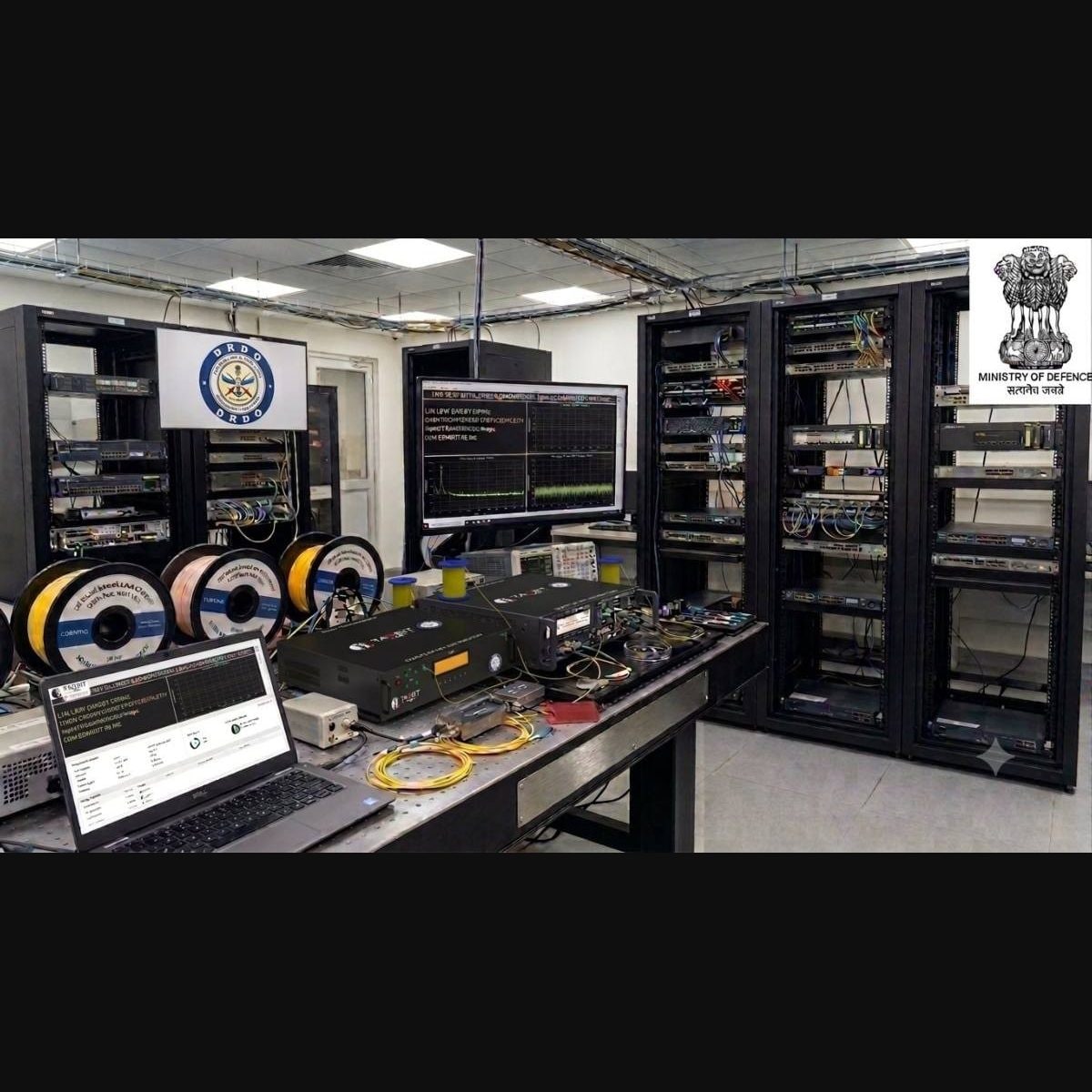
India's defence research establishment has taken a concrete step toward communications that stay secret even in a world with quantum computers. On 15 July 2026, the Defence Research and Development Organisation (DRDO) announced it had successfully completed military field trials of an indigenous, fibre-based Quantum Key Distribution (QKD) system — a milestone it says lays the foundation for large-scale, multi-hop quantum networks built entirely at home.
Securing the network before the threat arrives
The system was developed by DRDO together with its industry partner Taqbit Labs, a Bengaluru-based quantum-security startup. Crucially, this was not a laboratory demonstration but a field trial on operational-grade infrastructure, and DRDO described the result as a "scalable and practically secure" system — language that signals a shift from physics experiment to deployable product.
The threat it is designed to counter is often summarised as "harvest now, decrypt later." Adversaries can already intercept and store encrypted government or military traffic today, betting that a sufficiently powerful quantum computer in the future will crack the mathematics protecting it. Any secret with a long shelf life — strategic plans, weapons data, intelligence — is therefore vulnerable the moment it crosses a wire, even if no machine can read it yet. QKD is one of the few defences that neutralises that bet in advance.
What QKD actually does
Quantum Key Distribution does not encrypt messages directly. Instead, it is a method for two parties to share a secret encryption key with security guaranteed by the laws of physics rather than the difficulty of a maths problem. The key is encoded onto individual photons sent down an optical fibre. Because measuring a quantum state unavoidably disturbs it, any attempt by an eavesdropper to intercept the photons leaves a detectable signature — the two legitimate parties can simply notice the tampering and discard the compromised key.
This is a fundamentally different guarantee from the other pillar of the quantum-safe world, post-quantum cryptography (PQC), which replaces today's vulnerable algorithms with new mathematical ones believed to resist quantum attack. PQC is software that can be rolled out over the internet; QKD is hardware that needs a physical channel. Most experts see the two as complementary, and a serious national quantum-security posture will likely use both.
From the lab to the field
DRDO's announcement builds on a lengthening track record. In 2022, DRDO and IIT Delhi demonstrated QKD between two cities more than 100 km apart over commercial-grade optical fibre; in 2024 the same team showed entanglement-based free-space quantum communication over more than a kilometre. Those were proofs of concept. The July 2026 trials, DRDO said, take that accumulated experience and turn it into an "architected and productised" system hardened for real strategic networks.
The emphasis on "multi-hop" matters. A single point-to-point QKD link is useful but limited, because photons carrying quantum keys cannot simply be amplified and relayed the way ordinary signals are — doing so would destroy the very quantum properties that make the scheme secure. Building a network therefore requires chaining links through trusted nodes, and demonstrating that architecture is the difference between a secure phone line and a secure backbone.
The industry angle
The role of Taqbit Labs is as notable as the technology. India's National Quantum Mission has explicitly aimed to build an industrial base around quantum communication, not just academic capability, and pairing a DRDO laboratory with a domestic startup to productise a field-ready system is exactly the outcome the mission was designed to produce. Doing it indigenously also reduces reliance on foreign quantum-communication equipment — a sensitive dependency for systems whose entire purpose is to keep national secrets national.
What's next
Completing military field trials is a validation, not a deployment. The path from here runs through scaling the multi-hop architecture, integrating it with existing strategic communication systems, and proving that the hardware holds up over long durations and long distances in the field rather than on a test bench. But as a marker of where India sits in the global quantum-security race, the trial is significant: the country now has a home-grown, field-tested QKD system and a stated intent to grow it into a network.
Sources
- DRDO completes military field trials of Quantum Key Distribution system — The Week
- DRDO completes military trials of secure, intercept-proof quantum communication system — The Tribune
- DRDO official announcement on fibre-based QKD field trials — DRDO (X)
- DRDO and IIT Delhi demonstrate QKD between two cities 100 km apart — Press Information Bureau
Tags
More from Quantum Computing
Arvind Krishna Confirms Amaravati Will Host One of India's First Physical IBM Quantum Computers
IBM chairman and CEO Arvind Krishna has confirmed that Amaravati will host one of the first two physical IBM quantum computers deployed on Indian soil, with commissioning targeted for September 2026.
Andhra Pradesh Clears an 8.5-Acre Quantum and AI University Campus for Amaravati
Chief Minister Chandrababu Naidu has approved a ₹730.7 crore NIELIT campus dedicated to quantum computing, AI, chip design and HPC, with classes starting as early as September 2026.