
Mission Aagaman: Skyroot's Vikram-1 Becomes India's First Private Rocket to Reach Orbit
Skyroot Aerospace's Vikram-1 reached a ~450 km orbit on 18 July 2026, making it the first privately developed Indian rocket to reach space and India the third country with private orbital launch capability. Mission Aagaman carried CubeSats from Skyroot and Grahaa Space and an in-orbit soft-robotic-capture experiment.
Manik Gupta
Founder and editor of DeepTech India. Manik writes about India's frontier technology ecosystem — AI, semiconductors, space, quantum, robotics and biotech — translating research and policy into clear, reliable reporting.
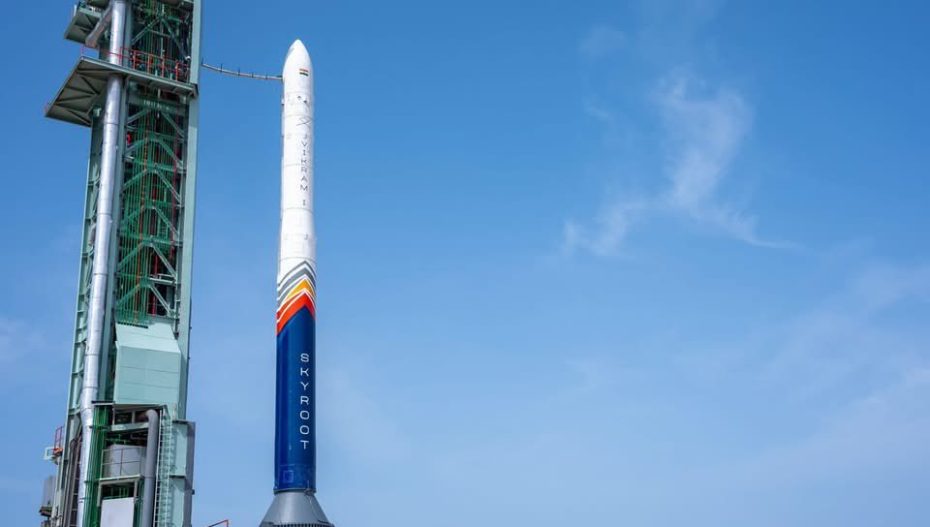
On Saturday, 18 July 2026, a rocket designed and built almost entirely by a private company climbed away from the Satish Dhawan Space Centre at Sriharikota and, roughly fifteen minutes later, released its payloads into a low-Earth orbit about 450 kilometres up. With that, Skyroot Aerospace's Vikram-1 became the first privately developed Indian rocket to reach orbit — and India became only the third country, after the United States and China, whose private sector can independently place satellites in space.
The Hyderabad-based company called the flight Mission Aagaman, Sanskrit for "arrival". It was an apt name for a moment the industry has been building toward since 2020, when the government first opened spaceflight to non-government players and set up the regulator IN-SPACe to license them.
A delayed but clean flight
Liftoff came at 12:05 pm India Standard Time (0635 GMT), about 35 minutes later than planned. Skyroot's team paused the countdown at the T-minus-five-minute mark after spotting a technical issue, worked through it, and then pressed ahead. The multi-stage vehicle — which Skyroot has described as built largely from lightweight carbon-composite, with solid-propellant stages topped by a liquid-fuelled orbital module for the final push and injection — performed as intended, and the company confirmed that the upper stage reached its targeted orbit and deployed its cargo about fifteen minutes after leaving the pad.
For a maiden orbital flight, that is an unusually smooth debut. Rockets frequently fail on their first attempt; getting to orbit on flight one places Skyroot in a small club.
What flew
Mission Aagaman was not just a technology demonstration for Skyroot's own rocket. It carried customer and experimental payloads that themselves mark firsts for India's private space ecosystem.
Among them was SOLARAS, a 1U CubeSat built by Karnataka-based Grahaa Space to prove out its indigenous, stackable nanosatellite bus in orbit — the platform, the communications link and its hosted-payload architecture. SOLARAS in turn carried VISWA-M, an academic research payload developed by VIT-AP University in Amaravati, showing that Grahaa's "bus-as-a-service" model can host university experiments alongside commercial ones. Skyroot flew its own CubeSat as well, and the mission included an in-orbit demonstration of a soft robotic capture system — an experiment aimed at the growing problem of orbital sustainability and debris handling.
The mix matters: a private Indian rocket carrying private Indian satellites and Indian university science is exactly the kind of end-to-end domestic supply chain the sector has promised but rarely delivered all at once.
Why it counts
India has long been a respected spacefaring nation through ISRO, whose PSLV and LVM3 rockets have flown government and commercial payloads for decades. But launch capability sat almost entirely inside the state agency. Vikram-1 changes the structure of the industry, not just the record books: it gives Indian satellite makers a home-grown commercial ride and gives Skyroot a flight-proven vehicle to sell on the global small-launch market, where demand for dedicated rides to specific orbits keeps climbing.
Skyroot, founded by former ISRO engineers Pawan Kumar Chandana and Naga Bharath Daka, became India's first space-technology unicorn and has drawn backing from investors including sovereign and global names as it scaled toward this flight. Its 2022 sub-orbital shot, Vikram-S under Mission Prarambh, was the proof of concept; Saturday's flight was the payoff.
The response was immediate. Prime Minister Narendra Modi hailed the launch as a defining milestone for India's space ambitions, and political and industry figures across the spectrum congratulated the company and ISRO — whose ranges, tracking and range-safety infrastructure at Sriharikota made the private launch possible. That partnership is itself the model the government has pushed: ISRO as enabler and anchor customer, private firms as the volume manufacturers and operators.
What comes next
A single successful flight does not make a launch business. Skyroot will now need to fly Vikram-1 again — repeatedly, reliably and on a predictable cadence — to convert a historic first into a commercial cadence that satellite operators can plan around. The company has signalled that it wants to ramp toward regular flights and heavier Vikram variants, and it is not alone: rivals such as Agnikul Cosmos are pursuing their own orbital debuts, and IN-SPACe is steadily transferring technology and opening infrastructure to private players.
There is also the wider context. ISRO is preparing to commission a second launch complex at Kulasekharapatnam in Tamil Nadu, purpose-built for small satellite launch vehicles, and is pressing ahead with its own crewed Gaganyaan programme. A private orbital capability slots into that expanding ecosystem rather than competing with it — adding launch slots, price competition and speed at the small end of the market.
For now, though, the significance is hard to overstate. Three years after the reforms that made it legal, a private Indian company has flown its own rocket to orbit. The arrival, as the mission name put it, has happened.
Sources
- Space.com — "'The dawn of a new space era': Vikram-1, India's 1st private orbital rocket, aces debut launch": https://www.space.com/space-exploration/launches-spacecraft/skyroot-aerospace-india-first-private-orbital-launch-vikram-1
- Al Jazeera — "India achieves milestone with launch of first private-sector orbital rocket": https://www.aljazeera.com/news/2026/7/18/india-achieves-milestone-with-launch-of-first-private-sector-orbital-rocket
- SpaceNews — "Skyroot Aerospace reaches orbit on first Vikram-1 launch": https://spacenews.com/skyroot-aerospace-reaches-orbit-on-first-vikram-1-launch/
- ANI — "Mission Aagaman: Skyroot's Vikram-1 reaches orbit": https://aninews.in/news/national/general-news/mission-aagaman-skyroots-vikram-1-reaches-orbit-marks-new-era-for-indias-private-space-sector20260718123655/
- Grahaa Space SOLARAS deployment: https://defence.newsd.in/india/grahaa-space-successfully-deploys-solaras-on-skyroots-vikram-1-mission
- Telangana Today — "PM Modi hails Skyroot's successful Vikram-1 launch": https://telanganatoday.com/pm-modi-hails-skyroots-successful-vikram-1-launch-as-defining-space-milestone
Tags
More from Space Technology
ISRO's GSLV-F17 Places EOS-05 Into Orbit, Its Heaviest-Ever Payload on a GSLV
ISRO's GSLV-F17 placed the 2,367-kg EOS-05 satellite into a higher-than-planned geosynchronous transfer orbit on September 4, redeeming the GSLV family after the 2021 loss of its predecessor and setting up a packed launch calendar toward Gaganyaan.
Kepler Aerospace Raises $8 Million to Build Six Autonomous ISR Satellites That Talk to Each Other in Orbit
Bengaluru's Kepler Aerospace has closed its first-ever external funding round to launch six swarming ISR satellites under two Ministry of Defence iDEX contracts.