ISRO Clears Three Quiet-but-Critical Gaganyaan Tests, and the Splashdown Comes Into Focus
ISRO has qualified three critical Gaganyaan crew-module systems — the flotation bags that self-right the capsule after splashdown, the umbilical-separation mechanism between the crew and service modules, and the apex-cover jettison that clears the parachutes. Each clears a must-work step on the road to India's first crewed flight.
Manik Gupta
Founder and editor of DeepTech India. Manik writes about India's frontier technology ecosystem — AI, semiconductors, space, quantum, robotics and biotech — translating research and policy into clear, reliable reporting.
Rockets and roaring engines get the headlines. But a crewed spaceflight lives or dies on the unglamorous systems that keep astronauts alive when things go quiet — the parachutes that slow the capsule, the mechanism that lets the crew module fall away from the rest of the spacecraft, the float bags that keep it upright while a recovery ship steams over. In the second week of July 2026, the Indian Space Research Organisation ticked three of those boxes at once.
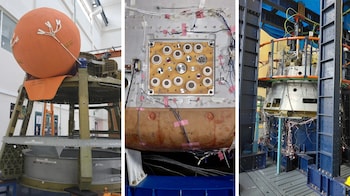
On 12 July, ISRO conducted three major qualification tests of key Gaganyaan crew module systems, announcing the results in the days that followed. None involved a launch. All three, taken together, move India measurably closer to putting its own astronauts in orbit.
Test one: staying upright after splashdown
Gaganyaan will end the way most crewed capsules do — with a parachute-slowed splashdown in the sea. But a blunt capsule bobbing in ocean swells can settle nose-down or on its side, leaving the crew hanging in their straps and the hatch underwater. To prevent that, the crew module carries a Crew Module Uprighting System (CMUS): a set of inflatable float bags that fire after splashdown and rotate the capsule to a stable, upright, hatch-up position.
The first of the three tests qualified the primary flotation unit of that system. ISRO has been developing a stored cold-gas-based uprighting arrangement, and demonstrating that it can reliably right the module is a prerequisite for safe crew recovery. It is the kind of system nobody notices when it works — and the only thing that matters if it doesn't.
Test two: cutting the cord between the modules
The Gaganyaan spacecraft is built in two parts: the crew module, where the astronauts ride, and the service module, which supplies power and propulsion during the mission. Before the crew module can begin its fiery descent, it has to cleanly separate from the service module — and that means severing the umbilical links that carry power, fluids and data between the two.
The second test examined exactly that: the mechanism that disconnects the umbilical connections at module separation. A snag here would be catastrophic, tethering the descending crew module to hardware it is supposed to leave behind. Qualifying the separation mechanism is one more link in the long chain of events that has to fire in the right order, at the right instant, for a crew to come home.
Test three: shedding the parachute cover
The third test dealt with the apex cover — the protective shroud at the top of the crew module that shields the parachutes and their associated subsystems through the punishing heat and loads of re-entry. Those parachutes cannot deploy until the apex cover is jettisoned, and jettisoning it imposes sudden structural loads on the capsule itself.
ISRO's third qualification test validated that the crew module structure can withstand the loads generated during apex-cover separation. In other words: the capsule holds together at the precise moment it has to let go of the cover, clearing the path for the parachute sequence that follows.
Three small steps, one deliberate programme
Individually, each test is narrow. Collectively, they knock out three of the discrete, must-work events that stand between a returning Gaganyaan capsule and a safe recovery: separate from the service module, shed the apex cover, deploy parachutes, splash down, and self-right for the recovery team. ISRO has been qualifying these systems methodically rather than in a single dramatic demonstration, and this batch reflects that grind.
The crew module itself — a roughly 5.3-tonne capsule designed to carry two or three astronauts in low Earth orbit at around 400 km for up to seven days — is built with Hindustan Aeronautics Limited. Its life-support, abort and recovery systems have been in development and testing for years, and each qualified subsystem narrows the list of open questions before a human ever climbs aboard.
What comes next
India's human spaceflight roadmap runs through a sequence of uncrewed test flights before any astronaut launches. The first, designated G1, is expected around late 2026. It will not be empty: riding in the commander's seat will be Vyommitra, a half-humanoid robot built to exercise the crew module's life-support and safety systems and report back on how a real occupant would fare.
If G1 goes well, two further uncrewed missions — G2 and G3 — are planned to build confidence across the full flight profile. Only after that clean sweep will ISRO commit to the first crewed mission, currently targeted for 2027. That is a deliberately conservative cadence, and it is the right one: the entire point of tests like the three cleared in July is to find and fix failures on the ground, in hardware, long before a crew is depending on them in orbit.
Seen on their own, three qualification tests barely register against the spectacle of a rocket launch. Seen as part of the plan, they are exactly the kind of steady, checklist-clearing progress that turns a national ambition into a flight-ready spacecraft.
Sources
- The Register: https://www.theregister.com/science/2026/07/14/indias-crewed-space-mission-is-ready-for-splashdown-but-not-launch/5270879
- The Week: https://www.theweek.in/news/sci-tech/2026/07/14/gaganyaan-mission-isro-tests-completed-launch-soon.html
- India TV News: https://www.indiatvnews.com/amp/news/india/isro-clears-three-gaganyaan-crew-module-tests-how-it-fast-tracks-indias-first-human-spaceflight-2026-07-12-1048024
- Manorama Yearbook: https://www.manoramayearbook.in/current-affairs/india/2026/07/14/isro-tests-gaganyaan-crew-module-systems.html
- Starlust: https://starlust.org/isro-aces-qualification-tests-of-major-spacecraft-systems-for-crewed-gaganyaan-mission/
Tags
More from Space Technology
ISRO's GSLV-F17 Places EOS-05 Into Orbit, Its Heaviest-Ever Payload on a GSLV
ISRO's GSLV-F17 placed the 2,367-kg EOS-05 satellite into a higher-than-planned geosynchronous transfer orbit on September 4, redeeming the GSLV family after the 2021 loss of its predecessor and setting up a packed launch calendar toward Gaganyaan.
Kepler Aerospace Raises $8 Million to Build Six Autonomous ISR Satellites That Talk to Each Other in Orbit
Bengaluru's Kepler Aerospace has closed its first-ever external funding round to launch six swarming ISR satellites under two Ministry of Defence iDEX contracts.