Skyroot's $60M Unicorn Round: The Cap Table Behind India's First Private Orbital Shot
Skyroot's $60M raise at a $1.1B pre-money made it India's first space-tech unicorn — co-led by Sherpalo and GIC, with BlackRock joining. The valuation is set ahead of orbital revenue; Vikram-1's maiden flight is the binding de-risking event.
Manik Gupta
Founder and editor of DeepTech India. Manik writes about India's frontier technology ecosystem — AI, semiconductors, space, quantum, robotics and biotech — translating research and policy into clear, reliable reporting.
On 7 May 2026, Skyroot Aerospace closed a $60M round at a $1.1B pre-money valuation, crossing the line that no Indian space company had crossed before: it became the country's first space-tech unicorn. The headline number is the easy part. The more revealing story is on the cap table, where the syndicate that priced this round tells you exactly what kind of bet sophisticated capital is now willing to place on Indian launch — and what milestone has to clear before that bet pays.
Because here is the uncomfortable arithmetic underneath the celebration: Skyroot has been valued at unicorn scale ahead of a single dollar of orbital revenue. The maiden commercial flight of Vikram-1 is still pending. That makes this round a financing event built on engineering credibility and a forward order book, not on flight heritage. Understanding why the world's largest asset manager and a sovereign wealth fund were comfortable underwriting that gap requires looking at both the cap-table mechanics and the vehicle's design.
The syndicate: who priced India's first space unicorn
The round was co-led by Sherpalo Ventures and the sovereign wealth fund GIC — Singapore's state investor and one of the most disciplined long-horizon allocators in the world. That GIC anchored a pre-revenue launch company is itself the signal; sovereign funds underwrite duration and strategic exposure, not quarterly momentum. Alongside the co-leads, existing backers exercised pro-rata rights — Greenko Group and Arkam Ventures both followed on to preserve their ownership percentages rather than be diluted by the new money coming in.
Pro-rata participation matters as a diligence tell. When insiders who already know the company's burn, test cadence and technical risk choose to put in more capital at a marked-up price, it removes the adverse-selection worry that haunts late-stage hardware rounds. The round then expanded beyond its initial target to admit BlackRock, Playbook Partners and the Shanghvi Family Office — the investment vehicle associated with Sun Pharma's founding family. An oversubscribed expansion of this kind usually means the lead set a price the broader market wanted in on; the cap table widened to absorb demand rather than to plug a shortfall.
The board addition is the part that compounds over time. Sherpalo founder Ram Shriram — one of the earliest investors in Alphabet/Google — joined Skyroot's board. Shriram's value here is not the cheque; it is pattern recognition across a category-defining hardware-and-software company scaling from prototype to global infrastructure. For a launch firm trying to compress the distance between "successful test" and "reliable commercial cadence," that is a specific kind of governance signal.
Where the $60M goes: orbital flight and high-cadence manufacturing
Skyroot has earmarked the capital for two tightly linked objectives: the imminent commercial orbital flight of Vikram-1, and the build-out of automated, high-cadence manufacturing. The pairing is deliberate. In small-launch economics, a single successful flight proves the vehicle; a repeatable, low-cost flight proves the business. The unit economics of this sector do not close on bespoke, hand-built rockets — they close on a production line that can turn out vehicles fast enough to clear the global backlog of small satellites waiting for a dedicated ride.
That backlog is the demand side of the thesis. The small-satellite launch market — constellations for Earth observation, communications and IoT — rewards operators who can offer precise orbital insertion on a predictable schedule, rather than waiting months to ride as a secondary payload on someone else's large rocket. High-cadence manufacturing is how a launch company converts a one-off engineering achievement into the kind of recurring, capacity-constrained revenue that a $1.1B valuation implicitly prices in.
The engineering: why Vikram-1's architecture is the moat
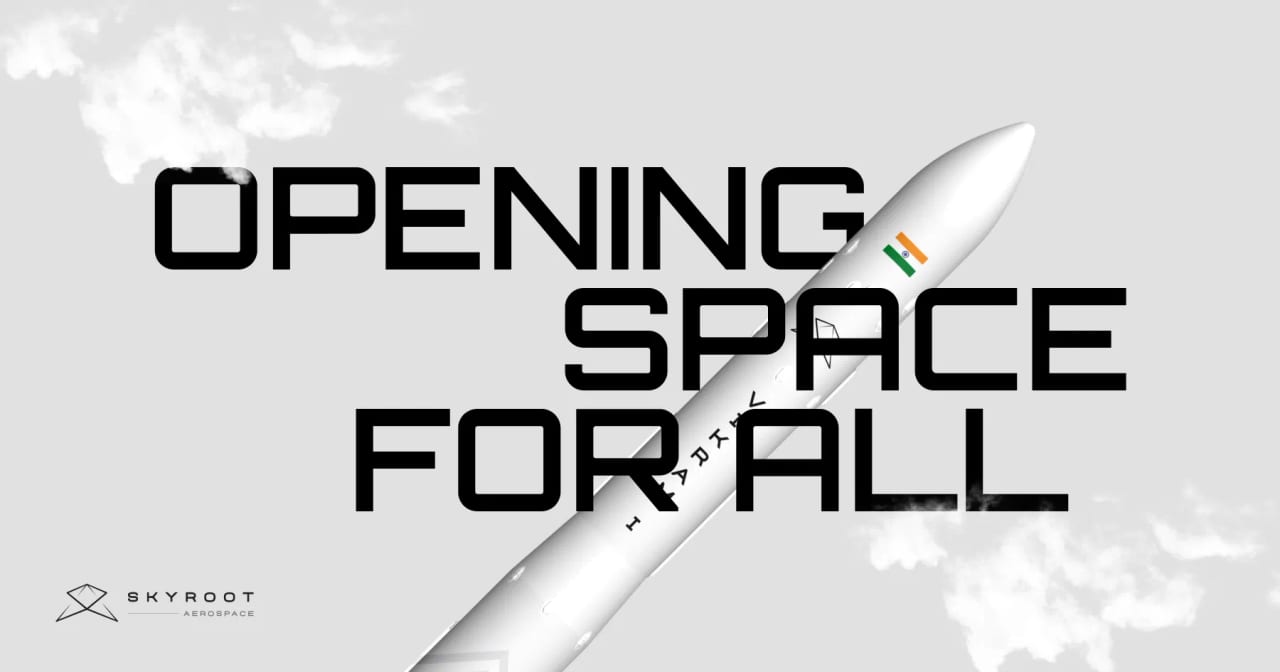
The technical case for that valuation rests on choices baked into the airframe and propulsion. Vikram-1 uses an all-carbon-composite structural frame. The physics here is direct: carbon-composite construction drives down dry mass — the mass of the empty vehicle — which improves the payload mass fraction, the share of total liftoff mass that can be useful payload rather than structure. Every kilogram shaved off the airframe is a kilogram that can become revenue-bearing payload or propellant margin. For a small launcher where payload capacity is the product, low dry mass is not a nicety; it is the economic engine.
The propulsion stack is an in-house hybrid architecture that splits the job by flight phase. Solid rocket motors handle the atmospheric ascent, where their simplicity and high thrust-to-weight buy reliability through the dense, high-dynamic-pressure portion of flight — solids have no turbopumps or complex feed systems to fail at the moment of maximum stress. Precision liquid upper stages with multiple restart capability then take over for orbital insertion. Restartable liquid stages are what let the vehicle coast, reignite and trim its trajectory to drop multiple payloads into distinct, accurate orbits — the exact capability constellation customers will pay a premium for. The combination is a considered trade: solids for the brute reliability of getting off the pad, liquids for the surgical control of where the payload ends up. Vikram-1 is rated to lift up to 350 kg to low Earth orbit.
Beyond the first vehicle, R&D is advancing on Vikram-2, a 1-tonne-class launcher with an advanced cryogenic upper stage. Cryogenic propulsion — typically liquid hydrogen and liquid oxygen — delivers materially higher specific impulse (the rocket-equivalent of fuel efficiency) than the storable propellants used lower in the stack, which is what makes a 1-tonne payload class reachable. Cryo is also among the hardest propulsion technologies to operationalise, so a credible Vikram-2 programme signals technical ambition well beyond a single product.
The investor stakes: a valuation priced ahead of revenue
Strip away the engineering and the financial structure is stark. Skyroot was founded in 2018 by ex-ISRO scientists Pawan Kumar Chandana and Naga Bharath Daka, and the unicorn milestone was publicly championed by ISpA Director General Lt. Gen. AK Bhatt as validation of the IN-SPACe-era reforms that opened Indian space to private launch. That policy framing is real, and it is part of the bull case: a domestic launcher reduces reliance on foreign rides and gives Indian and allied constellation operators a sovereign option.
But investors should price this round for what it is. The $1.1B valuation was set ahead of orbital revenue, on the strength of test campaigns, an order pipeline and the syndicate's read of the technology. The single binding de-risking event is the maiden Vikram-1 commercial flight. A clean orbital insertion converts the thesis into proof and likely re-rates the company upward; a failure or extended slip resets the entire valuation conversation, because there is no flight-revenue base to fall back on.
The honest framing for a deep-tech investor is therefore symmetric. The cap table — GIC, BlackRock, a Google-era board member, insiders following their pro-rata — is about as strong a vote of confidence as a pre-orbital launch company can attract, and the carbon-composite, hybrid-propulsion architecture is a defensible technical moat. Yet none of that substitutes for the flight itself. Skyroot has been financed like a winner; it now has to fly like one. Per Fortune India and YourStory, the round is the largest validation yet of India's private-space reforms — but the binding test is still on the pad.
Tags
More from Space Technology
U-Space and AXISCADES Sign Cooperation Deal to Explore India's Microsatellite Market
French space company U-Space and Bengaluru's AXISCADES have signed a commercial cooperation agreement to jointly pursue India's microsatellite market, one of three India-France private space deals struck at the Paris International Space Summit.
RIDE! Targets Q3 2028 Launches for Two TakeMe2Space Satellites
The launch-services agreement covers mission management for two spacecraft in the Hyderabad company’s planned orbital-computing constellation. It is a future deployment commitment, not evidence that the network is operating.