Red Balloon Aerospace Is Building the Towers in India's Sky, One Stratospheric Balloon at a Time
Vijayawada-based Red Balloon Aerospace flew India's first indigenous super-pressure stratospheric balloon in May and is now racing to build HELIX, a persistent stratospheric airship pitched as a cheaper, reusable alternative to satellites and ground towers.
India's space conversation has been dominated for two years by rockets reaching orbit and satellites launching into it. Red Balloon Aerospace, a Vijayawada-based startup barely a year old, is building the layer in between — a set of platforms that never leave the stratosphere at all, and that its founders argue can do a surprising amount of what a satellite does at a fraction of the cost and turnaround time.
From Rocket Scientist to Balloon Builder
The company was founded in 2025 by C V S Kiran, a former scientist at ISRO's Vikram Sarabhai Space Centre who went on to serve as a vice-president at Skyroot Aerospace, alongside co-founder Sireesh Pallikonda. Kiran's pivot from launch vehicles to near-space platforms is itself a bet on a gap in India's space infrastructure: the country has plenty of institutions that can build and fly rockets, but very few facilities for testing and operating hardware in the "near-space" band — roughly 20 to 50 kilometres up — that sits above where aircraft fly and below where satellites orbit.
Red Balloon's answer is a family of platforms it calls VISTA, ALTIS, HELIX and DIVE, covering everything from short-duration test balloons to a persistent, steerable stratospheric airship. The pitch is straightforward: a platform parked in the stratosphere can carry sensors, communications payloads or scientific instruments for a fraction of what it costs to build, launch and insure a satellite, and — unlike a satellite — it can be brought back down, serviced, and sent back up.
Mission SANA and India's Fifth Balloon
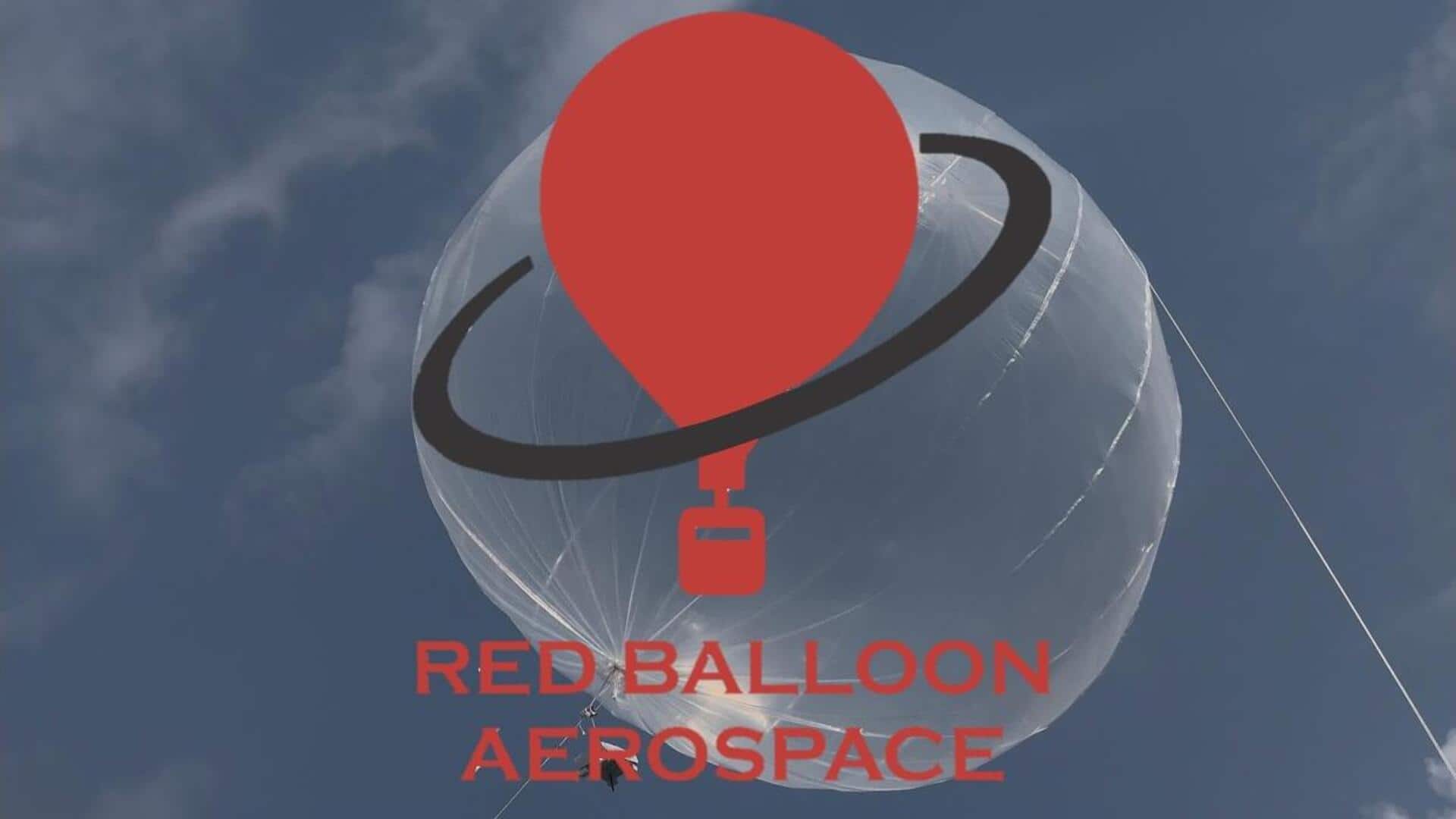
The company's first major public milestone came on May 27, 2026, when it launched VISTA — its super-pressure balloon platform — from the Indira Gandhi Stadium in Vijayawada as part of what it called Mission SANA. The balloon climbed to roughly 25 kilometres, carrying commercial and research payloads from seven national and international partners covering biological experiments, propulsion-technology testing, onboard computing platforms, earth-observation sensors and navigation-system validation. According to the company, every one of those payload missions returned usable data.
The technical detail that matters most here is "super-pressure": unlike a conventional weather balloon, which loses gas and altitude as it cycles between day and night temperatures, a super-pressure balloon holds a sealed volume of gas at a pressure above ambient, letting it maintain a stable altitude for extended periods rather than one flight lasting a few hours. Pulling that off with an indigenous platform put India in a small club — alongside the United States, France, Japan and China — of countries with a working, home-grown super-pressure stratospheric balloon capability. Red Balloon rehearsed the full launch sequence in a dedicated readiness exercise on May 13 before the actual flight, treating the mission with the same procedural rigour as an orbital launch rather than a research-balloon hobby project.
Getting from a founding date in 2025 to an operational commercial flight in roughly eight months is, by the company's own account and by outside coverage of the sector, one of the fastest timelines recorded anywhere in the global near-space industry — a pace closer to a software startup's shipping cadence than to the multi-year qualification cycles typical of aerospace hardware.
HELIX: Towers in the Sky
VISTA is a proof point; HELIX is the actual business. Described internally as an autonomous stratospheric airship, HELIX is designed to loiter at around 20 kilometres altitude for extended periods, functioning — in the company's own framing — as a "tower in the sky" capable of covering a radius of roughly 500 kilometres from a single platform. That framing points directly at the application Red Balloon is chasing hardest: non-terrestrial networks, the general term for using aircraft, balloons or satellites instead of ground towers to deliver connectivity.
The economics are the argument. A single HELIX platform parked over a disaster zone, a remote rural cluster, or a stretch of coastline with no fibre backbone could, in principle, substitute for dozens of ground towers or a much more expensive dedicated satellite, while being retrievable and reusable rather than a one-way trip. For a country with large low-connectivity rural and mountainous regions and a well-documented pattern of ground infrastructure failing during floods and cyclones, that combination of coverage, cost and reusability is the pitch investors are being asked to underwrite.
Red Balloon says it is targeting completion of the initial HELIX platform by December 2026, with flight trials beginning in early 2027 — an aggressive follow-on timeline given how recently the company proved out its underlying balloon technology.
Early Days, Early Capital
The company has so far raised only a pre-seed round and is preparing to go back to investors for a larger raise as it moves from short-duration balloon tests toward a persistent airship platform — a jump in engineering complexity and capital intensity that near-space companies elsewhere in the world have found to be the harder half of the problem. Red Balloon's presence among the 20 space startups Prime Minister Narendra Modi met with in New Delhi on August 21 is a marker of how quickly the company has moved from a two-person founding team to a name recognised alongside India's established launch-vehicle and satellite players — even though its own hardware has, quite literally, yet to leave the atmosphere.
Sources
- Red Balloon Aerospace launches India's 1st domestic super-pressure platform – Business Standard
- Red Balloon Aerospace tests near space platform for telecom, disaster monitoring applications – Business Today
- How Red Balloon Aerospace is building India's near-space infrastructure – YourStory
- 2 Vijayawada men built Red Balloon Aerospace to provide network & disaster response in dead zones – Startuppedia