
Quanfluence Raises $10 Million to Build a Full-Stack Photonic Quantum Computer in India
IIT Madras-incubated Quanfluence has raised $10 million in a round led by Chiratae Ventures, with Rainmatter and Pi Ventures. It will use the money to combine its photonic chips, electronics and software into a full-stack quantum computer.
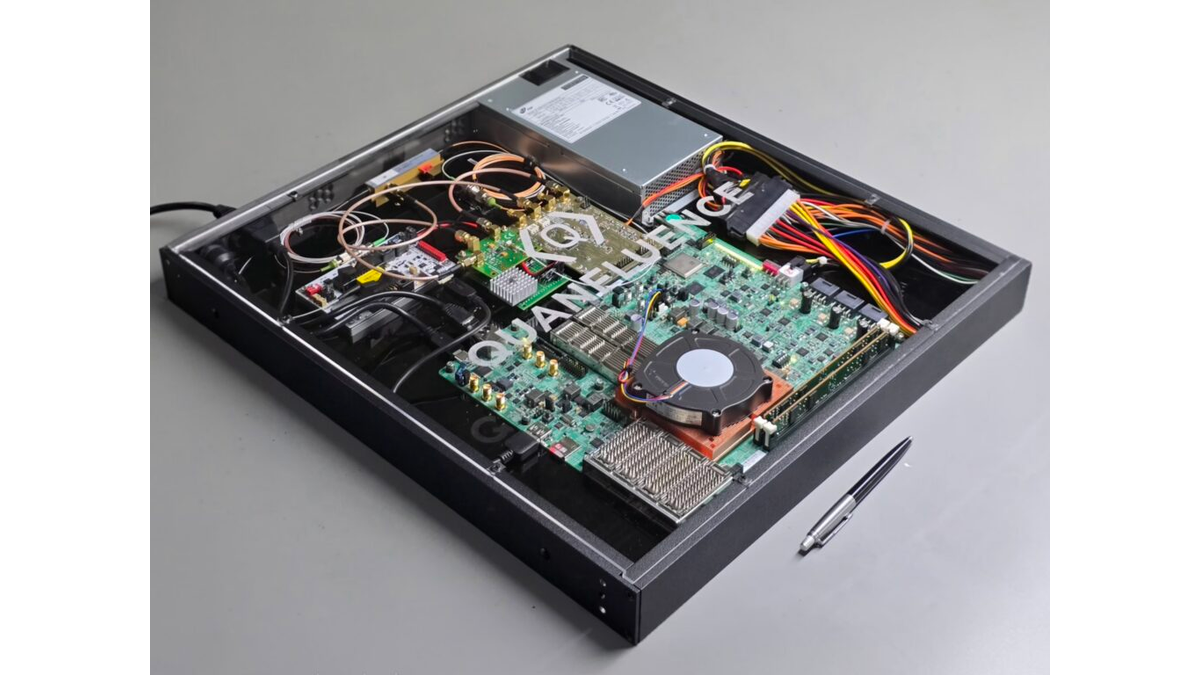
Indian quantum hardware just got another sizeable cheque. Quanfluence, a photonic quantum computing startup incubated at IIT Madras, has raised $10 million in a round led by Chiratae Ventures. Rainmatter by Zerodha joined as a new investor, and Pi Ventures, which led the company's seed round, came back in.
The round was announced on 7 October 2026. Quanfluence says the money will go into one task: putting its photonic chips, control electronics and software together into a working quantum computer.
What Quanfluence is building
Most quantum computers that grab headlines use superconducting circuits or trapped ions. Superconducting processors generally require cryogenic cooling, while trapped-ion systems use ultra-high vacuum. Quanfluence has taken a different route. It encodes quantum information in photons, or particles of light, and routes them through optical circuits.
Coverage of the round says the company's hardware combines optics and electronics to operate at room temperature. Photonic systems are not entirely free of cryogenics: single-photon detectors, for example, often need cooling. But avoiding refrigeration for the main processor is one of the reasons photonics draws investors around the world. It is also the reason this round is worth watching.
According to the company's announcement, the new capital will be used to build a full-stack photonic quantum computer. That system brings together indigenously designed photonic chips, control electronics and the software layer.
A product already in the market
Quanfluence is not starting from zero. Its official announcement says the company has commercialised optical Ising machines and optical instruments. Its OPTIQON platform addresses optimisation problems; it is distinct from the full-stack quantum computer now planned.
Ising machines are not universal quantum computers. They are built for a narrower class of problems: logistics routing, staff scheduling and portfolio-style optimisation, where the job is to find the best arrangement among a huge number of possibilities. For a young hardware company, a product that earns revenue is valuable. It brings in money, puts customers in touch with the hardware, and tests the optical and electronic subsystems that the bigger machine will need.
The roadmap, and how hard it is
The company targets early processors in 2027 and a larger, scalable machine in 2029. These are development targets, not delivered systems.
Photonic quantum computing is still early and unproven at scale. Its main engineering problems include making identical single photons on demand, keeping optical losses low across a chip, and detecting photons with high efficiency. Companies with much deeper pockets are working on the same problems.
Co-founder and CEO Sujoy Chakravarty described the round as the move from parts to a whole system. "Our goal at Quanfluence has never been to build a better experiment," he said in the company's statement, adding that the aim is "to build a useful quantum computer." He said the team had spent recent years building the chips, electronics, optics and algorithms separately. The new capital, he said, lets them integrate those parts into one complete system.
The team
Quanfluence was founded in 2021. The company lists its founders as Sujoy Chakravarty, Ravi Mehta, Biman Chattopadhyay, Aditi Vaidya, Anil Prabhakar and Sandeep Goyal. The company is incubated at IIT Madras, whose research park and incubation network have produced a steady stream of hardware startups.
Where this fits in India's quantum push
Quanfluence's round is notable for another reason: it is mostly private venture money backing a hardware approach that is different from QpiAI's superconducting qubits. India now has startups working on several of the main quantum modalities, along with companies building enabling technology such as cryogenics and quantum-safe communications. That variety is useful, because it is still unclear which approach will scale first.
Why it matters
India's quantum strategy has focused on building domestic capability: chips, control systems and software designed and owned in India rather than imported as black boxes. A photonic stack designed in India, if it works, would add to that capability in several ways. It could be built on photonic and semiconductor fabrication capacity that India is now trying to develop. It would need less of the cryogenic infrastructure that superconducting systems rely on. And it would already have a commercial product line in optimisation.
The next milestones to watch are early working processors, published performance figures, and evidence that the optical Ising machine is winning repeat customers. Ten million dollars is a large cheque for an Indian quantum startup but small by global standards, so how efficiently Quanfluence turns it into working hardware will matter as much as the headline number.