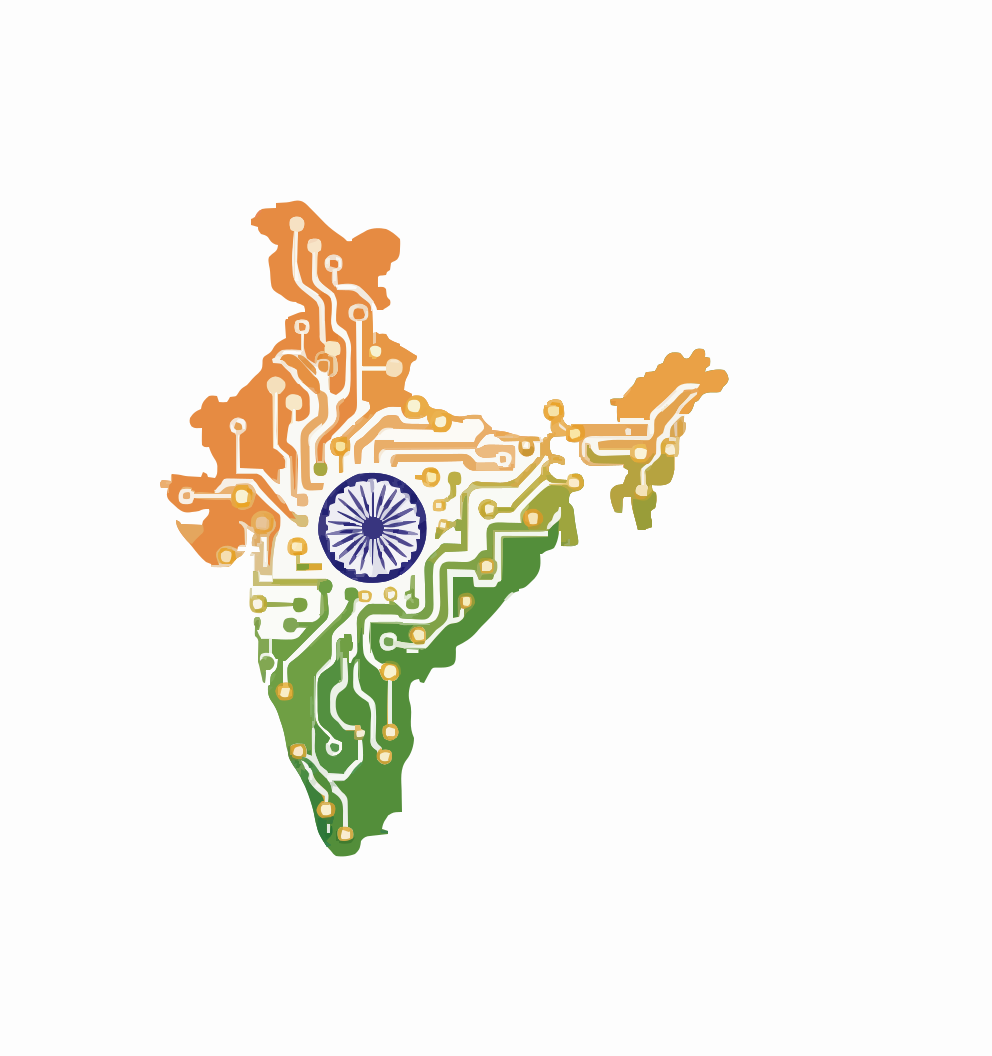
Pixxel-led ‘Allied Orbits’ consortium wins IN-SPACe deal to build India’s national Earth-observation constellation
A Pixxel-led consortium of four Indian space firms — Allied Orbits — has won an IN-SPACe public-private partnership to build, own and operate India's first privately led national Earth-observation constellation: 12 satellites, over ₹1,200 crore, all made and operated in India.
India's ambition to own a fully indigenous eye in the sky took a decisive step this week. IN-SPACe, the government's single-window space regulator and promoter, has selected a consortium led by hyperspectral-imaging company Pixxel to design, build, own and operate a national Earth-observation (EO) satellite constellation under a public-private partnership (PPP) model. The winning group — operating under the banner Allied Orbits — unites four Indian space companies: Pixxel, Dhruva Space, PierSight and SatSure.
Announced around 13 August 2026, the award is being described as India's first privately led national Earth-observation satellite system — a milestone in the country's decade-long shift from a state-run space programme towards a mixed public-private space economy.
A four-company consortium, one national system
Under the PPP, the Allied Orbits consortium will invest more than ₹1,200 crore (roughly $135 million) to build and operate a 12-satellite constellation in low-Earth orbit. Crucially, the satellites will be manufactured in India, launched on Indian rockets, and operated from indigenous ground infrastructure — an end-to-end domestic value chain rather than an assembly of imported hardware.
The four members bring complementary strengths. Pixxel, which already flies its commercial "Firefly" hyperspectral satellites, leads the group and anchors the optical-imaging side. Dhruva Space contributes satellite platforms, integration and ground-segment capability. PierSight adds synthetic-aperture-radar and maritime-surveillance expertise, while SatSure focuses on turning raw imagery into analytics for agriculture, infrastructure, insurance and governance. Together they span the full stack, from spacecraft to end-user insight.
Every sensing mode in one network
What makes the planned constellation unusual is the breadth of its payloads. Rather than specialising in a single imaging mode, the network is designed to integrate panchromatic, multispectral, hyperspectral and synthetic-aperture-radar (SAR) sensors across its satellites. Hyperspectral sensors capture hundreds of narrow spectral bands, allowing analysts to read the chemical and material signatures of crops, water bodies, minerals and pollutants. Radar payloads, by contrast, see through cloud and darkness, enabling all-weather, day-and-night imaging over land and sea.
Combining these modes in one coordinated system means the constellation can serve a wide sweep of users — from farm-level crop-health monitoring and mineral prospecting to coastal and maritime-domain awareness — without India having to buy imagery from foreign operators.
A ₹0 bid for data sovereignty
The commercial structure of the deal drew as much attention as the technology. According to reports on the award, the consortium bid ₹0 for the government's viability-gap support, forgoing up to ₹350 crore in PPP assistance and choosing to fund the constellation privately. If accurate, that stance is a strong signal of the members' confidence in commercial demand for sovereign Earth-observation data — and a marker of how far India's private space firms have matured on the financing side. Law firm Trilegal said it advised Pixxel on the ₹1,200 crore-plus PPP project.
Initial launches are expected to begin from 2027, with the full constellation rolled out over subsequent years as satellites are manufactured, tested and placed in orbit.
Why it matters
Earth-observation data underpins everything from disaster response and climate monitoring to defence reconnaissance and crop-insurance payouts. Historically, India has leaned on ISRO's own remote-sensing fleet and, for higher-cadence or specialised imagery, on foreign commercial providers. A privately built national constellation — designed, owned and operated within India — reduces that external dependence and keeps sensitive imagery under domestic control.
The award also fits a broader pattern. India's private space sector has been posting record funding and a steady stream of IN-SPACe authorisations, and the regulator has increasingly used PPP structures to crowd in private capital rather than fund missions from the public purse. By handing a national-scale asset to a private consortium — on terms where the companies carry the financial risk — IN-SPACe is signalling that India's newer space firms are ready to shoulder strategic infrastructure, not just experimental demonstrators.
For Pixxel, Dhruva Space, PierSight and SatSure, the challenge now shifts from winning the mandate to executing it: building a dozen satellites across multiple sensing modes, securing launch slots, and standing up the ground and analytics layers that turn orbital data into decisions on the ground.
Sources
- SatNews — Private Consortium Allied Orbits Secures Approval to Build India's ₹1,200 Crore Commercial Satellite Constellation
- domain-b — Pixxel-Led 'Allied Orbits' Consortium Signs ₹1,200 Crore Pact with IN-SPACe
- The Tribune — SatSure Joins Pixxel, PierSight and Dhruva Space as Winning Consortium for IN-SPACe EO Constellation
- PR Newswire — SatSure Joins Pixxel, PierSight and Dhruva Space as Winning Consortium for India's National EO Constellation
- Dhruva Space — IN-SPACe Awards EO-PPP to Dhruva Space, Pixxel, SatSure and PierSight
- Electronics For You — India's First Private 12-Satellite System Bid Awarded for $135M