Navy Chief Asks Skyroot to Build India's Military Space Capability 'in Mission Mode'
At the NDTV Defence Summit, Admiral Krishna Swaminathan invited Skyroot Aerospace to integrate with the armed forces and help build sovereign space capability over the next two decades.
India's Navy chief has made an unusually direct public request to a private rocket company. At the NDTV Defence Summit 2026 in New Delhi on 27 September, Admiral Krishna Swaminathan, Chief of the Naval Staff, invited Hyderabad-based Skyroot Aerospace to work with the armed forces "in mission mode" to build sovereign space capabilities over the next two decades.
"We request you to please integrate with us on a mission mode, understand our requirements and make us world beaters in the next 20 or 25 years," the Admiral said.
He made the remarks during an exchange with Pawan Kumar Chandana, Skyroot's co-founder and chief executive. No contract or formal programme was announced. But coming from a service chief, on a public stage, it is a strong signal of where the military wants its space capability to come from.
Skyroot's case
Chandana told the summit that the space sector is in a transition. He argued that access to space, launch capacity and sovereign satellite infrastructure will directly shape national security in the years ahead.
Skyroot has earned a seat at that table. In July 2026, its Vikram-1 rocket reached orbit on Mission Aagaman, making Skyroot the first Indian private company to put a rocket into orbit. In August it signed a three-launch deal with satellite maker HEX20, its first major commercial contract since that flight.
Why the military wants private launch
Responsiveness. In a crisis, the armed forces may need to put a satellite into a specific orbit quickly, to replace one that has failed or been disabled, or to watch a new area. ISRO's rockets are in heavy demand and are optimised for big national missions. Small private launchers like Vikram are designed for lighter payloads and faster turnaround, which is the capability militaries call responsive launch.
Capacity. Demand for military satellites is rising sharply. Ocean surveillance for a navy that patrols a large part of the Indian Ocean depends on persistent coverage from space: radar and optical imaging, signals intelligence and secure communications. More satellites need more launches, and ISRO alone cannot meet all of that demand. The government's decision to hand PSLV, LVM3 and SSLV production to industry points in the same direction.
Sovereignty. India has used foreign launchers for some of its satellites. For defence payloads, dependence on another country's rocket and launch schedule is a vulnerability. A domestic private launch industry adds redundancy that does not depend on either ISRO's queue or foreign providers.
The wider summit message
The Navy chief's invitation fitted a broader theme at the summit. Defence Minister Rajnath Singh called for self-reliance "from chips to ships", and restated the goal of raising defence exports to ₹50,000 crore by 2029, up from ₹686 crore in 2013–14. Other speakers included the Chief of Defence Staff, the Army chief, and the Defence Secretary.
The message running through the summit was that India's next military edge will come from technology built domestically, with private companies taking a much bigger role than in the past.
What to watch
An invitation is not an order. The next steps would be concrete: the Navy or the Defence Space Agency setting out requirements for responsive launch, trial missions carrying military payloads on Vikram, or a formal procurement framework that private launchers can bid into.
Skyroot's immediate priority is building a steady launch cadence for Vikram-1. For the armed forces, the value of a private launcher lies in whether it can fly reliably and on short notice, not in a single successful flight. If Skyroot can show that, the Navy chief's "mission mode" invitation may turn out to have been the start of a long partnership.
Sources
Core announcement or reporting
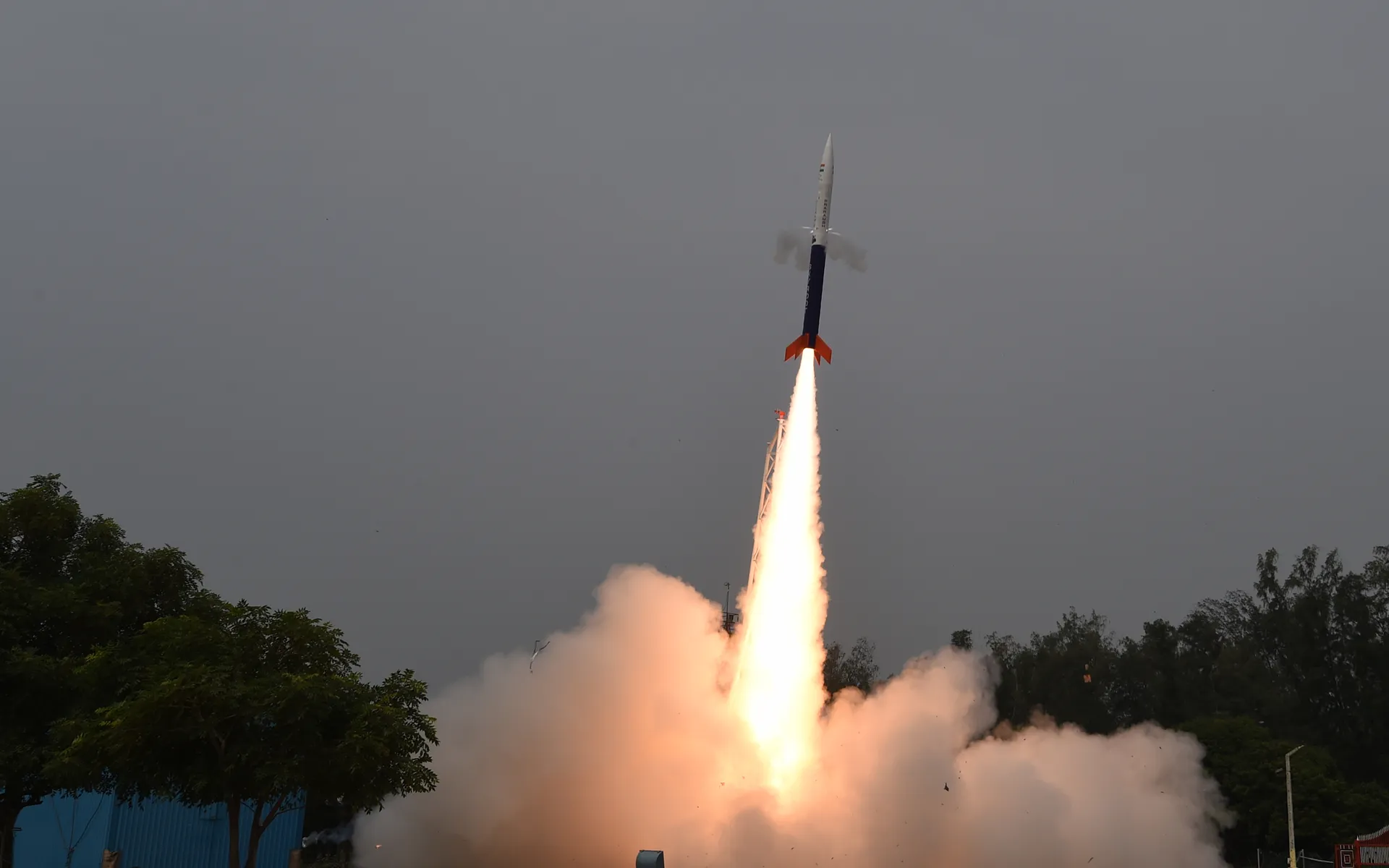
Image: Skyroot Aerospace. Skyroot’s official Vikram-S visual; historical launch vehicle, not the new military programme. Original source.