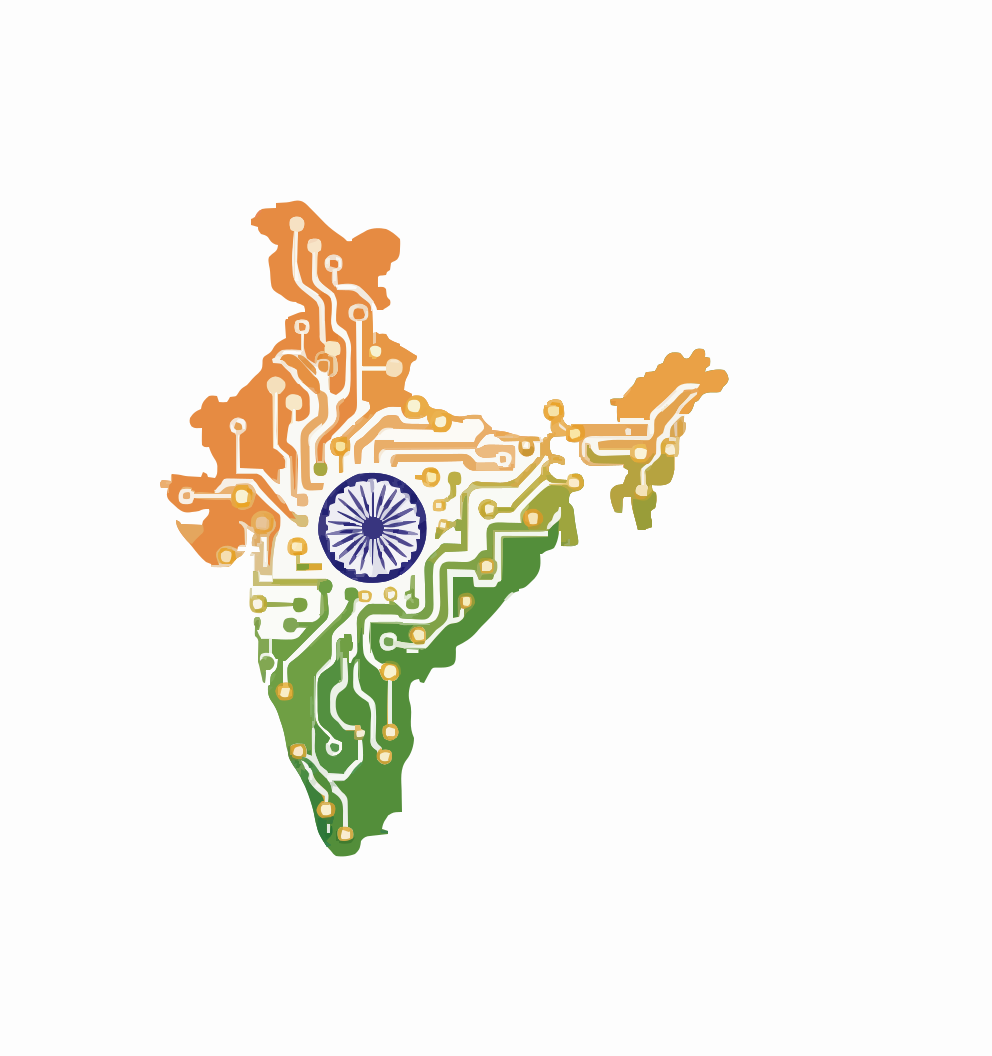
Nasscom's Emerge 50 'League of 10' Signals India's Deep Tech Is Moving From Lab to Market
At its Future Forge conference in Bengaluru on 7 August 2026, Nasscom named the Emerge 50 'League of 10' deep-tech startups and released ecosystem data showing 74% of applicants use AI, 83% have reached advanced technology-readiness, and 39% are already fully commercialised.

A flagship deep-tech scorecard
On 7 August 2026, at its Future Forge conference in Bengaluru, industry body Nasscom named the "League of 10" — the ten standout names drawn from its annual Emerge 50 cohort of deep-tech startups. More than a prize list, the announcement doubled as an X-ray of where India's frontier-technology ecosystem now stands, and the picture it painted was of a sector shifting from early-stage experimentation toward genuine commercial deployment.
The awards are Nasscom's long-running attempt to spotlight India's most promising young technology companies. This year's edition landed at Future Forge 2026, a two-day gathering on 6–7 August at Taj Yeshwantpur that Nasscom billed as one of South Asia's largest curated deep-tech leadership forums, convened under the theme "Charting India's DeepTech Architecture".
From 750 applications to a League of 10
Nasscom said this year's Emerge 50 drew roughly 750 applications spanning 11 frontier-technology domains. From that pool, 50 winners were selected, and from those, a "League of 10" was singled out as the cohort's most promising — startups building breakthrough technologies across artificial intelligence, quantum computing, semiconductors, space, synthetic biology, clean energy and other frontier areas.
The funnel matters as much as the names. A field of 750 applicants across 11 domains is a marker of how much wider India's deep-tech founder base has become, at a time when policy programmes — from the Rs 1 lakh crore Research, Development and Innovation fund to the IndiaAI Mission and Semicon 2.0 — are actively trying to seed hard-technology ventures.
AI is everywhere
The headline finding was the sheer reach of artificial intelligence. Nasscom said AI and machine learning were the most widely adopted technologies among applicants, woven into the solutions of 74 per cent of them. The applicant base extended well beyond software, though, taking in connected hardware and the Internet of Things, energy and cleantech, industrial automation and robotics — a spread that suggests AI is increasingly a layer inside physical-world products rather than a category unto itself.
Crossing from experiment to commercial deployment
Perhaps the most consequential data point was on maturity. Nasscom said 83 per cent of applicants had reached Technology Readiness Level 6 or above — the stage at which a technology has been demonstrated in a relevant, near-real environment — while 39 per cent were fully commercialised at TRL 9, the level reserved for systems proven in actual operation.
Those figures are the crux of Nasscom's argument that Indian deep tech is maturing. For years, the knock on the sector was that promising research rarely crossed the gap from lab bench to paying customer. A cohort in which two in five applicants are already commercialised, and the large majority have demonstrated their technology in the field, points to that gap narrowing.
Funding and founders
On capital, Nasscom said 46 per cent of applicants had raised external funding — a reminder that even in a maturing ecosystem, a little over half were still building without institutional backing, an enduring feature of hard-technology ventures whose long development cycles can deter generalist investors. On founder diversity, 38 per cent of applicants had at least one woman on the founding team.
The domains in play
The eleven frontier domains covered by this year's cohort read like a map of India's deep-tech priorities: artificial intelligence and machine learning; quantum computing; semiconductors; space technology; synthetic biology; clean energy; connected hardware and IoT; energy and cleantech; and industrial automation and robotics, among others. It is a portfolio that mirrors the government's own strategic bets — sovereign AI, a domestic chip supply chain, a private space industry and a clean-energy transition — and underscores how closely India's startup activity now tracks national technology missions.
Why it matters
Awards lists are easy to over-read, and a strong applicant pool is not the same as a wave of category-defining companies. Nasscom's own numbers carry that caveat: with just under half of applicants funded, and commercialisation still concentrated in a minority, India's deep-tech ecosystem remains a work in progress. Long development timelines, hardware capital intensity and thin later-stage funding are structural headwinds that a single cohort cannot resolve.
Still, the direction of travel is what makes the 2026 Emerge 50 notable. The blend of near-ubiquitous AI, high technology-readiness and a broad domain spread suggests India's frontier-tech founders are increasingly building things that work in the real world — not just prototypes and pitch decks. For an ecosystem that has spent a decade being told its deep-tech promise was perpetually around the corner, the League of 10 is a modest but concrete sign that the corner is being turned.