Meine Electric's Iron-Air Battery Clears Independent Testing — and Claims a Six-Hour Charge
An India-based startup says its iron-air battery charges in six hours and discharges over 18 — and has now cleared independent third-party validation of that claim, a potential opening for cheap, daily-cycling long-duration storage.
Manik Gupta
Founder and editor of DeepTech India. Manik writes about India's frontier technology ecosystem — AI, semiconductors, space, quantum, robotics and biotech — translating research and policy into clear, reliable reporting.
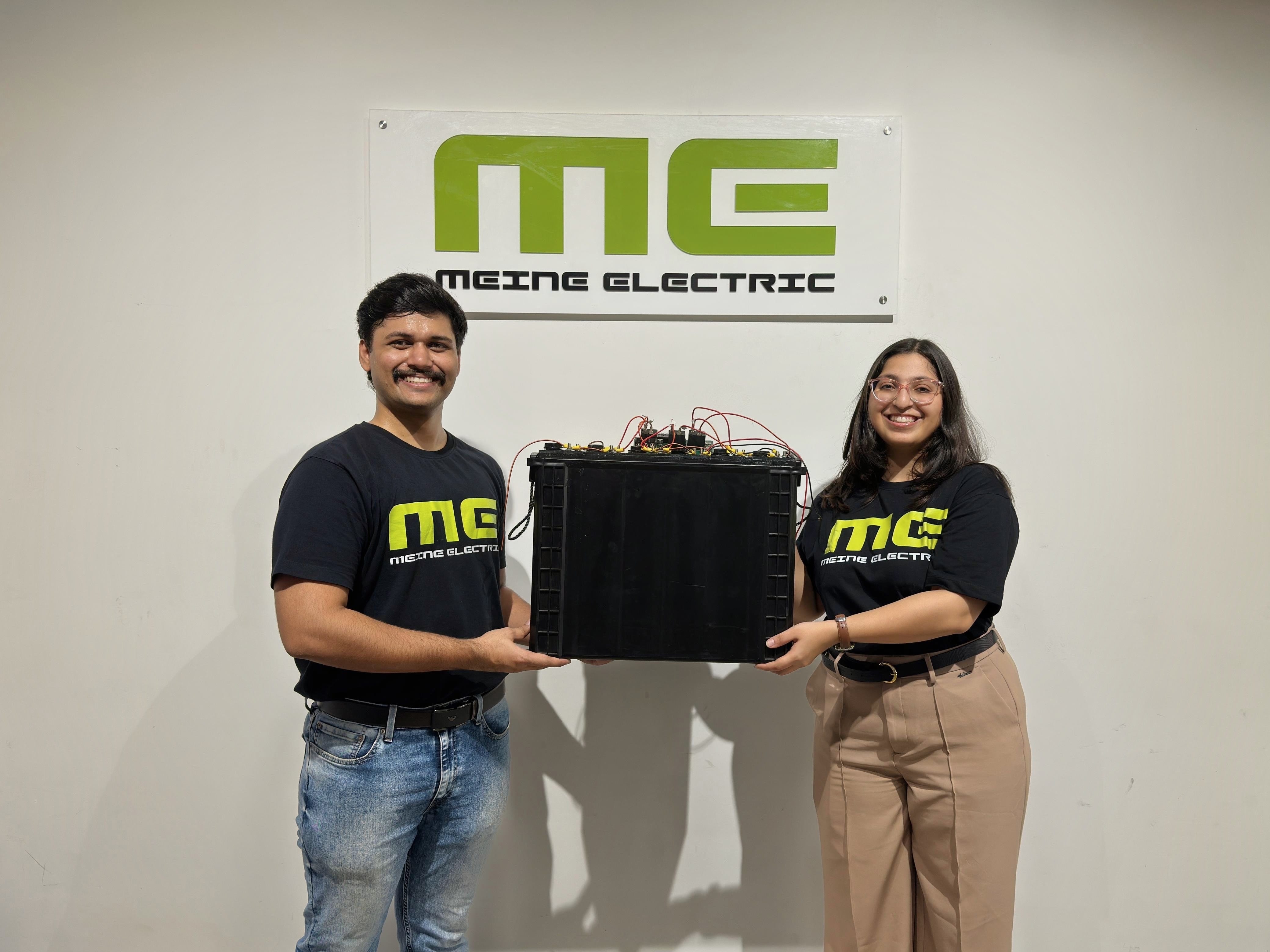
India-based deep-tech startup Meine Electric said on 14 July 2026 that its fast-charging iron-air battery has cleared independent validation, an early but meaningful step for a chemistry that most of the world associates with slow, multi-day storage rather than the daily charge-and-discharge cycle the company is chasing.
A rust-and-breathe battery, checked on the bench
Iron-air batteries work through a deceptively simple trick of chemistry: reversible rusting. When the cell discharges, iron metal reacts with oxygen drawn from the surrounding air to form iron oxide — rust — releasing electrons in the process. When the cell charges, that reaction is run in reverse, stripping the oxygen back out and returning the electrode to metallic iron. Because iron and air are among the cheapest and most abundant inputs on the planet, the appeal is obvious: a battery that trades the lithium, cobalt and nickel of conventional cells for materials you can source almost anywhere.
The catch has always been speed. The best-known iron-air developer, the US firm Form Energy, has built its business around batteries that charge and discharge over roughly 100 hours — excellent for riding out multi-day lulls in wind and solar, but poorly matched to the far more common job of soaking up cheap solar during the day and releasing it after dark.
Meine Electric says its proprietary "Fast Charge Long Discharge" (FCLD) design compresses that timeline dramatically, charging in about six hours and discharging over more than 18 — an asymmetric cycle built for exactly the daily rhythm of a solar-heavy grid.
What the validation measured
The independent assessment was carried out by Customized Energy Solutions (CES), a US-headquartered energy-services and technology firm that is also the parent of the India Energy Storage Alliance. According to the company, CES tested two iron-air electrochemical cells under a structured protocol that mirrored the intended duty cycle — a six-hour charge followed by an 18-hour discharge — and examined electrochemical performance, capacity retention and operational stability across the cycle.
Third-party validation matters in long-duration storage precisely because the field is crowded with laboratory claims that never survive contact with a repeatable test regime. Confirming that cells behave as advertised over a defined cycle is not the same as proving they will last for years in the field, but it moves the technology from pitch-deck assertion to measured result.
Why the economics could bite
Meine Electric pegs the levelised cost of storage for its system at under $0.05 per kilowatt-hour — roughly ₹5/kWh — a figure that, if borne out at scale, would sit well below lithium-ion for long-duration applications. Long-duration energy storage is the piece India's renewable build-out is increasingly missing: the country is adding solar capacity far faster than it is adding ways to shift that power into the evening peak, and lithium-ion becomes expensive once you need many hours of duration rather than raw power.
That is the gap iron-air is meant to fill, and it is why a genuinely low-cost, daily-cycling variant would be more disruptive than the multi-day systems that have dominated the conversation so far.
The India angle
Founded in 2023 by Priyansh Mohan, its co-founder and chief executive, and Stuti Kakkar, Meine Electric describes itself as the first company in the Asia-Pacific region and only the third globally to pursue iron-air long-duration storage. It raised a small pre-seed round of about $750,000 in January 2026 and has since collected recognition including a National Startup Award 2026 and a place on Nasscom's Emerge 50 list.
None of that guarantees commercial success. The company still has to show that its cells hold up over thousands of cycles, that it can manufacture them at cost, and that grid operators and industrial buyers will take a bet on a young firm working with an unfamiliar chemistry. But independent validation of the core claim — that iron-air need not be slow — is the kind of milestone that separates a science project from a company, and it lands as India hunts for storage cheap enough to make its solar ambitions run around the clock.
Sources
- Indian Deep-Tech Startup Meine Electric's Fast-Charging Iron-Air Battery Clears Independent Validation — Business Standard (ANI)
- Meine Electric's Fast-Charging Iron-Air Battery Achieves Independent Validation — SolarQuarter
- Meine Electric Unveils Fast-Charging Iron-Air Battery for Daily Long-Duration Energy Storage — Energetica India
- Indian startup Meine Electric raises $750,000 for iron–air long-duration energy storage — ESS News
- Meine Electric — official site
Tags
More from Energy Tech
Magna Doubles Down on Yuma Energy With $35 Million to Scale India's Battery-Swapping Network
Automotive supplier Magna International has put a further $35 million into Yuma Energy, the battery-swapping venture it co-founded with Yulu, to expand the network past 60 million swaps.
India Weighs a ₹13,000 Crore Push to Build the Battery Materials It Still Imports From China
A proposed incentive scheme would target anode, cathode, electrolyte, separator and copper-foil manufacturing — the upstream layer India's battery gigafactories still depend on Chinese suppliers for.