Havells Teams Up With Norway's Pixii to Build Battery Storage for India's Grid
Havells India has signed an MoU with Norway's Pixii AS to jointly develop battery energy storage systems for the Indian market, targeting the residential and commercial-and-industrial segments. The deal, announced on 10 July 2026, follows a phased roadmap from pilot installations toward local manufacturing.
Manik Gupta
Founder and editor of DeepTech India. Manik writes about India's frontier technology ecosystem — AI, semiconductors, space, quantum, robotics and biotech — translating research and policy into clear, reliable reporting.
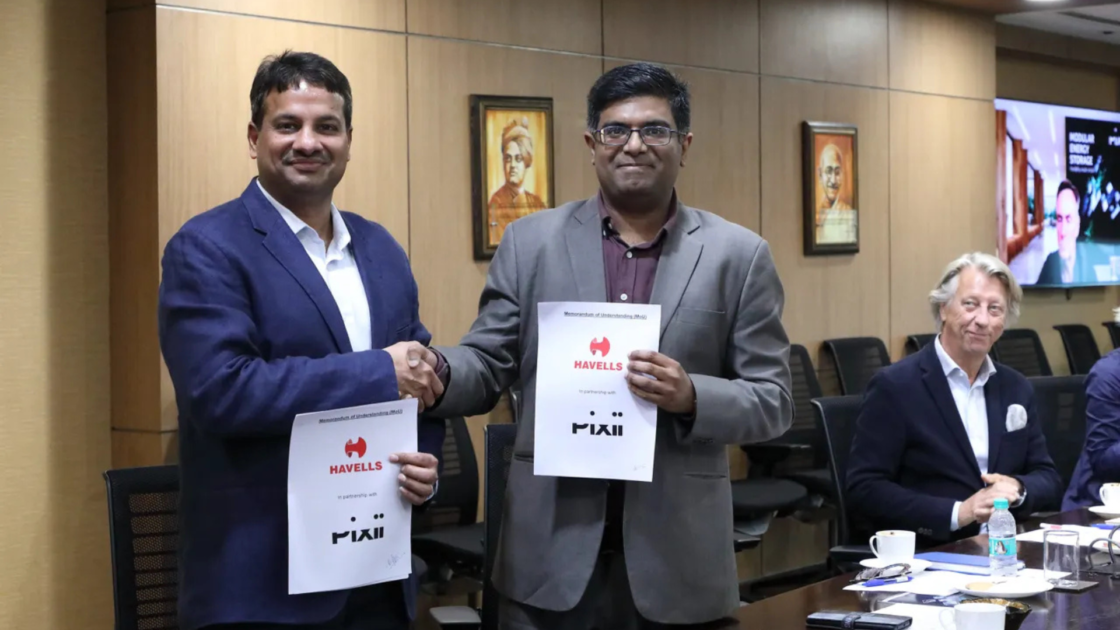
Havells India, better known to most households for its fans, wires and switchgear, is making a move into one of the fastest-growing corners of the energy transition. On 10 July 2026 the company announced a strategic collaboration with Pixii AS, a Norwegian energy-storage technology firm, to jointly develop battery energy storage systems (BESS) for the Indian market. The memorandum of understanding was signed in the presence of Norway's Ambassador to India, May-Elin Stener, along with representatives of the Norwegian embassy and both companies.
A division of labour
The logic of the tie-up is complementary. Havells brings what an incoming technology partner most needs in India: a large domestic manufacturing base, a deep distribution and after-sales network, and an intimate read of how Indian buyers — from homeowners to factories — actually purchase and use electrical equipment. Pixii brings the piece Havells lacks: a proven, modular battery-storage platform and the power-electronics know-how that sits at the heart of a modern BESS.
Rather than rushing a product to market, the two companies have set out a phased roadmap. They will begin with pilot installations to validate commercial demand, then co-develop an all-in-one energy-storage solution tailored to Indian conditions, and eventually move toward local manufacturing in India. That sequencing — prove, adapt, then localise — mirrors the "Make in India" template many foreign technology firms now follow when entering the market through a domestic champion.
Chasing the residential and C&I markets
The partnership is aimed squarely at the residential and the commercial and industrial (C&I) storage segments — the on-site batteries that let a home, a shop or a factory store solar power for later, ride through outages, and shave expensive peak-hour grid draw. It is a market that has lagged behind India's headline utility-scale storage build-out but is now widely expected to accelerate.
Industry estimates cited around the announcement put India's residential and C&I BESS market on a path to roughly ₹100 billion to ₹120 billion (about US$1.05 billion) by the 2030 financial year, growing at more than 100 percent a year over the next three years. That kind of curve is what draws an incumbent like Havells: storage is a natural adjacency to the solar, wiring and power-management products it already sells, and one where being early with a credible, locally supported product can lock in channel advantage.
Why storage, why now
Batteries have quietly become the swing factor in India's clean-energy plans. The country is adding renewable capacity at pace, but solar and wind are intermittent, and without storage that intermittency limits how much clean power the grid can actually absorb. At the household and business level, storage changes the economics of rooftop solar and offers relief from the unreliable supply and rising demand charges many commercial users face.
Most of the policy and investment attention so far has gone to grid-scale storage — the gigawatt-hours of batteries being tendered to firm up the national grid. The Havells–Pixii collaboration is a bet that the distributed end of the market, closer to the consumer, is about to have its own moment, and that a trusted consumer-electrical brand paired with European storage technology is well placed to serve it.
For now, the announcement is an MoU and a roadmap, not a factory or a shipping product, and its real test will be whether the pilots convert into a competitively priced, locally made system. But it is a notable signal: as India's storage market matures, established manufacturers — not just start-ups and utilities — are moving to stake a claim.
Sources
- Havells partners with Pixii on battery storage push in India — pv magazine India: https://www.pv-magazine-india.com/2026/07/10/havells-partners-with-pixii-on-battery-storage-push-in-india/
- Havells partners with Pixii on India battery storage push — ESS News: https://www.ess-news.com/2026/07/10/havells-partners-with-pixii-on-india-battery-storage-push/
- Havells enters India's battery energy storage market through collaboration with Pixii AS — SolarQuarter: https://solarquarter.com/2026/07/10/havells-enters-indias-battery-energy-storage-market-through-strategic-collaboration-with-pixii-as/
- Havells forays into battery energy storage through Pixii AS collaboration — Saur Energy: https://www.saurenergy.com/solar-energy-news/havells-forays-into-battery-energy-storage-through-pixii-as-collaboration-12150378
Tags
More from Energy Tech
Magna Doubles Down on Yuma Energy With $35 Million to Scale India's Battery-Swapping Network
Automotive supplier Magna International has put a further $35 million into Yuma Energy, the battery-swapping venture it co-founded with Yulu, to expand the network past 60 million swaps.
India Weighs a ₹13,000 Crore Push to Build the Battery Materials It Still Imports From China
A proposed incentive scheme would target anode, cathode, electrolyte, separator and copper-foil manufacturing — the upstream layer India's battery gigafactories still depend on Chinese suppliers for.