"Made in Bharat" Chips for Rockets: Vaishnaw Signals India''s Push for Indigenous Space-Grade Semiconductors
Union Minister Ashwini Vaishnaw has signalled that indigenously developed "Made in Bharat" semiconductors will soon go into Indian space launch vehicles, following Skyroot''s Vikram-1 orbital success. The intent leans on India''s VEGA/DIR-V processors, its plan for space-grade chips, and the newly expanded Semicon 2.0 programme.
Manik Gupta
Founder and editor of DeepTech India. Manik writes about India's frontier technology ecosystem — AI, semiconductors, space, quantum, robotics and biotech — translating research and policy into clear, reliable reporting.
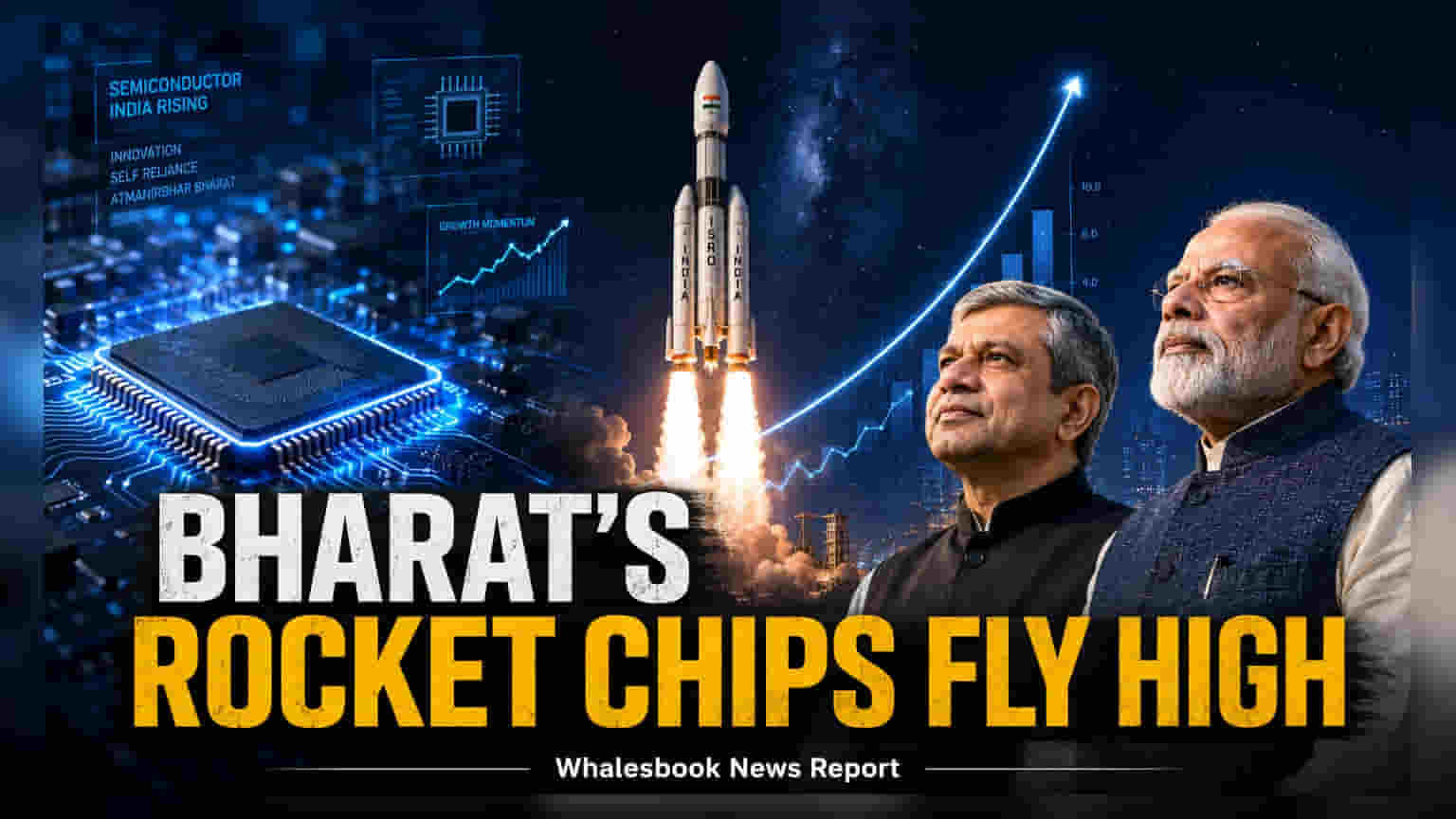
Fresh off India''s first private orbital launch, the government has put a marker down on the next frontier of self-reliance: the chips inside the rockets. On 27 July 2026, Union Minister for Electronics and IT Ashwini Vaishnaw signalled that domestically developed semiconductors will soon find their way into Indian space launch vehicles, posting after a meeting with the team behind Skyroot Aerospace''s successful Vikram-1 flight: "Made in Bharat" chips for our rockets... soon!
The statement is short, and it is a statement of intent rather than a finished milestone. But it lands at a moment when the two threads it ties together — India''s space ambitions and its semiconductor build-out — are both moving unusually fast, and it is worth unpacking what would have to be true for the aspiration to become hardware.
The launch that set the stage
The context is Skyroot Aerospace''s Vikram-1, which on 18 July 2026 became the first privately built Indian rocket to reach orbit on its maiden attempt, injecting payloads into a roughly 450-km low Earth orbit. That success made India the third country — after the United States and China — where a privately developed rocket has reached orbit, and it reframed India''s space story around home-grown industry rather than the state agency alone.
The minister''s meeting with the company, and the accompanying remark on indigenous chips, folds the semiconductor agenda into that narrative. Rockets, satellites and their ground systems depend on processors, controllers and specialised electronics — components that India has historically imported, often under tight export controls given their strategic sensitivity. Bringing that silicon in-house is a logical extension of the drive that produced an indigenous launch capability.
Why space-grade chips are hard — and strategic
Space-grade semiconductors are not ordinary chips. They must tolerate radiation, extreme temperature swings and vibration, and they carry stringent reliability and qualification requirements. That difficulty is exactly why domestic capability matters: a supply of trusted, indigenously designed and eventually manufactured components reduces dependence on foreign suppliers whose exports can be restricted, and it hardens the supply chain for strategic programmes.
India already has building blocks pointed in this direction. The country''s VEGA processor family, developed under the Digital India RISC-V (DIR-V) programme, is a home-grown, licence-free processor line intended precisely to cut reliance on foreign chip designs. Earlier in 2026, the space establishment set out plans to develop indigenous semiconductors — processors, controllers and specialised electronic systems for launch vehicles and satellites — over a multi-year horizon.
Riding the Semicon 2.0 wave
The timing also rides the momentum of Semicon 2.0, the roughly ₹1.27 lakh crore expansion of India''s semiconductor programme cleared by the Union Cabinet in mid-July 2026, which broadened government support across chip design, fabrication, advanced packaging, equipment, materials and design IP. A policy framework explicitly built to nurture domestic design and manufacturing is the kind of scaffolding a space-grade chip effort would need.
From aspiration to silicon
It is worth being precise about what the minister''s remark is and is not. It is not an announcement that a made-in-India chip is flying today; it is a signal of direction, tying a political commitment to a technical goal. Turning it into flight hardware means designing qualifying parts, manufacturing them to space-reliability standards, and validating them through the exacting test campaigns that space systems demand — a process measured in years, not weeks.
Still, the direction is coherent. India has an indigenous processor line, a newly enlarged semiconductor programme, a stated plan to build space-grade electronics, and now a private launch industry hungry for trusted components. The pieces that would make "Made in Bharat chips for our rockets" more than a slogan are, for once, visibly on the table. The task ahead is execution.
Sources
- "Made in Bharat" chips for space rockets soon, says Ashwini Vaishnaw — ANI
- "Made in Bharat" chips for space rockets soon, says Ashwini Vaishnaw — Times of Oman
- India''s space rockets to soon fly on indigenous "Made in Bharat" chips — Communications Today
- "Made in Bharat" Chips Set to Power India''s Rockets, Announces Union Minister Ashwini Vaishnaw Following Skyroot''s Milestone — idrw.org
- Inside India newsletter: Skyroot rocket puts India alongside U.S., China in private orbital launch — CNBC
Tags
More from Semiconductors
Makr Microsystems Raises ₹10.2 Crore to Help Chipmakers See What's Buried Beneath the Surface
Bengaluru's Makr Microsystems has raised ₹10.2 crore in a seed round led by Bluehill.VC to build nanoscale metrology tools that let chipmakers find hidden defects beneath a chip's surface without damaging it.
Zenergize Raises $4 Million to Scale India's First Indigenous Silicon-Carbide Power Electronics
Gurugram's Zenergize Technologies has raised a Pre-Series A round to scale its silicon-carbide EV chargers and solar inverters against an order book already worth ₹150 crore.