India Scraps Import Duties on the Inputs for Batteries, Displays and Inductors
India's Finance Ministry has waived basic customs duty on inputs for display assemblies, lithium-ion cells and inductor coil modules — including an expanded list of 85 battery-manufacturing machines — in a targeted move to make domestic electronics and battery production cheaper than imports.
Three notifications, one manufacturing bet
On 8 July 2026, India's Ministry of Finance issued three customs notifications waiving basic customs duty (BCD) on a range of goods used to manufacture display assemblies, lithium-ion cells and inductor coil modules. The move, reported the following day, is a targeted attempt to make it cheaper to build electronics inside India rather than import the finished products.
It is an unglamorous lever — a set of tariff-line exemptions rather than a marquee factory announcement — but it goes to the heart of how India is trying to climb the electronics value chain: by making the inputs to domestic manufacturing duty-free while keeping pressure on imported finished goods.
What is covered
The exemptions target three distinct pieces of the electronics supply chain.
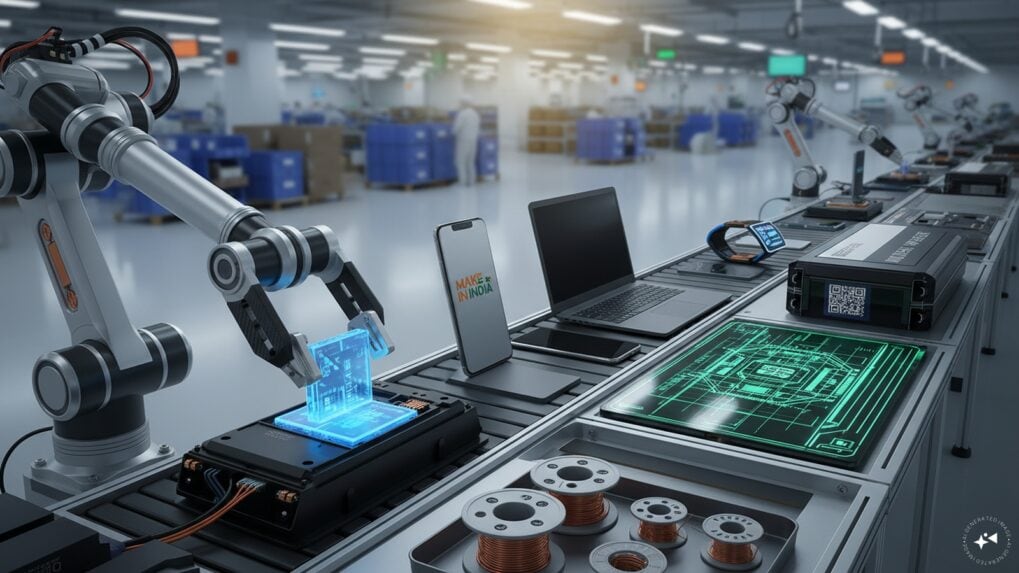
For display assemblies, the notifications extend duty relief to components used in display modules and wireless-charging modules — the glass-and-silicon stacks that go into smartphones, laptops, wearables and smart televisions.
For inductor coil modules, the list of duty-free inputs runs to specialised materials including nano-crystalline assemblies, E-shields, PET liners, PC shims, stranded and NFC coils, and neodymium-iron-boron (NdFeB) magnets. The exemptions for display assemblies and inductor coil modules are set to remain in force until 31 March 2029, giving manufacturers a multi-year planning horizon.
For lithium-ion cell manufacturing, a third notification replaces the existing list of machinery eligible for concessional customs duty with an expanded roster of 85 capital goods — coating machines, winding machines, welding systems, testing equipment, formation machines, drying systems and other specialised production gear. In other words, the tools needed to stand up a domestic battery-cell line just got cheaper to import.
The logic: cheaper inputs, deeper local value
The design here is deliberate. By zeroing out duty on components and capital equipment while leaving tariffs on many finished devices intact, the government tilts the maths in favour of assembling — and eventually making — those devices in India. It is the same inverted-duty philosophy that underpins the Production Linked Incentive (PLI) schemes for electronics and advanced chemistry cell batteries, and it dovetails with the broader push under the India Semiconductor Mission.
The battery piece is especially pointed. India has awarded gigawatt-hours of cell-manufacturing capacity under its ACC PLI programme, but domestic cell production is still nascent and heavily dependent on imported machinery and materials. Cutting duty on 85 categories of cell-making equipment lowers the entry cost for exactly the gigafactories the country is trying to seed.
A piece of a bigger self-reliance push
None of this is transformative on its own, and duty tweaks are reversible in a way that built factories are not. But taken together with the PLI schemes, the semiconductor mission and a string of component-manufacturing incentives, the July notifications are another increment in a consistent policy direction: make it steadily cheaper to build the guts of electronics — batteries, displays, magnetics — on Indian soil, and steadily less attractive to simply ship them in.
Sources
- Govt waives basic customs duty on key electronics manufacturing components — Business Standard
- Finance Ministry exempts customs duty on goods used in manufacturing lithium-ion cells, inductor coil modules and display assemblies — The Tribune
- Centre waives customs duty on key electronics mfg inputs — The Hans India