
IISc Builds a Porous Crystal That Switches Its Magnetism with Heat, Light and Pressure
IISc researchers have built a porous, beehive-like crystal whose magnetism can be switched on and off reversibly — by heat, light, pressure or passing gases — near room temperature, a long-sought goal with uses in memory, quantum hardware and sensing.
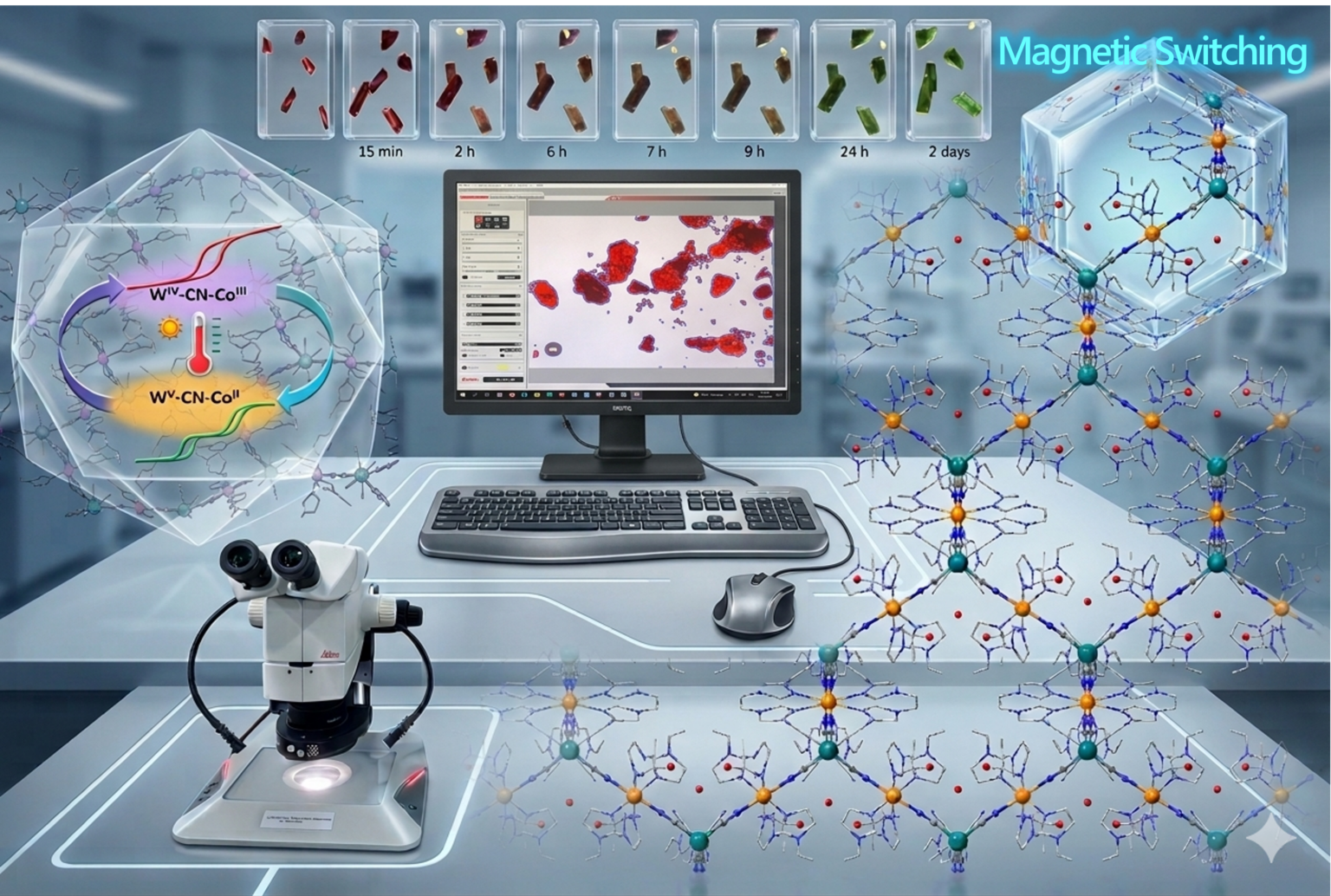
Indian materials scientists have built a crystal that can be told, on demand, whether or not to be magnetic — and it responds to heat, light, mechanical pressure and even the gases that drift through its pores.
A switchable magnet, near room temperature
A team at the Indian Institute of Science (IISc), Bengaluru, led by Abhishek Mondal of the Solid State and Structural Chemistry Unit (SSCU), has reported a porous metal-organic framework whose magnetic state can be flipped reversibly close to ambient temperature. The study was published in Angewandte Chemie International Edition, and IISc described it publicly in late June 2026.
The material belongs to a family known as spin-crossover compounds. In these, the electrons around a metal ion can rearrange between a "high-spin" and a "low-spin" configuration — in effect switching the material between two magnetic states. The difficult part has always been getting that switch to happen cleanly, reversibly, and at temperatures close to where real devices operate, rather than only in deep cold.
The "beehive" framework
Mondal's group built a three-dimensional, beehive-like hexagonal lattice — a flexible, highly porous heterobimetallic framework combining iron(II) and molybdenum(V) centres. Crucially, the lattice is elastic. When one metal centre switches its spin state, the strain it creates pushes on its neighbours through the elastic scaffold, and the change propagates across the whole crystal in a domino-like, cooperative fashion. That cooperativity is what turns a collection of independent atomic flips into a single, sharp, material-wide magnetic switch.
What makes the result stand out is the number of levers that trigger the switch. The team showed that heat, light, mechanical pressure and the adsorption or removal of guest molecules (solvents or gases) can each drive the transition — and that the process is fully reversible, so the material can be cycled and reused. When a target gas or liquid enters or leaves the pores, the lattice expands or contracts, nudging the metal centres to change their magnetic state.
Why it matters
Multi-stimuli, reversible switching in a single robust lattice is exactly the behaviour designers want for a class of "smart" devices:
- Data storage: a material that can be written by light or pressure and read out magnetically is a natural candidate for next-generation, energy-frugal memory.
- Quantum technologies: controllable spin states near ambient conditions are of interest as building blocks for quantum processors and spintronic components.
- Sensing: because gases entering the pores change the magnetic signal, the framework can act as a selective sensor — for instance for capturing or detecting molecules such as carbon dioxide, carbon monoxide and methane.
The bigger picture
The study is a piece of fundamental chemistry rather than a finished product, and the road from a lab crystal to a manufacturable device is long. But it lands squarely in an area India has been trying to strengthen — frontier materials that feed into quantum hardware, sensors and low-power electronics — and it adds to a growing body of indigenous work on functional materials coming out of IISc and its peer institutions.
For now, the headline is simpler: an Indian lab has made a porous crystal that can be switched between magnetic states using everyday stimuli, near room temperature, and switched back again. That combination has been a long-standing goal in the field.
Sources
- Synthetic chemical framework can switch magnetic spin states at near ambient temperatures — Phys.org
- Solvent-Regulated Lattice Elasticity and Pressure-Induced Multi-Stimuli Spin-State Bistability in a Porous Hexagonal Framework — Angewandte Chemie International Edition
- IISc Breakthrough in Smart Materials Unlocks Path to Quantum Processors, Sensors and Sustainable Data Storage — Indian Defence News