
IISc Uses Blue Light to Control Spindle Assembly in Engineered Human Cells
A reversible optogenetic research tool clusters Aurora A and substantially rescues spindle defects in engineered cells, helping researchers dissect cell-division machinery.
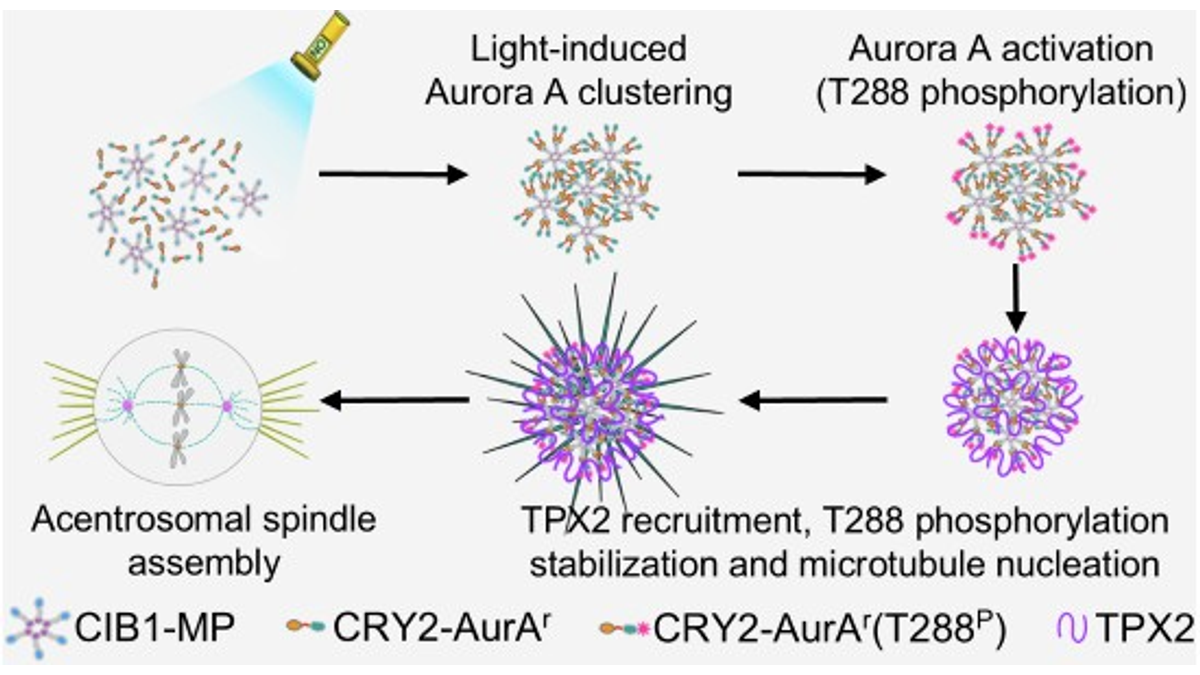
Researchers at the Indian Institute of Science have developed a blue-light-controlled tool for investigating how cells build the machinery that separates their chromosomes. IISc highlighted the work on 29 September; the peer-reviewed study appeared in EMBO Reports on 15 September 2026.
The technique, Light-Induced Spindle Assembly (LISA), lets researchers turn clustering of the enzyme Aurora A on and off in engineered human cells. The authors are Vignesh Olakkal, Madhumitha Balakrishnan and Sachin Kotak, from IISc's Department of Microbiology and Cell Biology.
A switch for a complicated cellular machine
Centrosomes help organise the microtubules that form a dividing cell's spindle. Working out which components are sufficient to initiate that process is difficult because the centrosome contains many interacting proteins.
The team adapted LARIAT, an existing light-responsive protein-clustering approach. Plant proteins CRY2 and CIB1 bring engineered Aurora A assemblies together when exposed to blue light. The resulting clusters activate the enzyme and provide sites from which microtubules can form, according to the institute's explanation.
The paper reports that this activation can bypass the usual Aurora A scaffold, Cep192. Another partner, TPX2, remains necessary for the clusters to drive microtubule nucleation. That distinction helps separate the role of concentrating the enzyme from the other interactions that make the assembly functional.
What the experiment demonstrated
In human cells whose centrosomes had been chemically removed, light-induced Aurora A clustering substantially rescued spindle-assembly defects. The authors describe a reversible synthetic-biology platform for studying the principles behind spindle formation.
This is a laboratory method demonstrated in engineered cells. It does not establish a treatment for patients or show that light can repair cell division throughout a human body. IISc points to potential future use in studying cancer-drug targets; translating a research tool into a clinical intervention would require separate evidence.
The practical research value is the ability to manipulate a component in living cells and observe the response, rather than relying only on cell extracts. LISA adds a controllable experimental handle to a complex process, with the dependency on TPX2 providing a specific next question to investigate.
Sources: IISc announcement, 29 September 2026; Olakkal, Balakrishnan and Kotak, EMBO Reports, 15 September 2026.
Figure licence: Creative Commons Attribution 4.0. Vignesh Olakkal, Madhumitha Balakrishnan and Sachin Kotak / EMBO Reports (2026), doi:10.1038/s44319-026-00928-9, CC BY 4.0. Published synopsis diagram of the laboratory method; resized and padded, with the complete figure retained.