IAF signs ₹135-crore deal with start-up Threye for Mirage 2000 part-task trainers
The Indian Air Force has contracted NewSpace Research subsidiary Threye Interactive for VR-based, networked part-task trainers for its Mirage 2000 fleet, a rare large follow-on order for a product built under iDEX.
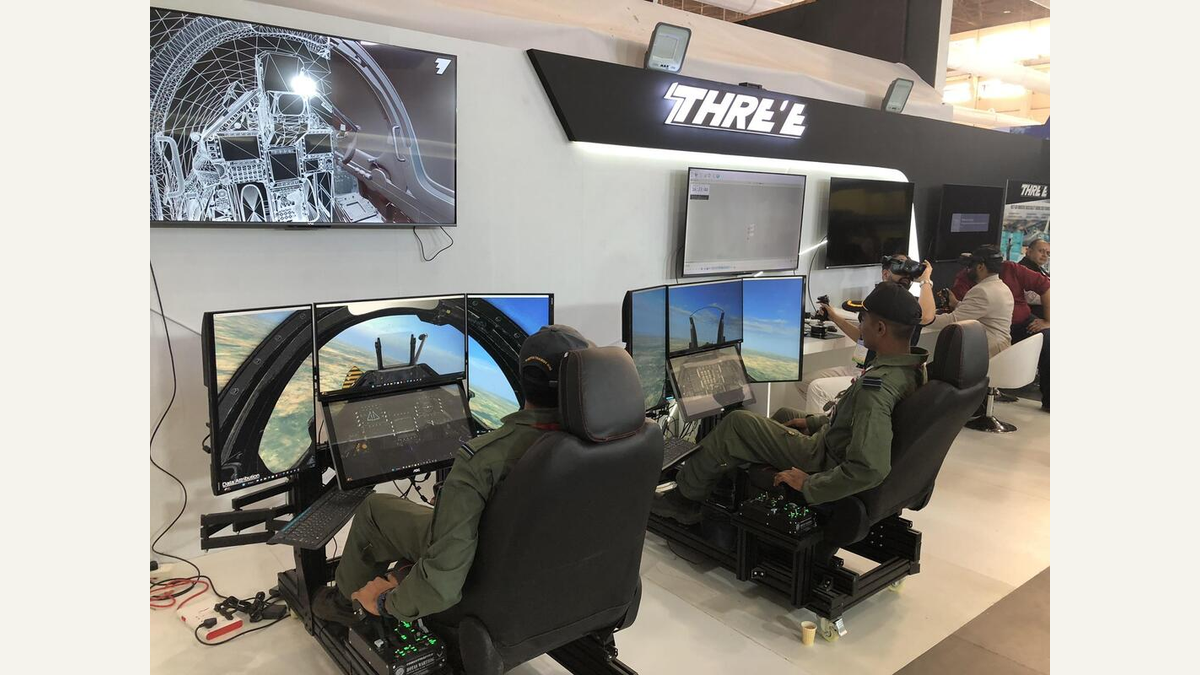
The Indian Air Force has signed a contract worth about ₹135 crore with New Delhi-based Threye Interactive for part-task trainers for its Dassault Mirage 2000 fleet. Livefist reported the signing on 29 September 2026. Threye's parent company, NewSpace Research & Technologies, confirmed the deal the next day.
The contract is modest next to India's big fighter and missile deals. It matters for a different reason: a simulator built by a start-up through the Ministry of Defence's innovation pipeline has secured a procurement route for a frontline IAF fleet, with delivery and integration still ahead.
What the IAF is buying
A part-task trainer (PTT) does not try to recreate the whole flying experience the way a full-motion simulator does. It reproduces one subsystem, control interface or set of procedures, so pilots can practise particular tasks over and over: identifying targets, selecting weapons and responding to threats. The Week describes these as drills that are expensive, and sometimes impractical, to repeat in a real cockpit.
Threye's trainer is built for the IAF's upgraded Mirage 2000 I/TI aircraft. It uses virtual reality, flight simulation and real-time networking. Reports describe a compact, PC-based system that supports both individual and group training, in VR and non-VR configurations. Because the trainers are networked, several pilots can rehearse the same scenario together. That makes the system especially useful for missions that need many jets to operate together, which are costly and hard to arrange with live aircraft.
Built through iDEX
Threye developed the trainer under the Defence India Start-up Challenge-5 (DISC-5), in the modelling and simulation category. DISC-5 is run by the Ministry of Defence's Innovations for Defence Excellence (iDEX) initiative. iDEX funds start-ups to build prototypes against problems set by the armed forces, and the hard step is turning a funded prototype into an actual procurement order. This one now has a contract.
The company has worked with the Mirage community before. Its AR/VR technical training system for the Mirage 2000 has already been accepted and deployed by the IAF. The new contract moves Threye from training ground crew to training the pilots themselves.
Why the Mirage 2000 still matters
The Mirage 2000 is a French-built multirole fighter that the IAF has flown since the mid-1980s. Its squadrons are based at Gwalior. The fleet has been upgraded to the Mirage 2000 I/TI standard and has been the IAF's precision-strike platform in several high-profile operations. Keeping these aircraft combat-relevant for another decade or more depends on avionics and weapons upgrades, and also on how efficiently pilots can learn and rehearse the more complex mission profiles those upgrades make possible.
Flying hours on a fourth-generation fighter are expensive, and every sortie puts wear on airframes and engines that cannot easily be replaced. Simulators that take procedural and tactical rehearsal off the aircraft let the IAF use real flying time for what only real flying can teach. The same economics is pushing air forces worldwide to invest in networked, synthetic training environments.
The NewSpace connection
Threye is a subsidiary of NewSpace Research & Technologies, a Bengaluru-based company best known for its work on unmanned aerial systems for the Indian armed forces. As an engineering observation, simulation is a natural partner to that business, since the software that models flight dynamics, sensors and mission environments for trainers overlaps heavily with what is needed to develop and test autonomous aircraft. The group now covers both uncrewed systems and synthetic training for crewed fighters, a combination of related engineering capabilities.
The bigger picture for Indian defence tech
The deal fits a wider pattern. iDEX is intended to connect military problem statements with start-up prototypes and procurement. A ₹135-crore order for a frontline fighter's training system is a larger, more operationally significant follow-on than the scheme usually produces.
For India's defence-technology ecosystem, the lessons are practical:
- Simulation and training are a realistic entry point. Start-ups can build credible capability in software-heavy training systems without the decades of qualification that propulsion or airframe programmes demand.
- Imported platforms can be supported locally. The Mirage 2000 is a French aircraft, but its training ecosystem no longer has to come from the original manufacturer.
- The procurement path is maturing. Moving from a DISC challenge to a contract of this size shows the iDEX funnel can carry a product all the way to the user.
Training systems built in India for foreign-origin platforms also help with sustainment. They reduce dependence on overseas vendors for updates, and they keep sensitive tactics and procedures inside Indian-controlled software.
What to watch
Details still to come include the number of trainer units, the delivery schedule and how the PTTs will fit into the IAF's wider Mirage training syllabus. Another open question is whether Threye's architecture can be adapted for other fleets in IAF service. The networking capability matters here: if the trainers can link with other simulators, they could become part of a larger synthetic training environment for joint missions.
For now, the contract shows that an Indian start-up can go from an iDEX challenge to equipping pilots of a frontline strike fighter.
Sources
Image: Threye Interactive. Company demonstration of its flight-training equipment; not a photograph of the September 2026 contract signing. Original source.