Dubai Chambers and Nasscom Sign MoU to Open a Fast Lane for India's Agentic AI and Deep-Tech Firms
Dubai Chambers signed MoUs with Nasscom and FKCCI in Bengaluru on August 20 to build a formal channel for Indian agentic-AI and deep-tech firms to expand into Dubai, anchored to the emirate's own push to adopt agentic AI across its private sector.
Two MoUs, One Bengaluru Afternoon
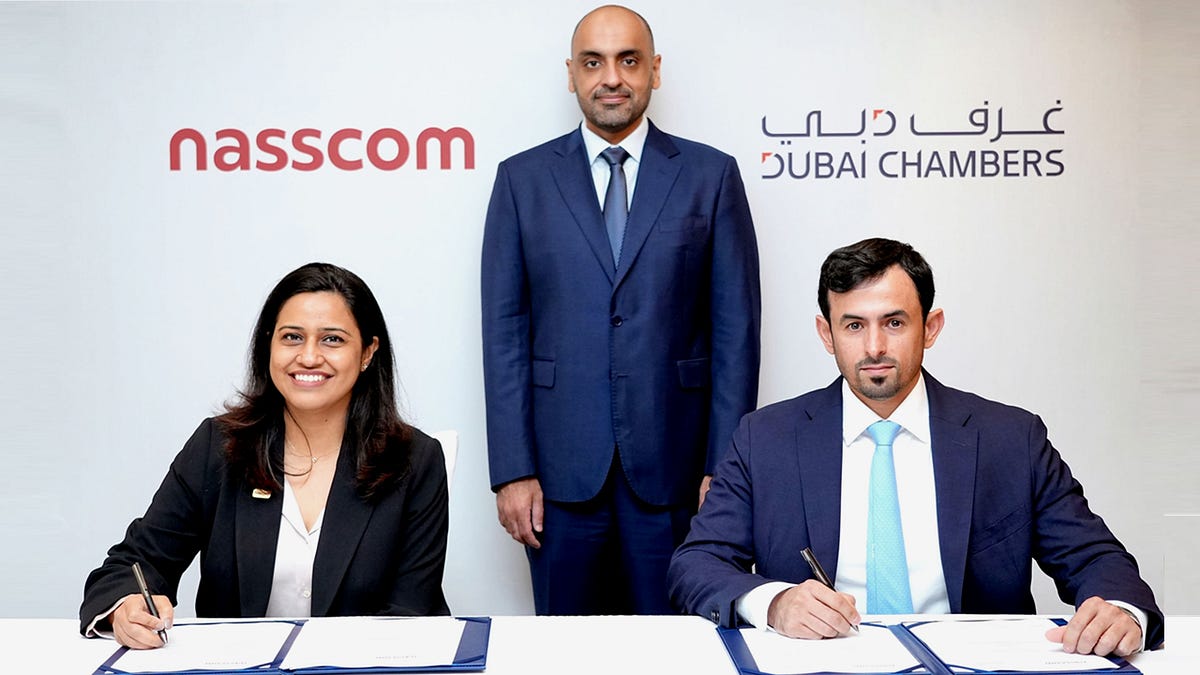
Dubai Chambers landed in Bengaluru this week with a specific ask: help Indian agentic-AI and deep-tech companies set up in Dubai, and help Dubai's push into the same technology lean on Indian expertise to get there faster. On August 20, the trade body signed two memoranda of understanding — one with Nasscom, India's software-industry apex body, and one with the Federation of Karnataka Chambers of Commerce and Industry (FKCCI) — during a high-level visit led by Mohammad Ali Rashed Lootah, President and CEO of Dubai Chambers.
The Nasscom MoU itself was signed by Salem AlShamsi, Dubai Chambers' Executive Vice President of International Relations, in Lootah's presence, and it does something narrower and more concrete than the usual trade-delegation paperwork: it sets up a formal channel for Indian companies working on agentic AI and deep tech to get market access in Dubai, alongside joint knowledge-sharing programmes, business delegations, B2B matchmaking and networking events run jointly by the two organisations.
Why Agentic AI, Specifically
The choice of agentic AI as the anchor is deliberate. In May 2026, Dubai launched an initiative to move its private sector onto agentic AI systems — software that can plan and execute multi-step tasks autonomously rather than just respond to prompts — within two years. That is an aggressive adoption timeline for an emirate that wants to position itself as a global hub for the technology, and it requires exactly the kind of applied AI engineering talent that Indian companies, particularly the deep-tech and enterprise-AI firms under Nasscom's banner, have been building for domestic and global clients over the past several years.
The visit's itinerary bears this out: alongside the formal signings, the Dubai Chambers delegation held sessions with Nasscom Deeptech (Nasscom's dedicated arm for AI, semiconductors, robotics and other frontier-technology startups), the Confederation of Indian Industry's Karnataka council, FKCCI and FICCI's Karnataka chapter — a sweep through essentially every major industry body with a stake in Bengaluru's tech ecosystem.
What Lootah Said
Lootah framed the agreements as building on an existing relationship rather than starting a new one. "Indian companies remain vital partners in Dubai's growth and form the emirate's largest foreign business community," he said. "Our agreements with Nasscom and FKCCI will build on this strong foundation by advancing cooperation in agentic AI and deep tech."
That framing matters for context: Indian firms are already the single largest foreign business community in Dubai, spanning trading, real estate, logistics and increasingly technology services. What this week's MoUs attempt is a narrower, sector-specific overlay on that broad existing base — steering some of that established India-Dubai commercial traffic specifically toward agentic AI and deep-tech ventures, rather than leaving the relationship to grow organically across all sectors at once.
The Two-Way Trade
The arrangement is explicitly reciprocal rather than a one-directional pitch for Indian firms to relocate. Dubai gets a formal pipeline into India's deep-tech talent and startup base at a moment when it is racing to build out its own agentic-AI ecosystem before its self-imposed two-year adoption deadline; Indian companies — particularly the AI and deep-tech firms Nasscom represents — get a lower-friction path to Dubai's market, which functions as a base for wider Gulf and African expansion for many Indian B2B software and AI firms.
FKCCI's parallel MoU with Dubai Chambers covers the broader trade and investment relationship between Karnataka and Dubai, giving the AI-specific Nasscom agreement a wider commercial scaffolding to sit on — business delegations and investment facilitation that go beyond agentic AI into Karnataka's manufacturing, services and startup base more generally.
For India's deep-tech sector, still working out how much of its growth should be built around domestic government contracts (IndiaAI Mission compute subsidies, sovereign foundation-model grants) versus international commercial expansion, this week's agreements are a small but concrete data point in favour of the latter — a foreign government-linked trade body actively soliciting Indian AI companies to set up abroad, rather than the more familiar pattern of global tech giants setting up shop in Bengaluru.
Sources
- Dubai Chambers Signs Two MoUs in Bengaluru to Advance Agentic AI Collaboration and Strengthen Trade and Investment Ties With India – The Tribune
- Dubai Chambers, NASSCOM join forces to accelerate Agentic AI adoption and attract Indian tech firms – Emirates 24|7
- Dubai Chambers signs MoU with NASSCOM to advance cooperation in Agentic AI – Zawya
- Dubai Chambers Signs Two MoUs in Bengaluru to Advance Agentic AI Collaboration and Strengthen Trade and Investment Ties With India – Business Standard